
Aug
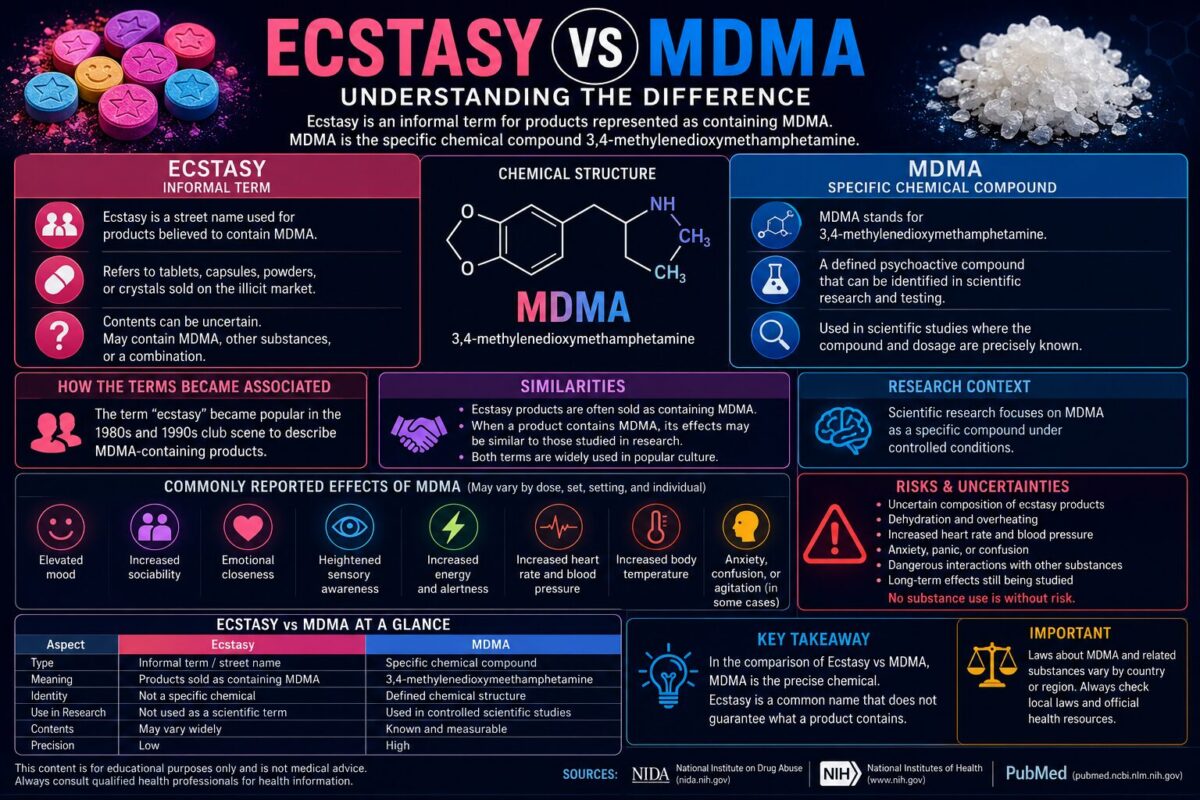
Ecstasy vs MDMA is a common comparison because the two terms are frequently used as though they mean exactly the same thing. While they are closely connected, there is an important distinction between the specific chemical compound MDMA and the informal name ecstasy, particularly when discussing scientific research and products obtained outside regulated settings.
MDMA stands for 3,4-methylenedioxymethamphetamine and refers to a specific psychoactive chemical compound. Ecstasy, by contrast, is an informal term historically used for products represented as containing MDMA. This difference is central to understanding Ecstasy vs MDMA and helps explain why scientific sources usually identify MDMA by its chemical name.
The distinction also matters because an informal name does not guarantee the chemical contents of an unregulated product. A tablet or other product sold as ecstasy may not necessarily contain only MDMA, which means findings from controlled research involving verified MDMA should not automatically be applied to every product marketed under the name ecstasy.
This guide examines Ecstasy vs MDMA from an educational perspective, comparing their terminology, chemical identity, history, commonly reported effects, research context, and potential risks. It does not provide instructions for taking either substance or information about dosing.
Table of Contents
- Ecstasy vs MDMA: The Basic Difference
- What Is MDMA?
- What Is Ecstasy?
- Chemical Identity and Terminology
- How the Terms Became Associated
- How Their Reported Effects Compare
- Ecstasy vs MDMA in Scientific Research
- Risks and Common Misconceptions
- Ecstasy vs MDMA Comparison Table
- Frequently Asked Questions
Ecstasy vs MDMA: The Basic Difference
The simplest way to understand Ecstasy vs MDMA is to distinguish between a chemical name and an informal product name.
| MDMA | Ecstasy |
|---|---|
| Specific chemical compound | Informal term |
| Short for 3,4-methylenedioxymethamphetamine | Historically associated with products represented as containing MDMA |
| Used as the scientific term | Common in popular culture and drug terminology |
| Can be specifically identified in controlled research | Name alone does not guarantee chemical composition |
This distinction is the foundation of Ecstasy vs MDMA. When scientists report the effects of MDMA, they are generally referring to the identified chemical compound. When someone uses the word ecstasy in everyday conversation, they may be referring to a product that is believed to contain MDMA.
That difference becomes especially important when evaluating claims about effects, safety, or research. A scientific study involving verified MDMA cannot necessarily tell us exactly what was present in an unregulated product sold using the name ecstasy.
What Is MDMA?
MDMA is a psychoactive compound that affects several neurotransmitter systems in the brain. It is commonly classified as a stimulant and empathogen because of its effects on arousal, mood, emotional processing, and social experiences.
According to the National Institute on Drug Abuse, MDMA increases the activity of serotonin, dopamine, and norepinephrine. Serotonin is particularly important because it plays a role in mood, emotional processing, sleep, appetite, and numerous other neurological functions.
These neurochemical effects help explain why Ecstasy vs MDMA comparisons often discuss emotional and social effects. Research involving MDMA has examined changes in mood, empathy, social interaction, sensory processing, physiological arousal, and other aspects of human experience.
MDMA has also attracted scientific interest because researchers have investigated its potential applications in controlled psychotherapy settings. These studies involve carefully defined compounds and clinical protocols, which is another reason precise terminology matters when discussing MDMA research.
What Is Ecstasy?
Ecstasy is an informal name that became strongly associated with MDMA-containing products, particularly during the late twentieth century. The term became widely recognized through nightlife and popular culture.
Unlike MDMA, however, ecstasy is not the formal name of a single chemical compound. The word describes how a substance or product is commonly identified rather than establishing its exact molecular composition.
This is one of the most important distinctions in Ecstasy vs MDMA. A product marketed as ecstasy may be represented as containing MDMA, but the informal label itself does not provide scientific confirmation of what is actually present.
The difference between terminology and chemical identity is also why researchers generally use “MDMA” when describing controlled experiments. It allows them to specify the compound being investigated rather than relying on an informal label.
Chemical Identity and Terminology
When discussing Ecstasy vs MDMA, chemical identity should take priority over street terminology. MDMA refers to a defined molecule, while ecstasy belongs to a broader category of informal language.
Another term frequently encountered is Molly. Like ecstasy, Molly is an informal term commonly associated with MDMA. However, the name itself does not guarantee that a product contains a particular substance or that its composition matches material used in scientific research.
For educational purposes, it is therefore useful to remember:
- MDMA is the specific chemical compound.
- Ecstasy is an informal term historically associated with MDMA-containing products.
- Molly is another informal term commonly associated with MDMA.
- Informal names do not establish chemical composition.
- Scientific studies generally identify the specific compound being investigated.
Understanding these distinctions makes Ecstasy vs MDMA much clearer and prevents informal terminology from being confused with scientific identification.
How the Terms Became Associated
The relationship between Ecstasy vs MDMA also has a historical component. MDMA was first synthesized in the early twentieth century, but widespread public awareness of the compound developed much later. During the late twentieth century, the term “ecstasy” became strongly associated with MDMA in nightlife and popular culture.
As the name became more common, ecstasy was increasingly used as a broad label for tablets and other products believed to contain MDMA. This popular usage helped establish a close connection between the two terms, even though the chemical identity of MDMA and the informal meaning of ecstasy remained different.
The historical relationship explains why many people still use the words interchangeably today. However, when discussing Ecstasy vs MDMA from a scientific perspective, it is more accurate to distinguish the chemical compound from the informal product name.
How Their Reported Effects Compare
When examining Ecstasy vs MDMA, discussions about effects can become confusing because scientific research generally focuses on verified MDMA, while personal reports may refer to products using the name ecstasy.
Research involving MDMA has documented a range of psychological, emotional, sensory, and physical effects. Reported experiences can include:
- Elevated mood
- Increased feelings of emotional closeness
- Greater sociability
- Heightened sensory awareness
- Increased energy or alertness
- Changes in emotional processing
- Increased heart rate
- Changes in body temperature
- Muscle tension or jaw clenching
- Anxiety or confusion in some circumstances
These effects should not be interpreted as a guaranteed description of every product sold as ecstasy. If the contents of a product are uncertain, its effects cannot reliably be predicted from the name alone.
This is a major reason why Ecstasy vs MDMA is more than a vocabulary comparison. The distinction affects how scientific findings, personal accounts, and public-health information should be interpreted.
How MDMA Affects the Brain
Understanding Ecstasy vs MDMA also requires looking at the biological effects of MDMA. The compound increases activity involving several neurotransmitters, particularly serotonin, dopamine, and norepinephrine.
Serotonin is strongly associated with MDMA’s effects on mood and emotional processing. Dopamine contributes to reward and motivation, while norepinephrine is involved in alertness and physiological arousal.
| Neurotransmitter | General Role | Relationship to MDMA |
|---|---|---|
| Serotonin | Mood and emotional processing | Major contributor to MDMA’s psychological effects |
| Dopamine | Reward and motivation | Contributes to mood and reinforcement |
| Norepinephrine | Alertness and arousal | Contributes to stimulation and cardiovascular effects |
These interacting systems help explain why MDMA can produce a combination of emotional and physical effects. They also demonstrate why scientific discussions generally use the precise term MDMA rather than treating every product called ecstasy as chemically identical.
Ecstasy vs MDMA in Scientific Research
Scientific research generally focuses on Ecstasy vs MDMA by identifying the specific compound being studied. Controlled studies can use verified MDMA and carefully measure its psychological, neurological, and physiological effects.
This allows researchers to investigate questions involving:
- Emotional processing
- Social behavior
- Brain activity
- Neurotransmitter systems
- Physiological responses
- Potential therapeutic applications
- Adverse effects
Research involving MDMA has also contributed to clinical investigations into MDMA-assisted psychotherapy. These studies take place under controlled conditions and should not be interpreted as evidence that recreational products sold as ecstasy have the same composition or effects.
The distinction is especially important when reading scientific studies online. If a study identifies pure or verified MDMA as the substance being investigated, its findings describe that compound under the conditions of the study—not necessarily every product sold using the word ecstasy.
Risks and Common Misconceptions
A balanced discussion of Ecstasy vs MDMA must also address risk. Neither the name of a substance nor its reputation provides a guarantee of safety.
MDMA can produce physiological changes including increased heart rate, increased blood pressure, and increased body temperature. Psychological effects can also include anxiety, agitation, confusion, or emotional distress.
Another concern is uncertainty about the contents of products sold outside regulated settings. A product marketed as ecstasy may contain MDMA, another compound, or a combination of substances. Consequently, research on verified MDMA cannot automatically be used to predict the effects of every product sold under an informal name.
This is one of the most important practical distinctions in Ecstasy vs MDMA: a chemical identity is more precise than a street name.
Common Myths About Ecstasy vs MDMA
Myth: Ecstasy and MDMA are always chemically identical.
Fact: MDMA is a specific chemical compound, while ecstasy is an informal term. The name of a product does not independently establish its chemical contents.
Myth: Every study about MDMA is automatically a study about ecstasy products.
Fact: Controlled research typically identifies the compound being administered. Unregulated products may have different compositions.
Myth: Molly, ecstasy, and MDMA are three different chemical compounds.
Fact: MDMA is the specific chemical compound. Molly and ecstasy are informal terms commonly associated with products represented as containing MDMA.
Myth: The appearance of a tablet proves what it contains.
Fact: Color, shape, logos, or names cannot reliably establish chemical composition.
Similarities Between Ecstasy and MDMA
Although the distinction is important, Ecstasy vs MDMA is not a comparison between completely unrelated substances. The terms are closely connected because ecstasy has historically been used to describe products represented as containing MDMA.
When a product actually contains MDMA, many of the effects discussed in scientific research on MDMA may be relevant. These can include changes in mood, emotional processing, social perception, sensory awareness, and physiological arousal.
The confusion arises because the informal term does not establish what is actually present. Consequently, it is more scientifically accurate to say that MDMA is the compound being studied, while ecstasy is a broader informal label.
Why Product Composition Matters
One of the most important considerations in Ecstasy vs MDMA is chemical composition. Scientific studies can identify the compound being investigated, while products obtained outside regulated settings may have uncertain contents.
This creates an important difference between laboratory research and real-world reports. A scientific paper may describe specific effects of verified MDMA, while an online account may describe an experience with a product called ecstasy without knowing exactly what it contained.
As a result, researchers and public-health organizations generally encourage precise terminology when discussing psychoactive substances. Chemical identity provides substantially more information than a product nickname or street name.
This distinction also explains why two products sold under similar names could potentially produce different effects. Their chemical composition may not necessarily be identical.
Where Does Molly Fit Into the Comparison?
The term “Molly” frequently appears alongside ecstasy and MDMA, making it relevant to Ecstasy vs MDMA discussions.
Molly is an informal term commonly associated with purported MDMA, while MDMA is the specific chemical compound. The name Molly does not independently verify the composition of a product.
Therefore, the three terms can be summarized as follows:
| Term | What It Refers To | Scientific Precision |
|---|---|---|
| MDMA | 3,4-methylenedioxymethamphetamine | Specific chemical identity |
| Ecstasy | Informal term historically associated with MDMA products | Not a precise chemical identity |
| Molly | Informal term commonly associated with purported MDMA | Not a guarantee of composition |
This terminology is important because scientific findings should be linked to verified compounds rather than assumptions based on informal names.
Ecstasy vs MDMA Effects: What Can Be Compared?
When discussing Ecstasy vs MDMA effects, the most accurate comparison focuses on verified MDMA versus the uncertainty surrounding products sold under the name ecstasy.
Research involving MDMA has documented effects involving:
- Mood and emotional processing
- Social interaction
- Perception and sensory awareness
- Energy and alertness
- Heart rate and blood pressure
- Body temperature
- Attention and cognition
If an ecstasy product contains MDMA as its primary active compound, some of these effects may be relevant. However, if its composition differs, its effects may also differ.
This is why a responsible Ecstasy vs MDMA comparison avoids treating every informal product label as proof of chemical identity.
Why Scientific and Legal Terminology Can Differ
The language surrounding Ecstasy vs MDMA can also differ between scientific, medical, legal, and popular contexts.
Scientists generally use the chemical name MDMA because it identifies a specific compound. News organizations and popular culture may use terms such as ecstasy or Molly because those names are more familiar to the general public.
Legal documents may also use precise chemical definitions when regulating controlled substances. The exact legal status of MDMA and related substances varies by jurisdiction and can change over time, so local laws should always be checked through current official sources.
This difference in terminology can make online information confusing. A reader may encounter several names for what appears to be the same substance while the sources are actually using those terms for different purposes.
Key Differences at a Glance
The simplest summary of Ecstasy vs MDMA is:
- MDMA is a specific chemical compound.
- Ecstasy is an informal term historically associated with products represented as containing MDMA.
- Scientific studies generally identify MDMA specifically.
- An informal product name does not guarantee chemical composition.
- Effects attributed to verified MDMA should not automatically be applied to every product called ecstasy.
- Molly is another informal term commonly associated with purported MDMA.
These distinctions make it easier to evaluate scientific research and avoid assuming that a street name provides the same information as a chemical identity.
Where Research Fits Into the Comparison
Modern research continues to examine MDMA’s effects on the brain, emotional processing, social behavior, and physiological systems. Researchers are also studying potential therapeutic applications under controlled clinical conditions.
Understanding Ecstasy vs MDMA is therefore useful when reading this research because it tells readers exactly what the researchers mean when they refer to MDMA.
For a broader introduction to the terminology, see our Ecstasy Definition guide. Readers interested in the subjective experience can also explore What Does MDMA Feel Like?.
Frequently Asked Questions About Ecstasy vs MDMA
What is the main difference between ecstasy and MDMA?
The main difference in Ecstasy vs MDMA is terminology. MDMA is the specific chemical compound 3,4-methylenedioxymethamphetamine, while ecstasy is an informal term historically associated with products represented as containing MDMA.
Is ecstasy the same chemical as MDMA?
Not necessarily. MDMA has a specific chemical identity, while ecstasy is a broader informal label. A product sold as ecstasy cannot be assumed to have a particular composition simply because of its name.
Why do people call MDMA ecstasy?
The term ecstasy became widely associated with MDMA-containing products during the late twentieth century. Popular culture and nightlife helped establish the connection between the two terms.
Is Molly the same as MDMA?
Molly is an informal term commonly associated with purported MDMA, while MDMA refers specifically to the chemical compound. The name Molly alone does not establish the actual chemical contents of an unregulated product.
Do ecstasy and MDMA have the same effects?
If a product called ecstasy actually contains MDMA, some of the effects documented in MDMA research may be relevant. However, products sold under informal names can have uncertain compositions, so their effects cannot be assumed to be identical.
What does MDMA do to the brain?
MDMA increases activity involving serotonin, dopamine, and norepinephrine. These neurotransmitter changes are associated with effects involving mood, emotional processing, reward, alertness, and physiological arousal.
Why does scientific research usually say MDMA instead of ecstasy?
Researchers use MDMA because it identifies a specific chemical compound. Scientific studies need to distinguish the substance being investigated from informal names that may refer to products with uncertain compositions.
Is ecstasy always safe if it contains MDMA?
No. MDMA itself can produce significant psychological and physiological effects, including increased heart rate, blood pressure, and body temperature. Serious adverse reactions can occur, and the risks can be further complicated when the contents of an unregulated product are uncertain.
Conclusion
Ecstasy vs MDMA is ultimately a comparison between an informal term and a specific chemical identity. MDMA refers to 3,4-methylenedioxymethamphetamine, while ecstasy is a name historically associated with products represented as containing MDMA.
The distinction is important because scientific research generally studies identified MDMA under controlled conditions. An informal name such as ecstasy does not independently confirm what a product contains, meaning research findings about verified MDMA should not automatically be applied to every product sold under that name.
Understanding Ecstasy vs MDMA also makes related terminology easier to interpret. Terms such as Molly and ecstasy are commonly associated with MDMA, but they do not provide the same level of chemical precision as the name MDMA itself.
For readers continuing their research, our Ecstasy Definition article explains the terminology in greater detail, while What Does MDMA Feel Like? examines the reported emotional, sensory, cognitive, and physical effects associated with MDMA.
Related MDMA & Ecstasy Guides
- Ecstasy Definition
- What Does MDMA Feel Like?
- Ecstasy Effects
- Ecstasy Side Effects
- What Does Ecstasy Look Like?
- MDMA Overdose
Authoritative References
PubMed — Peer-Reviewed Research
National Institute on Drug Abuse — MDMA

Pingback: MDMA Vs Molly: 7 Clear Differences You Should Know