Jun
DMT Laws: 12 Clear Country-by-Country Rules Explained
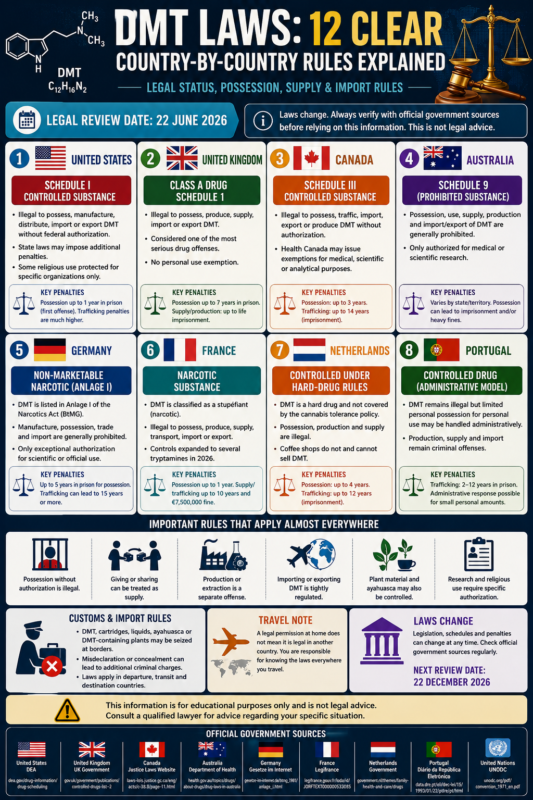
DMT laws differ between countries, but N,N-dimethyltryptamine is tightly controlled in most jurisdictions. Unauthorised possession, production, supply, importation and exportation may result in criminal, civil or administrative penalties.
DMT laws may also treat isolated DMT, vape cartridges, liquids, plant material, ayahuasca and research samples differently. A product’s botanical origin or religious description does not automatically make it lawful.
Legal review date: 22 June 2026.
This guide compares DMT laws in the United States, United Kingdom, Canada, Australia and selected European jurisdictions. It provides general educational information rather than legal advice. Always verify the latest official legislation before making legal decisions.
Table of Contents
- DMT Laws at a Glance
- 12 Clear Facts About DMT Laws
- International DMT Control
- DMT Laws in the United States
- DMT Laws in the United Kingdom
- DMT Laws in Canada
- DMT Laws in Australia
- DMT Laws in Germany
- DMT Laws in France
- DMT Laws in the Netherlands
- DMT Laws in Portugal
- Possession Versus Supply
- Customs and Import Rules
- Plants, Ayahuasca and Preparations
- Research and Religious Authorisation
- International Travel Risks
- Why DMT Laws Change
- Frequently Asked Questions
DMT Laws at a Glance
The broad pattern across international DMT laws is strict control. In most countries, DMT may be possessed or handled legally only by licensed researchers, authorised laboratories, government agencies or narrowly approved religious organisations.
| Jurisdiction | General Classification | Public Possession |
|---|---|---|
| United States | Federal Schedule I | Prohibited without federal authority |
| United Kingdom | Class A and Schedule 1 | Prohibited without appropriate licence |
| Canada | Schedule III | Restricted unless authorised |
| Australia | Schedule 9 prohibited substance | Generally prohibited except authorised research |
| Germany | Non-marketable narcotic | Prohibited without exceptional authority |
| France | Listed narcotic substance | Production, possession and supply restricted |
| Netherlands | Controlled under hard-drug rules | Not covered by cannabis toleration |
| Portugal | Controlled drug | Possession remains unlawful, although limited personal possession may be handled administratively |
These summaries do not replace the wording of the relevant statutes. DMT laws may distinguish between possession, use, trafficking, preparation, importation and production.
12 Clear Facts About DMT Laws
1. DMT Is Internationally Controlled
International DMT laws are influenced by the United Nations Convention on Psychotropic Substances. DMT appears in Schedule I of that convention, which supports strict controls on manufacture, trade and possession.
2. National Laws Are Not Identical
International scheduling does not create one worldwide criminal code. Each country implements its own DMT laws, classifications, exemptions and penalties.
3. Possession and Supply Are Usually Separate Offences
Many DMT laws treat simple possession differently from supplying, trafficking or possessing with intent to distribute. Supply offences commonly carry more serious penalties.
4. Giving DMT Away May Still Count as Supply
A sale is not always required. Transferring a controlled substance without payment may legally qualify as supply or distribution.
5. Production Is Commonly a Separate Offence
DMT laws may criminalise manufacture, extraction, preparation or processing independently from possession.
6. Importation Creates Additional Offences
Ordering DMT, cartridges, ayahuasca or plant material from another country may trigger customs, controlled-substance and false-declaration laws.
7. Natural Origin Does Not Guarantee Legality
DMT laws generally focus on the controlled chemical or preparation rather than whether it originated from a plant or laboratory.
8. Plant Material Can Still Be Seized
Customs authorities may detain botanical products when they contain a controlled substance, are prepared for psychoactive use or are suspected of being imported for production.
9. Ayahuasca Is Not Automatically Exempt
Ayahuasca may contain DMT and can fall under national controlled-substance laws. A traditional or religious description does not automatically create lawful possession.
10. Religious Protection Is Narrow
Some groups have obtained exemptions or court protection, but these arrangements normally apply to named organisations operating under strict safeguards.
11. Research Access Requires Formal Approval
DMT laws commonly permit licensed scientific work, but research institutions may need controlled-drug licences, security systems, ethics approval and detailed records.
12. Decriminalisation Is Not Legalisation
A country may replace criminal punishment for limited personal possession with an administrative response while continuing to prohibit possession, importation, production and supply.
International DMT Control
Modern DMT laws are partly shaped by the 1971 United Nations Convention on Psychotropic Substances. DMT is included in Schedule I, the category subject to the strictest treaty controls.
Countries may authorise limited scientific or medical activity, but unauthorised international trade is widely restricted.
Official treaty text is available from the United Nations Convention on Psychotropic Substances.
The treaty does not establish identical penalties. National governments decide offence definitions, sentencing rules and enforcement procedures.
DMT Laws in the United States
DMT laws in the United States operate at both federal and state levels. Under federal law, DMT is a Schedule I controlled substance.
Federal restrictions generally cover:
- Possession
- Manufacture
- Distribution
- Possession with intent to distribute
- Importation
- Exportation
The DEA drug-scheduling guide explains the federal scheduling framework.
State laws may create additional offences or penalties. A city-level decision to deprioritise psychedelic enforcement does not remove federal DMT laws.
Limited legal handling may occur through:
- DEA-registered research
- Approved clinical studies
- Licensed chemical analysis
- Specific religious protection or exemption
These circumstances do not authorise general consumer possession.
DMT Laws in the United Kingdom
DMT laws in the United Kingdom classify DMT as a Class A controlled drug under the Misuse of Drugs Act. It is also treated as a Schedule 1 drug under the Misuse of Drugs Regulations.
Unauthorised conduct may involve offences relating to:
- Possession
- Possession with intent to supply
- Supply
- Production
- Importation
- Exportation
The official UK controlled-drugs list provides current classifications.
Research institutions normally require appropriate Home Office licensing. Personal claims of spiritual or experimental use do not override DMT laws.
DMT Laws in Canada
Canadian DMT laws list N,N-dimethyltryptamine in Schedule III of the Controlled Drugs and Substances Act.
Unless authorised, federal restrictions may apply to:
- Possession
- Trafficking
- Possession for trafficking
- Production
- Importation
- Exportation
The official Canadian controlled-substance schedule lists the relevant controlled substances.
Canada may grant exemptions or licences for approved scientific, medical or public-interest purposes. These mechanisms do not make public possession lawful.
DMT Laws in Australia
Australian DMT laws operate through the national Poisons Standard together with Commonwealth, state and territory legislation.
DMT is treated as a Schedule 9 prohibited substance. Schedule 9 generally covers substances whose manufacture, possession, sale or use should be prohibited except for approved medical or scientific research.
Australian DMT laws may affect:
- Possession
- Use
- Manufacture
- Supply
- Importation
- Exportation
- Driving while impaired
The Australian Government’s drug-law overview explains how federal, state and territory rules operate together.
Penalties and procedural rules differ between states and territories. National scheduling does not mean every offence has an identical penalty throughout Australia.
DMT Laws in Germany
German DMT laws regulate DMT under the Betäubungsmittelgesetz, Germany’s narcotics law.
DMT appears in Anlage I, which covers narcotics that are generally not marketable. Activities involving these substances are highly restricted.
The official German Anlage I controlled-substance list provides the applicable classification.
German law generally requires official permission for activities involving controlled narcotics. For Anlage I substances, authorisation is exceptional and commonly limited to scientific or other recognised public-interest purposes.
Importation and exportation are also controlled. A research licence in another country does not automatically authorise transport into Germany.
DMT Laws in France
French DMT laws classify N,N-dimethyltryptamine as a stupéfiant, or narcotic substance.
The official French narcotics list specifically names DMT.
Without authority, French law restricts activities including:
- Production
- Possession
- Use
- Supply
- Transport
- Importation
- Exportation
France also expanded its controls over several related synthetic tryptamines in June 2026. Those changes illustrate why DMT laws and related-drug schedules require regular review.
DMT Laws in the Netherlands
Dutch DMT laws should not be confused with the Netherlands’ cannabis coffee-shop policy.
The Dutch Government explains that possession, sale and production of drugs are generally unlawful. Its toleration policy concerns limited cannabis sales and possession under specified conditions, not DMT or other hard drugs.
The official Dutch Government explanation of hard and soft drugs makes clear that hard-drug enforcement remains strict.
Therefore:
- Coffee shops do not lawfully sell DMT.
- Cannabis toleration does not extend to DMT.
- Possession or supply may lead to prosecution.
- Importation remains subject to customs and drug controls.
Travellers should not assume that the Netherlands has broadly legalised psychedelics.
DMT Laws in Portugal
Portuguese DMT laws are frequently misunderstood because Portugal decriminalised the handling of limited personal possession through an administrative system.
DMT remains a controlled drug under Portuguese legislation. The country’s drug law controls substances covered by international narcotics and psychotropic conventions.
The official Portuguese drug-control law establishes the general legal framework.
Decriminalisation does not mean:
- DMT is legally sold.
- Production is authorised.
- Trafficking is legal.
- Importation is unrestricted.
- Possession has no legal consequences.
Limited personal possession may be directed into an administrative process rather than treated as trafficking, depending on the facts. Supply, production and cross-border movement remain serious matters.
Possession Versus Supply Under DMT Laws
Most DMT laws distinguish between possession and supply.
Possession generally concerns control over a prohibited substance with knowledge of its presence. Supply may include:
- Selling
- Giving the substance away
- Sharing it with another person
- Delivering cartridges or liquid
- Offering to supply
- Possessing it for future distribution
Authorities may consider quantity, packaging, messages, payment records and other evidence when deciding whether a case involves personal possession or supply.
Exact legal tests differ by jurisdiction.
Customs and Import Rules
Customs enforcement is a major part of international these laws. A package crossing a border may create separate importation offences even when possession would otherwise be treated less severely.
Potentially controlled shipments include:
- DMT powder
- Crystalline material
- Vape cartridges
- Liquid products
- Ayahuasca preparations
- DMT-containing botanical material
- Products mislabelled as incense
Importation rules may apply in the departure country, destination country and any transit jurisdiction.
Customs declarations should never be falsified. Misdescription or concealment may create additional offences.
DMT-Containing Plants and Ayahuasca
The laws involving plants and ayahuasca are complex because legal systems may distinguish among a living plant, dried botanical material, a prepared mixture and isolated DMT.
Plant material may become legally significant when it is:
- Imported
- Processed
- Prepared as a psychoactive product
- Marketed for its DMT content
- Used for producing isolated DMT
Ayahuasca may be treated as a preparation containing a controlled substance. A cultural or religious history does not automatically create a personal legal exemption.
Read our guide answering is DMT legal for a fuller explanation of exemptions and possession rules.
Research and Religious Authorisation
Most of the laws allow some form of authorised scientific activity. Researchers may need:
- A controlled-substance licence
- Institutional ethics approval
- Secure storage
- Import or export permits
- Detailed inventory records
- Approved disposal procedures
Religious exemptions are narrower. They may depend on the organisation, jurisdiction, sincerity of belief, security controls and specific court or agency decisions.
A person cannot create an automatic exemption merely by describing DMT use as spiritual.
International Travel and DMT Laws
International travellers must consider several sets of the laws at once.
Relevant jurisdictions may include:
- The country of departure
- Every transit country
- The destination country
- The country where the package originated
A religious, research or medical permission issued in one country may not be recognised elsewhere.
Carrying a controlled substance through an airport or border may trigger detention, seizure, prosecution or immigration consequences.
Why DMT Laws Can Change
They can change through legislation, scheduling decisions, court judgments, treaty updates and administrative policies.
Legal changes may involve:
- New controlled-substance schedules
- Generic tryptamine definitions
- Research exemptions
- Religious decisions
- Decriminalisation policies
- Higher trafficking penalties
- New customs restrictions
Decriminalisation should not be confused with legalisation, and local enforcement changes should not be confused with national law.
Next scheduled legal review: 22 December 2026, or sooner if an official government announces a relevant change.
Frequently Asked Questions
Are DMT laws the same worldwide?
No. DMT is widely controlled, but classifications, penalties, exemptions and enforcement procedures differ between countries.
What are DMT laws in the United States?
DMT is a Schedule I controlled substance under United States federal law. Unauthorised possession, manufacture, supply and importation are prohibited.
What are DMT laws in the United Kingdom?
DMT is classified as a Class A drug and a Schedule 1 controlled substance.
What are DMT laws in Canada?
DMT is listed in Schedule III of Canada’s Controlled Drugs and Substances Act.
What are DMT laws in Australia?
DMT is treated as a Schedule 9 prohibited substance, with limited access generally restricted to authorised scientific or medical research.
Is DMT legal in Germany?
DMT is listed in Anlage I of Germany’s narcotics law and is generally non-marketable without exceptional official authorisation.
Is DMT legal in France?
France lists DMT as a narcotic substance and restricts unauthorised possession, production and supply.
Is DMT legal in the Netherlands?
No general legal access exists. The Dutch cannabis coffee-shop toleration policy does not apply to DMT.
Is DMT legal in Portugal?
DMT remains controlled. Limited personal possession may receive an administrative rather than trafficking response, but this is not legalisation.
Can DMT be shipped internationally?
Unauthorised shipment may violate controlled-substance, customs and importation laws in several countries.
Are ayahuasca ceremonies automatically legal?
No. Religious protection and exemptions are narrow, jurisdiction-specific and normally tied to particular organisations or legal decisions.
Final Thoughts
DMT laws are strict across the United States, United Kingdom, Canada, Australia and much of Europe. Classifications differ, but unauthorised possession, production, supply and importation are widely restricted.
it may also treat plant material, ayahuasca, cartridges and research samples differently. Decriminalisation, religious protection and scientific licences are limited legal concepts rather than general permission.
Because the laws can change, use current official government sources and seek qualified legal advice for individual circumstances.
Last legally reviewed: 22 June 2026.
This article provides general educational information and is not legal advice.
