
Jun
DMT Cart vs DMT Pen: 10 Clear Differences Explained
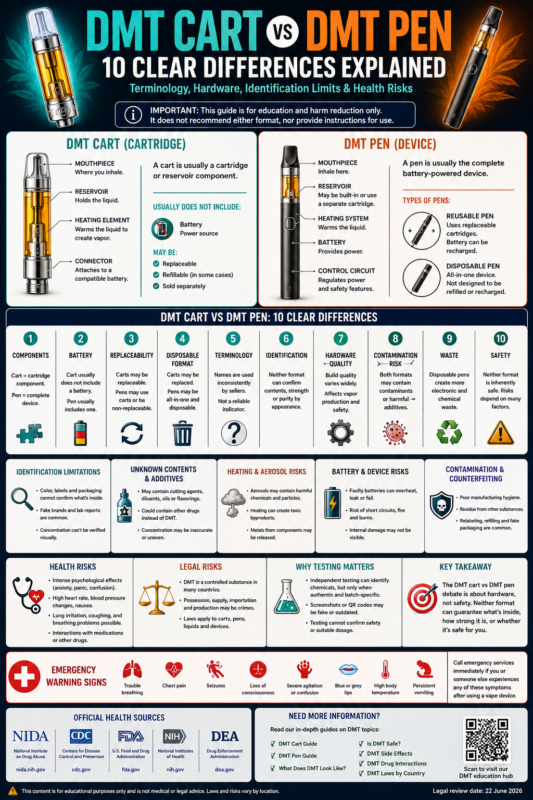
DMT cart vs DMT pen is mainly a comparison of terminology and hardware rather than two scientifically standardised products. A DMT cart usually refers to a cartridge or reservoir, while a DMT pen generally refers to a complete battery-powered device or an all-in-one disposable unit.
However, the terms are used inconsistently in unregulated markets. Some sellers call a complete disposable device a cart, while others call a cartridge attached to a battery a pen. Packaging, colour and appearance cannot confirm that either product contains DMT.
This educational guide examines DMT cart vs DMT pen terminology, hardware differences, disposable devices, identification limitations and health risks. It does not recommend either format or provide instructions for filling, modifying, operating or consuming from these devices.
Table of Contents
- DMT Cart vs DMT Pen: What Is the Difference?
- DMT Cart vs DMT Pen Comparison Table
- 10 Clear Differences
- What Does DMT Cart Mean?
- What Does DMT Pen Mean?
- Disposable DMT Pens
- Hardware Differences
- Why the Terminology Is Inconsistent
- Identification Limitations
- Unknown Liquid and Additives
- Heating and Aerosol Risks
- Battery and Device Risks
- Contamination and Counterfeiting
- Health Risks
- Legal Risks
- Emergency Warning Signs
- Frequently Asked Questions
DMT Cart vs DMT Pen: What Is the Difference?
The simplest answer to DMT cart vs DMT pen is that a cart is generally one component, while a pen is generally the complete device.
A cartridge commonly contains:
- A reservoir
- An internal heating element
- A mouthpiece
- A connection point for a compatible battery
A vape pen commonly includes:
- A power source
- Control circuitry
- A cartridge or built-in reservoir
- A heating system
- A mouthpiece
Some pens are reusable battery units that accept replaceable cartridges. Others are sealed disposable products in which the battery, reservoir and heating component form one unit.
The difference is therefore primarily structural. It does not establish what chemical is inside, how concentrated it is or whether the product is safe.
DMT Cart vs DMT Pen Comparison Table
| Feature | DMT Cart | DMT Pen |
|---|---|---|
| Usual meaning | Cartridge or reservoir component | Complete battery-powered device |
| Battery included | Usually no | Usually yes |
| Heating component | Often built into the cartridge | Contained in or connected to the complete device |
| Replaceable | May be replaceable | May accept cartridges or be fully disposable |
| Disposable format | Cartridge may be discarded separately | Entire device may be discarded |
| Terminology consistency | Not standardised | Not standardised |
| Contents identifiable visually | No | No |
| Concentration identifiable visually | No | No |
| Safety guaranteed by packaging | No | No |
| Unregulated-product risk | High uncertainty | High uncertainty |
10 Clear DMT Cart vs DMT Pen Differences
1. A Cart Usually Means a Cartridge
In a DMT cart vs DMT pen comparison, the word cart is normally an abbreviation for cartridge. It generally refers to the part intended to hold liquid and contain a heating element.
The cartridge may require a separate battery. Without the power unit, the cartridge is not a complete electronic vaping device.
2. A Pen Usually Means the Complete Device
The word pen usually refers to the full device because many early vaping products had a narrow, pen-like shape.
A complete pen generally combines a battery with the cartridge or reservoir system. The shape may no longer resemble a writing pen, but the name continues to be used.
3. Some Pens Use Replaceable Cartridges
One common DMT cart vs DMT pen distinction is replaceability. A reusable battery may accept a detachable cartridge.
In that arrangement, the cartridge and pen are connected parts of the same system. The cart is the replaceable upper component, while the pen refers to the assembled device.
4. Some Pens Are Disposable
A disposable pen combines the battery, liquid reservoir, heating element and mouthpiece into a sealed or semi-sealed unit.
The entire device is discarded after the battery or liquid is depleted. This creates additional electronic and chemical waste.
5. Sellers Use the Terms Inconsistently
The DMT cart vs DMT pen distinction is not reliably reflected in online listings. A seller may describe a disposable device as a cart or market a cartridge-and-battery package as a pen.
Terminology alone cannot verify the design or contents.
6. A Cartridge Does Not Identify Its Contents
A clear or coloured reservoir cannot prove that it contains DMT. Many substances, flavourings, oils and carrier liquids may look similar inside a cartridge.
Labels, logos and printed concentration claims can also be copied or fabricated.
7. A Complete Pen Does Not Provide Greater Chemical Certainty
A professionally manufactured exterior does not mean the internal liquid was produced or tested professionally.
Unregulated devices may be assembled using generic components, copied branding and unknown liquids.
8. Hardware Can Affect the Aerosol
Heating components, internal metals, reservoir materials and device condition may influence the aerosol produced.
Wear, manufacturing defects, contamination or unsuitable liquid may create additional exposure beyond the claimed active substance.
9. Disposable Devices Create More Waste
A disposable pen contains electronic components and a battery in addition to liquid residue. A separate cartridge also produces waste, but a reusable battery is not necessarily discarded with every cartridge.
Neither format should be placed where children, animals or sanitation workers may contact residual liquid.
10. Neither Format Can Be Recommended as Safe
The central conclusion of DMT cart vs DMT pen is that the hardware distinction does not make either format inherently safe.
Risks arise from the claimed drug, unknown concentration, unidentified additives, contaminated hardware, heating products, psychological effects and legal status.
What Does DMT Cart Mean?
A DMT cart is commonly described as a small cartridge reportedly containing a DMT-related liquid. The cartridge may have a mouthpiece, reservoir, heating element and battery connection.
However, “DMT cart” is a market term rather than a recognised pharmaceutical product category. There is no universal formula, verified concentration or manufacturing standard attached to the name.
Products using the same label may contain different:
- Liquids
- Concentrations
- Additives
- Hardware components
- Contaminants
- Unrelated drugs
Read our educational DMT cart guide for more information about terminology and identification limits.
What Does DMT Pen Mean?
A DMT pen generally means a complete vaping device allegedly containing or designed for a DMT-related liquid.
The phrase may refer to:
- A rechargeable battery with a cartridge attached
- A battery sold with a separate cartridge
- A disposable all-in-one device
- A generic vape pen relabelled as a DMT pen
The term does not establish quality, authenticity or regulatory approval.
Our DMT pen guide explains the device category without providing use instructions.
Disposable DMT Pens
Disposable products complicate the DMT cart vs DMT pen comparison because the cartridge and battery cannot always be separated.
A disposable device may conceal:
- The size of the reservoir
- The internal heating material
- The condition of the liquid
- The origin of the battery
- Evidence of leakage
- Signs of internal corrosion
A sealed body is not proof of tamper resistance. Products may be filled, relabelled or repackaged before sale.
DMT Cart vs DMT Pen Hardware Differences
Hardware is the most meaningful technical difference in a DMT cart vs DMT pen comparison.
A cartridge is generally a consumable component. A pen is the powered system that activates the heating element. In disposable devices, those functions are combined permanently.
Hardware-related variables include:
- Battery quality
- Electrical circuitry
- Heating-element material
- Reservoir construction
- Seal integrity
- Manufacturing cleanliness
- Age and storage history
These characteristics cannot usually be assessed completely from photographs or packaging.
Why DMT Vape Terminology Is Inconsistent
DMT cartridges and pens are not standardised pharmaceutical products. Unregulated sellers may choose whichever term attracts more searches or seems easier for buyers to recognise.
Other phrases may include:
- DMT vape
- DMT vaporiser
- DMT disposable
- DMT cartridge
- DMT vape pen
- DMT liquid device
These names may describe overlapping products. Therefore, terminology should not be treated as evidence of construction, contents or performance.
DMT Cart vs DMT Pen Identification Limitations
Visual identification is one of the greatest limitations in the DMT cart vs DMT pen discussion.
A photograph cannot confirm:
- Whether DMT is present
- Which DMT-related compound is present
- The concentration
- The liquid ingredients
- The presence of another drug
- Whether contaminants are present
- Whether the hardware is genuine
- Whether the product has degraded
Colour is especially unreliable. Clear, pale, amber, yellow or dark liquid may reflect ingredients, oxidation, contamination, storage or colouring agents.
Learn more through our guide explaining what DMT looks like.
Unknown Liquids, Additives and Concentration
An unregulated cartridge may contain carrier liquids, flavouring compounds, oils, diluents, degradation products or substances not listed on the label.
Even when DMT is present, the concentration may be:
- Lower than claimed
- Higher than claimed
- Unevenly distributed
- Changed during storage
- Mixed with another psychoactive compound
Packaging claims cannot replace independent analytical testing connected to the exact product batch.
Heating and Aerosol Risks
Vaping devices heat liquid to form an aerosol. The user may inhale the claimed active ingredient together with carrier substances, additives, particles and chemicals formed during heating.
Potential concerns include:
- Airway irritation
- Unknown thermal breakdown products
- Fine and ultrafine particles
- Metal exposure from device components
- Contamination from the reservoir
- Unexpected additives
Evidence from nicotine and cannabis vaping cannot determine the exact risk of every DMT-labelled device, but it demonstrates why inhaled cartridge products should not be assumed harmless.
Battery and Device Risks
The pen side of the DMT cart vs DMT pen comparison adds electrical and battery hazards.
Faulty or damaged devices may create risks involving:
- Overheating
- Leakage
- Short circuits
- Battery failure
- Fire
- Burns
A device that appears normal externally may still have internal damage.
Contamination, Refilling and Counterfeiting
Unregulated cartridges may be produced, refilled or stored without validated hygiene and quality-control systems.
Possible contamination sources include:
- Dust and fibres
- Microorganisms
- Cleaning chemicals
- Metals
- Residue from another drug
- Packaging materials
- Degraded liquid
Counterfeit branding creates another problem. Logos, security labels and laboratory-style documents may be copied without authorisation.
DMT Cart vs DMT Pen Health Risks
The health concerns in a DMT cart vs DMT pen comparison overlap because both formats may expose a person to the same claimed psychedelic and an unknown aerosol.
Potential acute concerns include:
- Severe anxiety
- Panic
- Confusion
- Disorientation
- Impaired coordination
- Increased heart rate
- Blood-pressure changes
- Nausea
- Loss of situational awareness
- Accidental injury
Additional uncertainty comes from unknown ingredients, medication interactions, pre-existing health conditions and simultaneous use of other substances.
Read is DMT safe, our DMT side-effects guide and our DMT drug-interactions guide for broader safety information.
Legal Risks of DMT Carts and Pens
Hardware that contains DMT may be treated as a controlled-substance product rather than an ordinary vaping device.
Potential offences may involve:
- Possession
- Supply
- Possession with intent to supply
- Production
- Importation
- Exportation
- Drug-impaired driving
A cartridge’s small size or commercial appearance does not remove controlled-substance laws.
Review our current DMT laws by country guide and our article answering is DMT legal.
Why Verified Testing Matters in a DMT Cart vs DMT Pen Comparison
A reliable DMT cart vs DMT pen comparison cannot be based on branding, liquid colour or device design. Both formats may use generic hardware, copied labels and liquids with unknown composition. Even professional-looking packaging cannot confirm that the claimed substance is present or that the product matches a laboratory report.
Public-health agencies warn that vaping aerosols may contain ultrafine particles, volatile organic compounds and metals released from device components. These risks are separate from the effects of the claimed active substance. The NIDA vaping-device overview explains how battery-powered devices heat liquids to create inhaled aerosols, while the CDC overview of e-cigarettes and vaping products describes potential exposure to harmful chemicals and particles.
Independent testing can examine chemical identity, but a report is useful only when it is authentic and traceable to the exact batch. A screenshot, QR code or seller-provided certificate may be outdated, altered or connected to another product.
For that reason, the main conclusion of DMT cart vs DMT pen remains unchanged: neither hardware style can establish identity, purity, concentration or safety.
Emergency Warning Signs
Urgent medical help may be necessary when someone develops:
- Difficulty breathing
- Chest pain
- Blue or grey lips
- Seizures
- Loss of consciousness
- Severe agitation
- Dangerous confusion
- Very high body temperature
- Persistent vomiting
- Symptoms suggesting injury or poisoning
Tell emergency professionals what may have been taken and mention that a vaping product was involved. Accurate information can support assessment and treatment.
Frequently Asked Questions
What is the main DMT cart vs DMT pen difference?
A cart usually means the cartridge component, while a pen generally means the full battery-powered device. Disposable pens combine both parts.
Is a DMT cart the same as a DMT pen?
Not exactly, although sellers often use the terms interchangeably. A cart is usually one component of a pen system.
Does a DMT cart include a battery?
Usually not. A cartridge commonly requires a separate compatible battery, but product terminology is inconsistent.
What is a disposable DMT pen?
It is generally described as an all-in-one device containing a battery, reservoir, heating element and mouthpiece. The label does not verify its contents.
Can a DMT cart be identified by its liquid colour?
No. Colour cannot reliably confirm chemical identity, concentration, purity or safety.
Is a sealed DMT pen safer than a cartridge?
A sealed exterior does not prove the liquid or hardware was manufactured safely. The device may still contain unknown substances or defective components.
Can packaging prove that a DMT vape is genuine?
No. Packaging, labels, QR codes and laboratory-style reports may be copied or unrelated to the exact product.
Can DMT vape products affect the lungs?
Any inhaled aerosol may expose the respiratory system to particles, additives, contaminants and heating products. The exact contents of an unregulated product may be unknown.
Are DMT carts and pens legal?
DMT is controlled in many countries. A cartridge or pen containing it may create possession, supply or importation offences.
Which is better: a DMT cart or DMT pen?
This article does not recommend either format. The hardware difference does not resolve concerns about chemical identity, concentration, contamination, psychological effects or legality.
Final Thoughts
The DMT cart vs DMT pen distinction is mostly about components. A cart generally means a cartridge, while a pen generally means the complete battery-powered or disposable device.
However, DMT cart vs DMT pen terminology is inconsistent and provides no assurance about chemical identity, strength, purity or manufacturing quality.
Neither format can be identified reliably by appearance, and neither should be presented as inherently safer. Unknown liquids, heating products, hardware contamination, battery defects, intense psychological effects and legal restrictions remain important concerns.
This article is provided for public-health, identification and harm-reduction education. It does not recommend either format or provide instructions for operating, modifying, filling or consuming from vaping devices.
