Jun
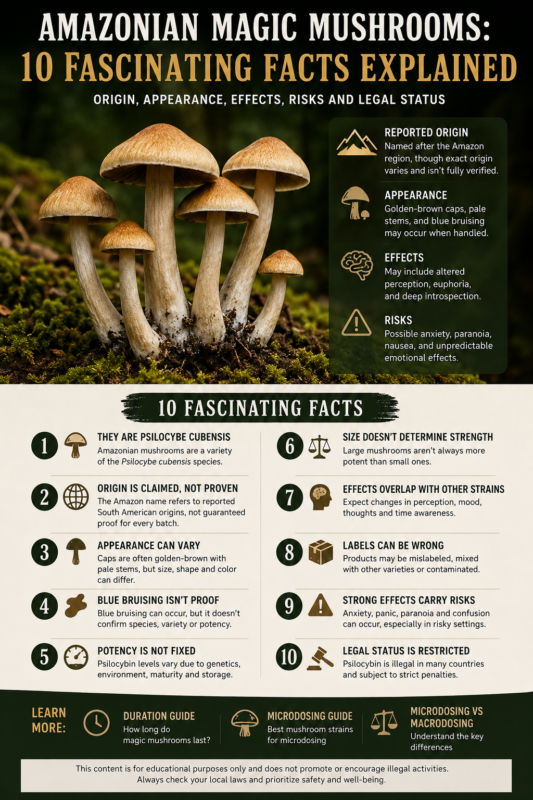
Amazonian Magic Mushrooms are commonly discussed as a named variety associated with Psilocybe cubensis, a species of mushroom known for producing psilocybin and related compounds. The name “Amazonian” is widely used in cultivation and mushroom communities, but it should not be confused with a formally established species name.
If you are researching Amazonian Magic Mushrooms, one of the most important points is that a popular strain name does not automatically guarantee a standardized chemical profile. Modern research has found substantial variation in psilocybin and other tryptamine concentrations between Psilocybe cubensis strains and even between individual mushrooms from the same strain.
What Are Amazonian Magic Mushrooms?
Amazonian Magic Mushrooms is a common name used for a type of psilocybin mushroom generally associated with Psilocybe cubensis. The name is often used to distinguish a particular cultivated line or phenotype from other commonly named varieties.
Scientifically, however, “Amazonian” is not the species name. Psilocybe cubensis is a recognized fungal species within the genus Psilocybe. NCBI’s taxonomy record for Psilocybe cubensis identifies P. cubensis as a species of basidiomycete fungi.
This distinction is important because common strain names are not necessarily formal taxonomic categories. A name used by growers or mushroom enthusiasts can describe a cultivated line without representing a separate species.
For broader background, the site’s verified magic mushroom resource provides additional context about the broader category.
What Is the Scientific Classification?
Psilocybe cubensis belongs to the fungal genus Psilocybe. It is one of the best-known psilocybin-producing mushroom species and has been the subject of chemical, genetic, pharmacological, and clinical research.
NCBI lists Psilocybe cubensis as a species within the fungal kingdom and the genus Psilocybe. The formal scientific name is therefore different from the popular “Amazonian” label.
Research into the genetics of P. cubensis has also shown that domesticated cultivars have a complicated genetic history. A population-genomics study found that many cultivars share related ancestry, while also identifying genetic variation that may contribute to differences in psilocybin biosynthesis. The published population-genomics research provides additional scientific context.
What Does the “Amazonian” Name Mean?
The “Amazonian” name is generally used as a cultivar or strain-style designation rather than a formal species designation.
The name can suggest an association with the Amazon region, but a commercial or community strain name should not automatically be interpreted as proof of geographic origin. Without documented provenance and scientific authentication, a name alone cannot establish where a particular specimen originated.
This is a broader issue with named Psilocybe cubensis varieties. Scientific literature has highlighted substantial gaps in strain-level documentation and the need for more systematic genetic and chemical characterization.
A recent review of P. cubensis strains discusses genetic diversity, phenotypic variation, psychoactive-compound production, and the research gaps that remain around individual named strains. The peer-reviewed review of Psilocybe cubensis strains provides a useful overview of this subject.
What Do Amazonian Magic Mushrooms Look Like?
Descriptions of Amazonian Magic Mushrooms commonly mention brown to golden-brown caps and pale stems, but appearance can vary according to genetics, maturity, environmental conditions, and the particular cultivated line being described.
That means there is no single visual template that can reliably identify every mushroom carrying the Amazonian label.
Physical characteristics can be useful for describing mushrooms, but visual appearance alone cannot establish an exact species, strain, or chemical composition.
Why appearance varies
- Genetic differences can influence size, pigmentation, and shape.
- Maturity can change the appearance of caps and stems.
- Environmental conditions can influence physical development.
- Different cultivated lines can display different phenotypes.
For these reasons, photographs should be treated as descriptive rather than definitive scientific identification.
Psilocybin and Psilocin
The principal compounds associated with the psychedelic effects of psilocybin mushrooms include psilocybin and psilocin.
Psilocybin is converted into psilocin in the body, and psilocin is closely associated with the pharmacological effects produced after psilocybin administration.
Scientific research frequently measures both compounds when studying the chemistry of Psilocybe mushrooms. A peer-reviewed analytical study developed a laboratory method for measuring psilocybin and psilocin in multiple Psilocybe cubensis strains. The LC-MS/MS study of psilocybin and psilocin content demonstrates why laboratory analysis is more informative than relying solely on a strain name.
The important point is that the presence of psilocybin-related compounds does not mean every specimen contains the same concentration.
How Consistent Is Their Potency?
There is no scientifically reliable basis for assuming that all Amazonian Magic Mushrooms have an identical potency.
Research published in 2026 examined 14 Psilocybe cubensis strains cultivated under controlled conditions and found substantial variation in total tryptamine concentrations between strains. The study also found meaningful variation between individual fruiting bodies within selected strains. The 2026 study on inter- and intra-strain tryptamine variability provides recent evidence for this point.
This is especially relevant when a popular strain name is treated as though it represents a fixed chemical formulation. A name can identify a commonly recognized line, but it does not provide a laboratory measurement of the actual material.
Why chemical content can vary
Variation can occur between individual mushrooms and cultivated lines. Research has identified differences associated with genetics, developmental stage, environmental conditions, and storage.
Earlier analytical research also found substantial variation in psilocybin and psilocin concentrations among Psilocybe cubensis samples. Research examining psilocybin and psilocin levels across Psilocybe cubensis harvests illustrates how chemical concentrations can vary even within the same species.
| Factor | Why it matters |
|---|---|
| Genetics | Different cultivated lines can have different biochemical characteristics. |
| Individual fruiting body | Concentrations can vary between individual mushrooms. |
| Development | Chemical composition can change during mushroom development. |
| Storage | Psilocybin and psilocin can change over time under some storage conditions. |
| Laboratory method | Analytical techniques influence how compounds are measured and reported. |
What Effects Are Associated With Psilocybin Mushrooms?
Because Amazonian Magic Mushrooms are generally discussed in the context of psilocybin-containing Psilocybe cubensis, their reported effects are best understood through research on psilocybin rather than as a completely separate pharmacological category.
Psilocybin can produce changes in perception, mood, cognition, sensory processing, and the subjective experience of time. The intensity and character of the experience can vary substantially between people and circumstances.
Research has also investigated psilocybin in controlled clinical settings for potential therapeutic applications. These studies should not be interpreted as proof that every mushroom experience produces the same effects or outcomes.
The distinction between a named mushroom variety and the pharmacology of psilocybin is therefore important when evaluating claims about specific strains.
What Does Scientific Research Tell Us?
Scientific interest in psilocybin has expanded considerably, including research into pharmacology, chemistry, genetics, subjective effects, and potential therapeutic applications.
At the mushroom level, recent studies are increasingly focused on measuring chemical content rather than assuming that popular strain names correspond to standardized concentrations.
A 2024 analytical study examined multiple P. cubensis strains individually using liquid chromatography-tandem mass spectrometry and demonstrated measurable differences in average psilocybin and psilocin concentrations between the strains tested. The published analytical research provides an example of how laboratory methods can characterize mushroom chemistry more precisely.
More recent work has gone further by measuring several tryptamine compounds across 14 strains cultivated under standardized conditions. That study found more than seven-fold variation in total tryptamine concentrations between the strains examined and additional variation between individual fruiting bodies.
These findings reinforce an important principle: a strain label is not a substitute for chemical analysis.
Can Appearance Confirm a Mushroom’s Identity?
No. Appearance can provide useful descriptive information, but it cannot by itself establish a mushroom’s species, cultivar, geographic origin, or chemical composition.
Research examining DNA authentication and chemical analysis of Psilocybe specimens has documented widespread problems with specimen identification and inconsistencies in metabolite measurements. The DNA-authentication and chemical-analysis study highlights why scientific identification can require more than visual comparison.
This is particularly important for mushrooms sold or described using informal names. A photograph that resembles Amazonian Magic Mushrooms cannot establish that a specimen actually belongs to a particular named line.
Important Safety Considerations
Psilocybin-containing mushrooms can produce significant changes in perception, cognition, mood, and sensory processing. Individual responses can be unpredictable, particularly when the chemical composition of the material has not been analytically characterized.
Anyone experiencing severe confusion, extreme agitation, loss of consciousness, seizures, difficulty breathing, chest pain, or another serious medical emergency should seek urgent medical assistance.
People should not drive or operate machinery while experiencing psychoactive effects. Combining psychoactive substances can also increase uncertainty and risk.
Clinical research takes place under controlled conditions involving screening, supervision, standardized procedures, and defined research protocols. Those conditions can differ substantially from unsupervised use.
Frequently Asked Questions
What are Amazonian Magic Mushrooms?
Amazonian Magic Mushrooms is a commonly used name associated with a type of Psilocybe cubensis. The name is generally used as a cultivar or strain-style designation rather than as the formal name of a separate species.
Are Amazonian Magic Mushrooms a separate species?
No. The species generally associated with the name is Psilocybe cubensis. “Amazonian” is a commonly used name rather than the formal species designation.
Do Amazonian Magic Mushrooms contain psilocybin?
Psilocybe cubensis is a psilocybin-producing mushroom species. However, the concentration of psilocybin and related compounds can vary between individual mushrooms and cultivated lines.
Are Amazonian Magic Mushrooms always the same potency?
No. Research has demonstrated substantial chemical variation between Psilocybe cubensis strains and between individual fruiting bodies, so a strain name should not be treated as a guarantee of a fixed potency.
What do Amazonian Magic Mushrooms look like?
They are commonly described using golden-brown or brown caps and pale stems, but physical appearance can vary depending on genetics, maturity, and growing conditions.
Are Amazonian Magic Mushrooms stronger than other Psilocybe cubensis varieties?
There is not enough standardized scientific evidence to establish a universal potency ranking for every named Psilocybe cubensis variety. Laboratory research has demonstrated substantial variability across strains.
Does the Amazonian name prove geographic origin?
No. A commonly used cultivar name does not by itself establish that a particular specimen originated in the Amazon region. Documented provenance and scientific authentication would be needed for a stronger geographic claim.
Can you identify Amazonian Magic Mushrooms from a photograph?
A photograph can show visual characteristics, but it cannot reliably establish species, cultivar identity, geographic origin, or chemical composition on its own.
Why can Amazonian Magic Mushroom potency vary?
Genetics, individual fruiting bodies, developmental stage, environmental conditions, storage, and analytical methods can all contribute to variation in measured chemical content.
Why is laboratory testing more reliable than a strain name?
A strain name is a descriptive label, while laboratory analysis can directly measure target compounds such as psilocybin and psilocin. Recent research shows that chemical content can vary substantially even among mushrooms assigned to the same strain.
Conclusion
Amazonian Magic Mushrooms are best understood as a commonly used name associated with Psilocybe cubensis, rather than as a formally recognized species of their own.
The most important scientific takeaway is that a popular name does not guarantee a standardized chemical profile. Recent research has demonstrated substantial variation in psilocybin and other tryptamine concentrations between P. cubensis strains and even between individual fruiting bodies.
Appearance can help describe a mushroom, but it cannot establish exact potency, strain identity, or geographic origin. For that reason, claims about Amazonian Magic Mushrooms should be evaluated carefully and distinguished from what laboratory and peer-reviewed research actually demonstrates.
