Jun
What Does DMT Look Like? 10 Essential Identification Facts
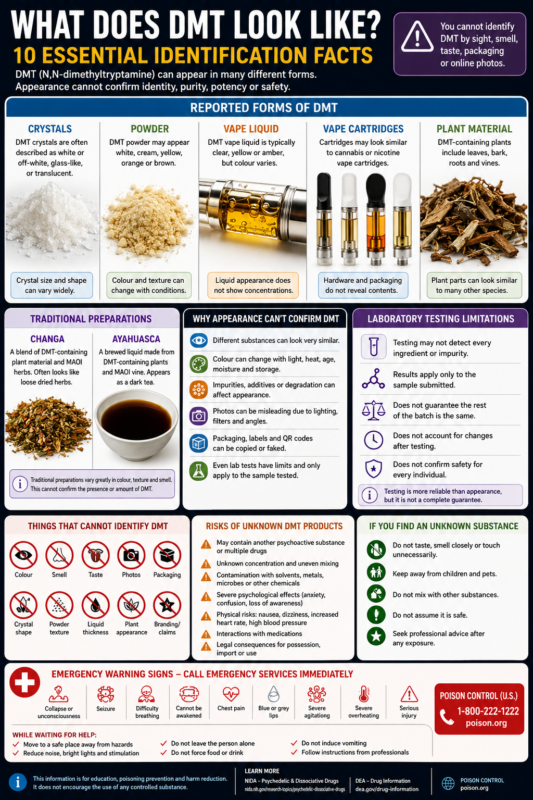
What does DMT look like is a common question, but N,N-dimethyltryptamine does not have one reliable appearance in unregulated products. Materials represented as DMT may be described as crystals, powder, liquid, vape cartridges, herbal mixtures or plant preparations.
Colour, texture, smell, packaging and photographs cannot prove that an unidentified substance contains DMT. Different chemicals may look similar, and products with nearly identical appearances may contain different substances or concentrations.
This educational guide explains reported DMT forms, visual-identification limitations, cartridge and plant-material concerns, laboratory-testing limits and emergency warning signs. It does not provide instructions for purchasing, preparing, extracting, testing, dosing or consuming a controlled substance.
Table of Contents
- What Does DMT Look Like?
- 10 Essential DMT Appearance Facts
- What Do DMT Crystals Look Like?
- What Does DMT Powder Look Like?
- What Does DMT Vape Liquid Look Like?
- What Do DMT Cartridges Look Like?
- What Do DMT Plant Preparations Look Like?
- What Does Changa Look Like?
- Why Appearance Cannot Confirm DMT
- Laboratory-Testing Limitations
- Risks of Unknown DMT Products
- Emergency Warning Signs
- Frequently Asked Questions
What Does DMT Look Like?
The most accurate answer to what does DMT look like is that there is no single dependable visual form. DMT discussed in research settings is a defined chemical, but products represented as DMT in unregulated settings can vary considerably.
Reported forms may include:
- Crystalline material
- Fine or coarse powder
- Clear, yellow or amber liquid
- Vape cartridges
- Disposable vape pens
- Dried plant material
- Herbal mixtures such as changa
- Traditional plant preparations
- Licensed research formulations
These descriptions are not identification criteria. An unknown product may contain another tryptamine, several substances, inactive materials or contaminants.
For broader scientific, legal and health information, visit our complete DMT guide.
10 Essential DMT Appearance Facts
1. DMT Has No Universal Street Appearance
There is no regulated colour, texture, package, crystal shape or branding standard for illicit products represented as DMT.
One product may look pale and crystalline, while another may appear yellow, waxy, oily or powder-like. These differences do not confirm authenticity or quality.
2. Crystalline Appearance Is Not Proof
Many unrelated chemicals form crystals. A material that appears crystalline may contain DMT, another substance, several compounds or no DMT at all.
Crystal size, sparkle and transparency cannot reveal molecular identity.
3. Powder Colour Can Vary
Powder represented as DMT may be described as white, cream, yellow, orange or brown. Colour can be influenced by impurities, degradation, storage, lighting or unrelated ingredients.
A lighter colour does not automatically indicate purity, and a darker colour does not provide a reliable measure of strength.
4. Vape Liquid Has No Reliable Visual Signature
DMT vape liquid may be described as clear, pale yellow, amber or darker. Its appearance cannot reveal which chemical is present or how concentrated it may be.
Carrier liquids, additives, age and heat exposure can all affect colour and thickness.
5. Cartridge Hardware Reveals Nothing About Contents
Cartridges may resemble nicotine or cannabis vape hardware. Empty cartridges and packaging can be filled or reused by unrelated individuals.
A professional-looking cartridge is not chemical evidence.
6. Plant Material Cannot Be Identified Reliably From Photos
Dried leaves, bark, roots and herbal mixtures may resemble many ordinary botanical materials. Species identification from photographs can be difficult, especially after grinding, drying or mixing.
Even correct plant identification would not reveal alkaloid concentration, contamination or legal status.
7. Changa May Resemble Ordinary Dried Herbs
Changa is generally described as an herbal mixture represented as containing DMT and other active plant compounds. Its appearance may resemble loose tea, tobacco or dried herbs.
Appearance cannot establish which plants or chemicals are present.
8. Smell Is Not a Reliable Identification Method
Odour descriptions are subjective and can be influenced by packaging, solvents, plant materials and contamination.
Closely smelling or tasting an unknown substance creates unnecessary exposure and should not be used as an identification method.
9. Photographs Can Be Misleading
Online photographs may be mislabeled, edited or copied from unrelated products. Lighting, camera settings and screens can alter colour and texture.
A visual match with an online image does not prove chemical identity.
10. Laboratory Testing Still Has Limits
Professional chemical analysis can provide more information than appearance, but a result generally applies only to the sample examined.
Testing one portion does not automatically establish that every package, cartridge or batch from the same source is identical.
What Do DMT Crystals Look Like?
Materials represented as DMT crystals may be described as:
- Small crystalline grains
- Needle-like crystals
- Irregular crystalline fragments
- Clear or translucent particles
- White, cream or yellowish solids
- Waxy or partially crystalline material
These descriptions overlap with many unrelated chemicals. Crystal shape depends on numerous factors and cannot be used as a dependable identification tool.
A photograph cannot reveal:
- Molecular identity
- Purity
- Concentration
- Residual chemicals
- Contamination
- Storage history
What Does DMT Powder Look Like?
Powder represented as DMT may appear fine, coarse, clumped or partially crystalline. It may be light-coloured or darker.
Visible differences can result from:
- Moisture exposure
- Heat or light
- Impurities
- Oxidation or degradation
- Other ingredients
- Grinding or processing
The question what does DMT look like cannot be answered by treating one powder colour as authentic. Many dangerous or harmless substances may resemble the same material.
What Does DMT Vape Liquid Look Like?
Liquid represented as DMT may appear clear, yellow, amber, brown or another colour. It may be thin or thick depending on temperature and additional ingredients.
Liquid appearance cannot establish:
- Whether DMT is present
- Which form of DMT is present
- Concentration
- Whether the liquid is evenly mixed
- Whether solvents or additives are present
- Whether contamination has occurred
Colour and bubble movement are not dependable potency indicators.
Read our DMT pen guide for more information about device appearance, unknown liquids and hardware risks.
What Do DMT Cartridges Look Like?
A cartridge represented as DMT may resemble an ordinary vape cartridge. It may contain a transparent reservoir, mouthpiece, metal components and clear or coloured liquid.
Cartridges may differ in:
- Shape
- Size
- Connection type
- Mouthpiece design
- Liquid colour
- Branding
- Packaging
None of these features confirms what is inside. Empty hardware can be purchased, reused or filled with unrelated substances.
Counterfeit cartridges may reproduce logos, QR codes and supposed laboratory reports. These details are not proof that the exact cartridge was independently analysed.
What Do DMT Plant Preparations Look Like?
Plant preparations associated with DMT may involve leaves, bark, roots, vines, shredded plant material or mixed botanical products.
After drying, grinding or packaging, many plant species can look similar. Visual inspection may not accurately identify:
- The plant species
- The plant part
- Whether several plants are mixed
- Alkaloid content
- Pesticide residues
- Mould or microbial contamination
- Legal status
Natural appearance does not mean a product is safe. Plants can contain powerful or toxic compounds, and concentration may vary substantially.
What Does Changa Look Like?
Changa is generally described as a dried herbal mixture represented as containing DMT and other active botanical compounds.
It may resemble:
- Loose dried leaves
- Herbal tea
- Shredded tobacco
- Mixed green or brown plant material
- Crushed herbs with uneven texture
Appearance cannot confirm whether DMT, monoamine oxidase-inhibiting compounds or other substances are present.
Mixtures may be uneven, meaning different portions may not have identical chemical composition.
Why Appearance Cannot Confirm DMT
The central lesson in answering what does DMT look like is that appearance is not chemical identification.
Visual identification fails because:
- Different chemicals may look alike.
- The same chemical may appear differently.
- Colour changes with light, heat and age.
- Contaminants may be invisible.
- Concentration cannot be seen.
- Packaging can be copied.
- Plant materials may be mixed.
- Online images may be mislabeled.
An unknown product should not be treated as genuine merely because it resembles a photograph or seller description.
Laboratory-Testing Limitations
Professional laboratory analysis may identify substances present in a submitted sample and may sometimes estimate concentration. This provides more reliable information than colour, smell or texture.
However, laboratory testing may not establish that:
- Every ingredient was detected
- Every portion is evenly mixed
- Another product from the same seller is identical
- The substance remained stable after testing
- The hardware is safe
- The product is medically safe for a particular person
A laboratory certificate should also be traceable to the exact sample. Seller-provided documents may be copied, incomplete or associated with a different batch.
Risks of Unknown DMT Products
Unknown products represented as DMT may create psychological, physical and legal risks.
Possible concerns include:
- Exposure to another psychoactive substance
- Unexpected concentration
- Severe anxiety or panic
- Confusion and disorientation
- Loss of environmental awareness
- Heart-rate or blood-pressure changes
- Medicine interactions
- Contamination
- Multiple-substance exposure
- Delayed treatment caused by mistaken identification
Read our guide to DMT effects for more information about reported psychological and physical reactions.
Our DMT pipe article also explains why residue and the appearance of an object cannot reveal which substance was previously used.
Emergency Warning Signs
Call emergency services immediately if someone who may have been exposed to DMT or another unknown substance:
- Collapses or loses consciousness
- Has a seizure
- Has difficulty breathing
- Cannot be awakened
- Experiences chest pain
- Develops blue or grey lips
- Shows severe overheating
- Becomes dangerously agitated
- Threatens self-harm or harm to others
- Suffers a serious injury
- May have taken several substances
Do not delay medical care while searching for photographs or attempting to identify a product by appearance.
While waiting for professional help:
- Move the person away from traffic, water, heights and fire when safe.
- Reduce loud noise, bright lights and unnecessary stimulation.
- Speak calmly and avoid confrontation.
- Do not leave an unconscious person alone.
- Do not force food or drink.
- Do not encourage vomiting.
- Follow instructions from emergency professionals.
In the United States, contact Poison Control for immediate assistance. People elsewhere should contact their local poison centre or emergency service.
Why Reported DMT Appearance Varies
People asking what does DMT look like often expect one colour, texture or physical form. In reality, products represented as DMT may vary because of their formulation, age, storage conditions, added ingredients and actual chemical composition.
The appearance of an unknown material may also change after exposure to light, air, moisture or heat. A substance that looks different from an online photograph is not necessarily weaker or stronger, and a close visual match does not prove authenticity.
Reported differences may involve:
- Colour
- Crystal size
- Powder texture
- Moisture content
- Liquid thickness
- Plant ingredients
- Packaging and storage
- Contamination or degradation
This is why the question what does DMT look like must be answered with caution. Appearance can describe an object, but it cannot verify its molecular identity.
Common Myths About DMT Colour
Colour is frequently treated as an informal sign of purity, but this is unreliable. Materials represented as DMT may be described as white, cream, pale yellow, deep yellow, orange, brown or darker.
Several myths should be avoided:
- White material is not automatically pure DMT.
- Yellow material is not automatically stronger.
- Dark material is not automatically contaminated.
- Clear vape liquid is not automatically safer.
- Amber liquid does not reveal concentration.
Many unrelated chemicals can share these colours. Lighting, camera settings and screen calibration may also make the same sample appear different in separate photographs.
When someone searches what does DMT look like, colour should therefore be presented as a descriptive feature rather than an identification test.
Can Texture or Consistency Identify DMT?
No. Texture and consistency cannot reliably identify DMT. A substance may be described as crystalline, powdery, sticky, waxy, oily or clumped, but these characteristics are not unique to dimethyltryptamine.
Texture may change because of:
- Humidity
- Temperature
- Impurities
- Degradation
- Added liquids
- Grinding
- Packaging pressure
- Storage time
A fine powder could be DMT, another psychoactive compound or an ordinary household material. Crystalline fragments may also belong to many unrelated substances.
The safest explanation of what does DMT look like is that texture can vary and cannot confirm chemical contents.
Why DMT Vape Appearance Is Especially Unreliable
Vape products create an additional layer of uncertainty because most of the claimed substance is concealed inside a reservoir or disposable device.
A cartridge may show clear, yellow, amber or brown liquid, but the user cannot determine from sight:
- Which active chemical is present
- Whether several drugs are mixed
- The concentration
- Whether the liquid is evenly distributed
- Whether harmful additives are present
- Whether the heating element has released particles
Branding can also create false confidence. A cartridge with polished packaging, a hologram or a QR code may still contain an unidentified liquid.
Readers asking what does DMT look like should understand that a vape cartridge mainly reveals the appearance of the hardware and liquid—not the actual molecular contents.
Our DMT pen guide explains how device appearance, copied labels and unknown liquids can mislead consumers.
Why Plant Material Is Difficult to Identify
DMT occurs naturally in certain plants, but processed botanical materials can be extremely difficult to identify visually. Bark, roots, leaves and vines may be dried, shredded, powdered or mixed with other plants.
Even experienced observers may struggle to identify plant species once the material has been processed. Photographs may not show microscopic features, smell, growing conditions or chemical composition.
Correctly identifying a plant would still not reveal:
- The amount of DMT present
- Which plant part was used
- Whether pesticides were applied
- Whether mould or bacteria are present
- Whether another plant was substituted
- Whether several species were combined
Therefore, the answer to what does DMT look like cannot be reduced to photographs of leaves, bark or roots.
Why Packaging Cannot Prove DMT Identity
Packaging may include chemical names, purity percentages, concentration claims, batch numbers or supposed laboratory results. None of these details proves that the material inside matches the description.
Packaging can be:
- Copied from another seller
- Printed without quality controls
- Reused after the original contents are removed
- Connected to an unrelated laboratory report
- Designed to imitate a legitimate research supplier
A professional presentation may influence how people answer what does DMT look like, but packaging is a marketing feature rather than scientific evidence.
Problems With Identifying DMT From Photographs
Online image comparisons are unreliable because photographs cannot show chemical structure. A photograph records visible light, not the molecular identity of an unknown sample.
Online images may also be:
- Mislabeled
- Heavily edited
- Copied from another website
- Taken under unusual lighting
- Associated with a different substance
- Used as advertising rather than documentation
Image quality creates another problem. Shadows, reflections, filters and background colours may alter the apparent shade and texture of a substance.
Someone wondering what does DMT look like should never treat a matching photograph as confirmation that an unknown material contains DMT.
Research DMT Versus Unregulated Products
DMT used in legitimate research is characterized through professional documentation and analytical testing. Researchers work with controlled materials whose identity, purity, concentration and storage conditions are recorded.
Unregulated products do not necessarily have the same quality controls. A material represented as DMT may be mislabeled, degraded, unevenly mixed or contaminated.
| Research Material | Unregulated Product |
|---|---|
| Documented chemical identity | Identity may depend on seller claims |
| Measured concentration | Concentration may be unknown |
| Controlled storage | Storage history may be unavailable |
| Quality and purity testing | Testing may be absent or unverifiable |
| Batch documentation | Packaging may provide no traceability |
This distinction matters when answering what does DMT look like. The appearance of a street product cannot establish that it is equivalent to a substance used in a scientific study.
What Can Professional Laboratories Determine?
Professional laboratories may use analytical techniques to identify chemicals and investigate impurities. Depending on the method and sample, testing may provide information about identity, concentration and contamination.
However, a laboratory result has boundaries. It generally applies to the sample submitted and may not represent every portion of an uneven mixture or every product from the same source.
A test also cannot establish:
- That another package contains the same substance
- That a cartridge’s hardware is safe
- That the product remained stable after testing
- That the substance is safe for an individual
- That no future contamination will occur
Testing is far more reliable than trying to determine what does DMT look like from colour or texture, but it is not an unlimited guarantee.
How to Respond to an Unknown Material
An unknown powder, liquid, cartridge or plant preparation should not be tasted, closely smelled or handled unnecessarily in an attempt to identify it.
Basic precautions include:
- Keep the material away from children and animals.
- Avoid touching the eyes or mouth after handling an unknown item.
- Do not mix the material with other substances.
- Do not assume that packaging is accurate.
- Seek professional advice after accidental exposure.
- Call emergency services for serious symptoms.
The practical purpose of answering what does DMT look like is not to teach visual authentication. It is to explain why visual authentication is unreliable and why unknown substances should be treated cautiously.
DMT Appearance Summary
The phrase what does DMT look like may refer to crystals, powder, liquid, vape cartridges, plant preparations or herbal mixtures. None of these forms provides a dependable visual signature.
The most important points are:
- Colour cannot confirm purity.
- Crystal shape cannot confirm identity.
- Powder texture cannot reveal concentration.
- Liquid thickness cannot measure potency.
- Cartridge packaging can be copied.
- Plant materials can be substituted or mixed.
- Photographs cannot reveal molecular contents.
- Laboratory analysis has limits but is more reliable than appearance.
Ultimately, what does DMT look like has no single scientifically reliable visual answer. An unknown product should not be treated as genuine or safe because it resembles an online photograph, package or commonly repeated description.
Frequently Asked Questions
What does DMT look like?
DMT represented in unregulated products may appear as crystals, powder, liquid, cartridges, herbal mixtures or plant preparations. No visual appearance confirms chemical identity.
What colour are DMT crystals?
Materials represented as DMT may appear white, cream, yellow or darker. Colour cannot verify identity, purity or potency.
Does pure DMT always look white?
No visual rule can authenticate an unknown substance. A white material may be unrelated, while colour can be influenced by many factors.
What does DMT vape liquid look like?
It may appear clear, yellow, amber or darker, but liquid colour and thickness cannot confirm its contents or concentration.
Can a DMT cartridge be identified visually?
No. Cartridge shape, oil colour, packaging and branding do not prove which chemicals are present.
What do DMT-containing plants look like?
Plants associated with DMT vary by species and plant part. Dried or processed materials can be difficult to identify visually.
What does changa look like?
Changa may resemble loose dried herbs or tea. Appearance cannot confirm its ingredients or chemical concentration.
Can smell identify DMT?
No. Odour is subjective and unreliable, and deliberately smelling an unknown chemical may create unnecessary exposure.
Can laboratory testing prove a product is safe?
No. Testing may provide information about a sample but cannot guarantee even distribution, safe hardware or individual medical safety.
When should emergency help be requested?
Call immediately for collapse, seizure, breathing difficulty, inability to awaken, chest pain, severe overheating or another serious reaction.
Final Thoughts
What does DMT look like has no single dependable answer. Products represented as DMT may appear as crystals, powder, liquids, cartridges, plant materials or herbal mixtures.
Colour, texture, smell, packaging and online photographs cannot establish chemical identity, purity or concentration. Professional analysis offers more information but still has important limitations.
This article is provided for education, poisoning prevention and harm reduction. It does not encourage the purchase, possession, preparation, extraction or use of controlled substances.
