
Jun
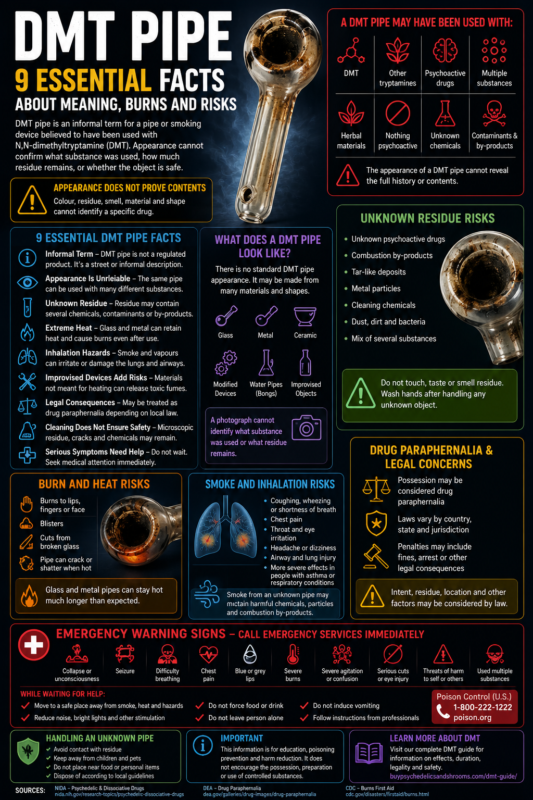
DMT Pipe: 9 Essential Facts About Meaning, Burns and Risks
A DMT pipe is an informal term for a pipe or smoking device believed to have been used with N,N-dimethyltryptamine. The name describes an assumed use, not a unique or scientifically identifiable object.
A pipe’s material, shape, colour, residue or smell cannot confirm what substance was previously placed inside it. The same object could have been used with another drug, several substances, ordinary herbs or nothing psychoactive at all.
This educational article explains terminology, appearance limitations, drug paraphernalia risks, burns, inhalation hazards and emergency warning signs. It does not provide instructions for preparing, heating, smoking or consuming DMT.
Table of Contents
- What Is a DMT Pipe?
- 9 Essential DMT Pipe Facts
- What Does a DMT Pipe Look Like?
- Why a Pipe Cannot Confirm the Substance Used
- Unknown Residue and Contamination Risks
- Burn and Heat Risks
- Smoke and Inhalation Risks
- Drug Paraphernalia and Legal Concerns
- Risks of Handling an Unknown Pipe
- Emergency Warning Signs
- Frequently Asked Questions
What Is a DMT Pipe?
A DMT pipe is not a regulated product category. It is a street or informal description applied to a device believed to have been associated with DMT.
The term may be used for several objects, including:
- A small glass pipe
- A metal pipe
- A modified smoking device
- A water-filtered device
- An object not originally designed for drug use
- A pipe containing unknown residue
None of these physical forms proves that DMT was present. A pipe is only an object; its chemical history cannot be established by sight alone.
For broader information about dimethyltryptamine, effects, duration and safety, visit our complete DMT guide.
9 Essential DMT Pipe Facts
1. “DMT Pipe” Is an Informal Term
The phrase DMT pipe describes an assumed use rather than a scientifically distinct tool. There is no official size, colour, material or design that identifies a pipe as being specifically for DMT.
Different people may use the term for completely different objects.
2. Appearance Cannot Confirm Previous Contents
A pipe may contain staining, residue, soot or odour, but these features cannot identify a specific drug. Many substances can leave similar-looking deposits.
Visual inspection cannot establish:
- Which chemical was present
- How much residue remains
- Whether several substances were used
- Whether contamination occurred
- How recently the object was used
- Whether the residue is hazardous
3. Unknown Residue May Contain More Than One Substance
Residue inside an unidentified device may contain a mixture of combustion products, degraded chemicals, dust, cleaning agents, biological material or multiple drugs.
Even a small amount of residue should not be assumed harmless.
4. Glass and Metal Can Become Extremely Hot
Pipes made from glass or metal can retain heat after exposure to a flame or another heat source. Burns may occur even when the object no longer appears hot.
Thin glass can also crack or shatter after repeated heating, cooling or physical damage.
5. Inhaled Smoke Can Irritate the Airways
Smoke and heated chemical vapours may irritate the nose, throat and lungs. Possible symptoms include coughing, wheezing, chest discomfort, headache and difficulty breathing.
The risk becomes harder to assess when the substance and temperature history are unknown.
6. Homemade Devices Can Add Additional Hazards
An improvised object may contain plastics, coatings, adhesives, paint or metals that were not designed to be heated or inhaled.
Heating unsuitable materials can release irritating or toxic compounds.
7. A Pipe May Be Treated as Drug Paraphernalia
Depending on local law, an object may be classified as drug paraphernalia when its design, residue, circumstances or intended use connects it with illegal drugs.
Legal treatment varies by country, state and jurisdiction. Possession of an object that is lawful in one context may lead to legal consequences in another.
8. Cleaning Does Not Guarantee Safety
A pipe that appears clean may still contain microscopic residue, cracks, contamination or chemical deposits.
Household cleaning products may also leave substances that are hazardous when reheated.
9. Serious Symptoms Need Immediate Medical Help
Do not delay emergency care while attempting to determine what was in a pipe. Severe burns, breathing difficulty, loss of consciousness, seizure or chest pain require urgent professional attention.
What Does a DMT Pipe Look Like?
There is no standard DMT pipe appearance. A device associated with the term may resemble many ordinary smoking tools.
Possible visible features may include:
- Glass, metal, ceramic or mixed materials
- A narrow stem
- A bowl or chamber
- Dark residue or discolouration
- Heat marks
- Cracks or chips
- An attached water chamber
- A homemade or modified design
These features are not unique to DMT. Similar objects may be associated with tobacco, cannabis, stimulants, herbs or other substances.
A photograph cannot reveal which substance was used. It also cannot show whether invisible contaminants or chemical residues remain.
Why a DMT Pipe Cannot Confirm the Substance Used
An object cannot authenticate the drug associated with it. Calling something a DMT pipe may create false confidence when its history is actually unknown.
Identification by appearance fails because:
- One pipe may be used with multiple substances.
- Different substances can leave similar residues.
- Residue colour changes with heat and age.
- Odour is subjective and unreliable.
- Online images may be mislabelled.
- Cleaning can alter visible evidence.
- Contaminants may not be visible.
Professional laboratory analysis may sometimes identify chemicals in a residue sample, but any result applies only to the material examined. It does not necessarily establish the full history of the object.
Unknown Residue and Contamination Risks
Residue inside an unidentified pipe may contain substances produced by heating, incomplete combustion or chemical breakdown.
Possible contents include:
- Unknown psychoactive drugs
- Combustion by-products
- Tar-like deposits
- Metal particles
- Cleaning chemicals
- Dust or dirt
- Bacteria or biological contamination
- Residue from several substances
Touching residue may transfer it to the skin, eyes, mouth, food or other surfaces. Children and animals may also be exposed if an unknown pipe is left within reach.
Do not taste, smell closely or deliberately touch residue in an attempt to identify it.
DMT Pipe Burn and Heat Risks
Burn and inhalation risks are important because glass, metal and ceramic can retain heat longer than expected.
Possible injuries include:
- Burns to the lips
- Burns to the fingers or hands
- Facial burns
- Blisters
- Cuts from shattered glass
- Eye injuries
- Fire involving clothing or nearby materials
A cracked pipe may fail suddenly when heated or handled. Small fractures may be difficult to see.
For a minor thermal burn, move away from the heat source and cool the area gently with cool running water. Do not apply ice directly. Seek urgent medical care for burns involving the face, eyes, hands or feet, for blistering, severe pain, numbness, electrical or chemical burns, or any injury involving smoke inhalation.
Smoke and Inhalation Risks
Smoke exposure can irritate the respiratory system even when the exact substance is unknown.
Possible symptoms include:
- Coughing
- Wheezing
- Shortness of breath
- Chest pain
- Headache
- Eye irritation
- Throat irritation
- Dizziness
- Confusion
- Fatigue
Symptoms may result from smoke, heated residue, another drug, combustion products or materials released from the device itself.
People with asthma, heart disease or other respiratory conditions may be especially vulnerable to inhalation exposure.
Drug Paraphernalia and Legal Concerns
Drug paraphernalia risks include possible criminal or civil consequences. Laws may consider the object’s design, residue, instructions, marketing, location and surrounding circumstances.
Potential legal issues may involve:
- Possession of drug paraphernalia
- Possession of controlled-substance residue
- Sale or distribution of paraphernalia
- Importation restrictions
- Use in public places
- Driving or workplace consequences
DMT itself is controlled in many jurisdictions. Legal rules vary, and an online article cannot determine whether possession of a particular object is lawful in a specific location.
Consult current local legislation or a qualified lawyer when legal consequences matter.
Risks of Handling an Unknown Pipe
An unidentified pipe should be approached as an object with an unknown chemical and heat history.
Potential concerns include:
- Sharp or broken glass
- Hot surfaces
- Unknown residue
- Leaking liquid
- Biological contamination
- Chemical cleaners
- Fire damage
- Exposure involving children or pets
Avoid placing an unknown object near food, personal items or surfaces used by children. If accidental exposure occurs, contact a local poison centre or medical professional for guidance.
Emergency Warning Signs
Call emergency services immediately if someone associated with an unknown pipe or substance:
- Collapses or loses consciousness
- Has a seizure
- Has difficulty breathing
- Cannot be awakened
- Experiences chest pain
- Has severe wheezing
- Develops blue or grey lips
- Has a serious facial or airway burn
- Shows severe agitation or confusion
- Threatens self-harm or harm to others
- Suffers a serious cut or eye injury
- May have used several substances
Do not wait for symptoms to resolve when breathing, consciousness or severe burns are involved.
While waiting for help:
- Move the person away from smoke, flame and other hazards when safe.
- Reduce loud noise and unnecessary stimulation.
- Do not force food or drink.
- Do not encourage vomiting.
- Do not apply ice directly to a burn.
- Do not leave an unconscious person alone.
- Follow instructions from emergency professionals.
In the United States, contact Poison Control for immediate exposure guidance. People elsewhere should contact their local poison centre or emergency service.
Frequently Asked Questions
What is a DMT pipe?
A DMT pipe is an informal term for a pipe or smoking object believed to have been used with dimethyltryptamine. The name does not prove what substance was actually present.
What does a DMT pipe look like?
There is no standard appearance. It may be made from glass, metal, ceramic or another material and may resemble many ordinary smoking devices.
Can residue confirm that a pipe was used for DMT?
No. Different substances can leave similar residues, and one pipe may have been used with several materials.
Can a DMT pipe be identified from a photograph?
No. A photograph cannot reveal chemical residue, contamination, prior use or heat damage that is not visible.
Are glass pipes a burn risk?
Yes. Glass may retain heat, crack or shatter, leading to burns and cuts.
Can smoke from an unknown pipe damage the lungs?
Smoke and heated chemical vapours may irritate the lungs and airways, causing coughing, wheezing, chest pain or breathing difficulty.
Is a DMT pipe illegal?
The answer depends on local law, intended use, residue and surrounding circumstances. Drug paraphernalia laws vary by jurisdiction.
Does cleaning a pipe make it safe?
No. Cleaning may not remove all residue, contamination or structural damage, and cleaning products can leave additional chemicals.
Can laboratory testing identify pipe residue?
Professional analysis may identify chemicals in a tested sample, but it cannot necessarily establish every substance previously used in the object.
When should emergency help be requested?
Call immediately for loss of consciousness, seizure, breathing difficulty, chest pain, severe burns, blue lips or another serious symptom.
Final Thoughts
A DMT pipe is an informal name based on assumed use. Its shape, material, residue, colour or smell cannot establish what chemical was present.
Unknown residue, hot surfaces, shattered glass, smoke exposure and possible legal consequences create several layers of risk. Serious breathing symptoms, burns or changes in consciousness require immediate professional attention.
This article is provided for education, poisoning prevention and harm reduction. It does not encourage the possession, preparation or use of controlled substances.
