Jun
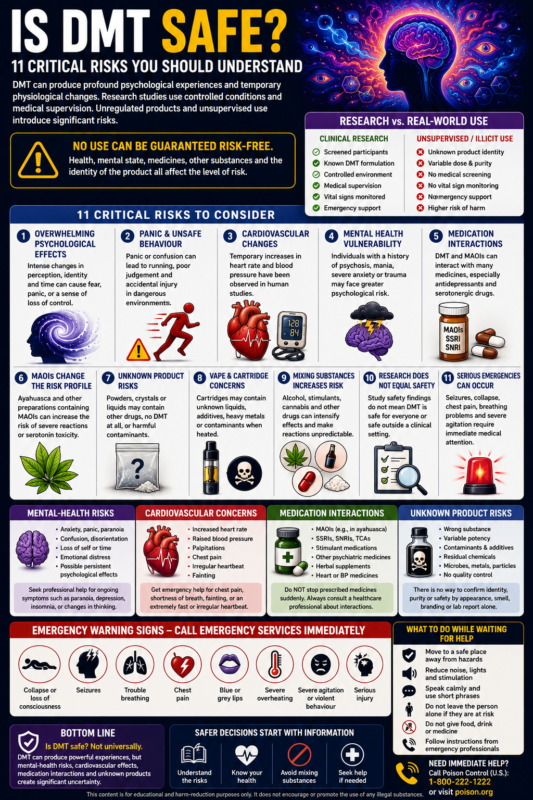
Is DMT Safe? 11 Critical Risks You Should Understand
Is DMT safe is not a question that can be answered with a simple yes. DMT can produce rapid and profound changes in perception, awareness and emotional state. Research settings may reduce certain risks through participant screening, verified formulations, controlled administration and medical supervision, but these protections are absent when an unidentified powder, cartridge, liquid or plant preparation is involved.
Possible concerns include panic, confusion, cardiovascular changes, unsafe behaviour, medication interactions, contaminated products and delayed treatment after an unexpected reaction. The actual level of risk differs according to a person’s health, mental-health history, medicines, other substances and the identity of the product.
This educational guide examines whether DMT is safe by comparing controlled research with unsupervised and illicit-market exposure. It does not provide instructions for obtaining, preparing, dosing or consuming DMT.
Table of Contents
- Is DMT Safe?
- 11 Critical DMT Safety Concerns
- Mental-Health Risks
- Cardiovascular Concerns
- Medication Interactions
- Unknown Product and Contamination Risks
- Why Clinical Research Is Different
- What Medical Supervision Can and Cannot Do
- Who May Face Greater Risk?
- Emergency Warning Signs
- Frequently Asked Questions
Is DMT Safe?
The responsible answer to is DMT safe is that no use can be guaranteed risk-free. Carefully controlled studies suggest that screened participants can sometimes receive known DMT formulations without serious complications, but these findings apply to specific research conditions.
They do not prove that DMT is safe for:
- People with heart or blood-pressure conditions
- People with a history of psychosis or mania
- People taking interacting medicines
- Products with unknown identity or concentration
- Vape cartridges containing unidentified liquids
- Plant preparations containing additional active compounds
- Situations without medical monitoring
- Use involving alcohol or other drugs
For general information about effects, duration, forms and legal status, visit our complete DMT guide.
11 Critical DMT Safety Concerns
1. DMT Can Produce Overwhelming Psychological Effects
DMT may cause intense changes in perception, time, identity and environmental awareness. Some people may experience fear, panic, paranoia or a sense that they are dying.
A brief experience can still be psychologically overwhelming. Duration alone does not determine whether an experience is safe.
2. Panic Can Lead to Dangerous Behaviour
A frightened or disoriented person may attempt to run, leave a secure location, resist assistance or enter an unsafe area.
Possible environmental dangers include:
- Traffic
- Stairs and balconies
- Open water
- Fire and hot surfaces
- Broken glass
- Sharp objects
- Conflict with other people
Some DMT-related harm may therefore result from impaired awareness and judgement rather than direct toxicity alone.
3. Heart Rate and Blood Pressure May Increase
Controlled human research has documented temporary increases in heart rate and blood pressure after DMT administration. The significance of these changes can differ according to the formulation, exposure and individual health.
Chest pain, fainting, severe breathlessness or an irregular heartbeat should not be dismissed as an ordinary psychedelic reaction.
4. Mental-Health History May Affect Risk
People with a personal or family history of psychosis, bipolar disorder, mania or severe anxiety may face additional uncertainty.
Intense psychedelic experiences may worsen paranoia, disorganised thinking or emotional instability in vulnerable individuals.
5. Medication Interactions Are Not Fully Understood
DMT acts on serotonin-related systems, while some DMT-containing preparations also involve monoamine oxidase-inhibiting compounds. These factors create potential interaction concerns with antidepressants and other serotonergic medicines.
Research on psychedelic drug interactions remains incomplete. A lack of documented complications does not prove that a combination is safe.
6. Monoamine Oxidase Inhibitors Change the Risk Profile
Monoamine oxidase inhibitors can alter the metabolism and duration of certain tryptamines. This is particularly relevant to ayahuasca and other preparations containing harmala alkaloids.
Combining monoamine oxidase inhibition with other serotonergic medicines can increase concern about severe reactions, including serotonin toxicity.
7. Illicit Products May Not Contain What Their Labels Claim
Powders, crystals, liquids and cartridges represented as DMT may contain another substance, several drugs, contaminants or no DMT at all.
Colour, texture, smell, branding and packaging cannot confirm chemical identity.
Read what DMT looks like to understand why visual identification is unreliable.
8. Vape Products Add Respiratory and Hardware Concerns
A vape cartridge may expose a person to unknown carrier liquids, additives, metals, particles and substances produced during heating.
The device may also leak, overheat or contain counterfeit components. Professional-looking packaging does not establish what is inside.
Our DMT pen guide explains why cartridge appearance and branding cannot verify safety.
9. Mixing Substances Makes Reactions Less Predictable
Alcohol, stimulants, sedatives, cannabis and other psychedelics may alter coordination, heart rate, breathing, consciousness or emotional stability.
When several substances are involved, symptoms cannot safely be attributed to DMT alone.
10. Clinical Research Does Not Prove Street Products Are Safe
Research participants may undergo medical and psychiatric screening before receiving a documented formulation in a monitored environment.
Researchers may also track blood pressure, heart rate, psychological reactions and other safety measures. These safeguards are not available with an unknown street product.
11. Serious Emergencies Can Occur
Seizures, collapse, inability to awaken, breathing difficulty, chest pain, dangerous agitation and severe overheating require immediate medical attention.
Do not wait for the presumed psychedelic effects to end when serious symptoms are present.
Mental-Health Risks
When considering is DMT safe, mental health is one of the most important factors. DMT can temporarily change a person’s interpretation of themselves and their surroundings so profoundly that ordinary reassurance may become difficult to understand.
Possible psychological reactions include:
- Anxiety
- Panic
- Paranoia
- Confusion
- Disorientation
- Fear of dying
- Loss of ordinary self-awareness
- Difficulty communicating
- Distorted awareness of danger
- Emotional distress after the experience
Some people may continue to experience anxiety, disturbed sleep, unusual perceptions or difficulty processing the experience after the acute effects have ended.
Professional assessment is important when symptoms include persistent paranoia, several nights without sleep, severe mood elevation, suicidal thoughts, ongoing hallucinations or inability to manage ordinary responsibilities.
Cardiovascular Concerns
DMT has produced temporary increases in heart rate and blood pressure in controlled human studies. Although monitored participants may tolerate these changes, research volunteers are often selected according to specific health criteria.
Someone with hypertension, heart disease, a previous stroke, an abnormal heart rhythm or another cardiovascular condition may not have the same risk profile as a healthy research participant.
Seek urgent medical assistance for:
- Chest pain
- Fainting
- Severe shortness of breath
- An irregular or extremely rapid heartbeat
- Blue or grey lips
- Sudden weakness
- Severe headache with neurological symptoms
Anxiety can cause palpitations and chest tightness, but it is unsafe to assume that every cardiovascular symptom is caused by panic.
DMT Medication Interactions
Medication interactions are an important reason why the question is DMT safe cannot be answered without considering individual circumstances.
Potentially relevant medicine categories may include:
- Monoamine oxidase inhibitors
- Selective serotonin reuptake inhibitors
- Serotonin–norepinephrine reuptake inhibitors
- Tricyclic antidepressants
- Stimulant medicines
- Other psychiatric medicines
- Heart or blood-pressure medicines
- Herbal products affecting serotonin
Evidence for many specific combinations is limited, and different DMT preparations may carry different interaction profiles.
Ayahuasca is especially relevant because it normally includes monoamine oxidase-inhibiting compounds in addition to DMT. This may create interaction concerns that do not apply in exactly the same way to DMT alone.
Do not stop a prescribed medicine without guidance from a qualified clinician. Abruptly discontinuing psychiatric or cardiovascular medication can itself be dangerous.
Unknown Product and Contamination Risks
Illicit-market contamination creates a major difference between clinical research and unsupervised exposure.
An unregulated product may contain:
- Another tryptamine
- A stimulant
- A sedative
- Several psychoactive substances
- Residual chemicals
- Unknown vape additives
- Metals or particles
- Microbial contamination
- An uneven concentration
- No DMT at all
A seller’s claim, product photograph or laboratory document may not correspond to the exact material in someone’s possession.
Testing one sample also does not guarantee that every part of a mixture, cartridge or later batch is identical.
Why Clinical DMT Research Is Different
Clinical DMT research is designed to reduce avoidable uncertainty. Depending on the study, safeguards may include:
- Medical screening
- Psychiatric screening
- Exclusion of higher-risk participants
- Known chemical identity
- Measured formulations
- Controlled storage
- Trained staff
- Monitoring of heart rate and blood pressure
- Prepared emergency procedures
- Follow-up assessments
These measures do not make research completely risk-free. They help researchers identify, manage and document potential complications.
When online discussions claim that studies prove DMT is safe, they often overlook the selection criteria and supervision used in those studies.
What Medical Supervision Can and Cannot Do
Medical supervision may allow changes in vital signs, distress and unexpected symptoms to be recognised earlier. Staff may also protect participants from environmental injury and respond to emergencies.
However, supervision cannot guarantee:
- A comfortable psychological experience
- No increase in blood pressure or heart rate
- No panic or confusion
- No delayed emotional effects
- No previously unknown individual vulnerability
Clinical supervision reduces certain risks; it does not transform DMT into a universally safe substance.
Who May Face Greater Risk?
Risk cannot be calculated accurately for every individual, but greater concern may apply to people with:
- Heart disease
- Uncontrolled high blood pressure
- A previous stroke
- Abnormal heart rhythms
- A history of psychosis
- Bipolar disorder or mania
- Severe anxiety or panic disorder
- Pregnancy
- Multiple prescription medicines
- Recent use of several substances
People using an unknown product also face uncertainty that cannot be resolved by appearance, branding or another person’s experience.
When to Call Emergency Services
Call emergency services immediately if someone who may have taken DMT or another unknown substance:
- Collapses or loses consciousness
- Has a seizure
- Cannot be awakened
- Has trouble breathing
- Experiences chest pain
- Develops blue or grey lips
- Shows severe overheating
- Becomes dangerously agitated or violent
- Threatens self-harm or harm to others
- Suffers a serious injury
- May have taken multiple substances
While waiting for help:
- Move the person away from traffic, fire, water and heights when safe.
- Reduce loud noise and unnecessary stimulation.
- Speak calmly using short sentences.
- Do not leave an unconscious person alone.
- Do not force food, drink or medicine.
- Do not induce vomiting.
- Follow instructions from emergency professionals.
In the United States, contact Poison Control for immediate exposure guidance. People elsewhere should contact their local poison centre or emergency service.
Frequently Asked Questions
Is DMT safe for everyone?
No. Individual health, mental-health history, medication use, other substances and product identity can all change the risks.
Is DMT safe in clinical research?
Some screened participants have received DMT under medical supervision without serious complications. This does not mean that DMT is risk-free or safe for everyone.
Can DMT affect the heart?
Yes. Controlled studies have reported temporary increases in heart rate and blood pressure.
Can DMT cause mental-health problems?
DMT can produce anxiety, panic, paranoia and confusion. Persistent or severe symptoms require professional assessment.
Can DMT interact with antidepressants?
Potential interactions depend on the medicine and DMT preparation. Preparations containing monoamine oxidase inhibitors create particular concerns with serotonergic medicines.
Are DMT vape cartridges safe?
The safety of an unregulated cartridge cannot be confirmed by its appearance or packaging. It may contain unknown liquids, additives, contaminants or another drug.
Does a laboratory report prove that DMT is safe?
No. A report may describe one tested sample but cannot guarantee safe use, safe hardware, even distribution or individual medical suitability.
Is natural DMT safer than synthetic DMT?
Natural origin does not guarantee safety. Plant preparations may contain several active compounds, variable concentrations, contaminants or monoamine oxidase inhibitors.
Can DMT cause seizures or unconsciousness?
Seizure, collapse or inability to awaken should be treated as a medical emergency, regardless of the substance believed to be involved.
When should emergency help be requested?
Call immediately for seizure, collapse, breathing difficulty, chest pain, severe overheating, dangerous behaviour or loss of consciousness.
Final Thoughts
Is DMT safe has no universal yes-or-no answer, but DMT should not be described as harmless. Mental-health reactions, cardiovascular changes, medication interactions, environmental injuries and unknown-product contamination all contribute to risk.
Clinical research takes place under carefully controlled conditions that cannot be assumed to apply to illicit powders, cartridges, liquids or plant preparations.
This article is provided for education, poisoning prevention and harm reduction. It does not encourage the purchase, possession, preparation or use of controlled substances.
