
Jun
DMT Cart: 10 Critical Facts About Appearance and Risks
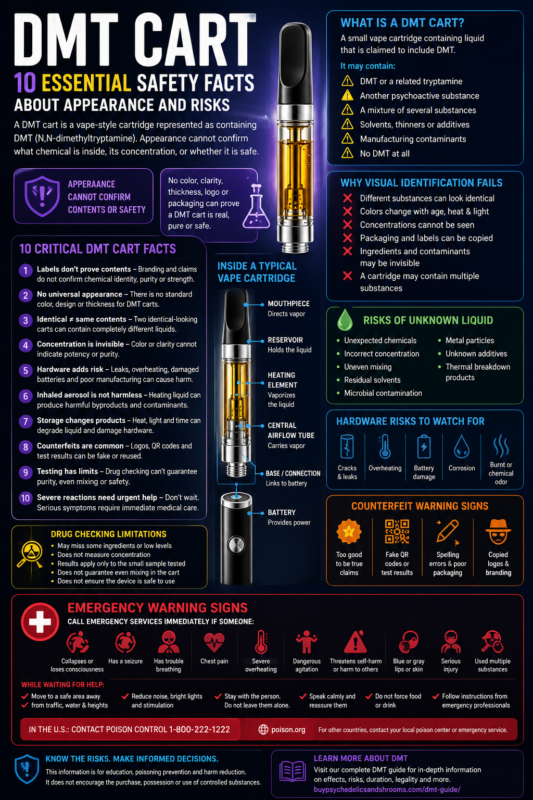
A DMT cart is an informal term for a vape-style cartridge represented as containing N,N-dimethyltryptamine. These cartridges may resemble ordinary nicotine or cannabis vape products, but their appearance cannot confirm what chemical is inside, its concentration or whether contamination has occurred.
Unregulated cartridges may contain an unknown liquid, a related tryptamine, several substances, inactive ingredients or no DMT at all. Hardware quality may also vary, creating additional concerns involving leaks, overheating, metals, damaged batteries and inhaled contaminants.
This guide explains what a DMT cart means, how cartridges are generally constructed, why visual identification is unreliable and which symptoms require urgent medical help. It does not provide instructions for buying, filling, modifying, operating or consuming a controlled substance.
Table of Contents
- What Is a DMT Cart?
- 10 Critical DMT Cart Facts
- What Does a DMT Cart Look Like?
- General Cartridge Components
- Can a DMT Cart Be Identified Visually?
- Risks of Unknown Cartridge Liquid
- Cartridge and Hardware Risks
- Counterfeit Branding and Labels
- Drug-Checking Limitations
- Possible Health Risks
- Emergency Warning Signs
- Frequently Asked Questions
What Is a DMT Cart?
A DMT cart is usually described as a small cartridge containing liquid that is claimed to include DMT. It may be attached to or incorporated into an electronic vaping device.
The term describes the product’s claimed purpose and physical format. It is not a scientific classification or proof of chemical identity.
A cartridge represented as DMT may contain:
- N,N-dimethyltryptamine
- A related but chemically different tryptamine
- Another psychoactive substance
- A mixture of several substances
- Solvents or thinning agents
- Flavoring or coloring materials
- Manufacturing contaminants
- No DMT at all
Readers seeking broader scientific and safety information can visit our complete DMT guide.
10 Critical DMT Cart Facts
1. A Cartridge Label Does Not Confirm Its Contents
A label containing the letters “DMT” does not prove that a cartridge contains dimethyltryptamine. Labels and packaging can be printed, copied or applied to unrelated products.
Even professional-looking branding does not establish:
- Chemical identity
- Purity
- Concentration
- Manufacturing quality
- Storage history
- Absence of contamination
2. DMT Carts Have No Universal Appearance
There is no regulated color, cartridge shape, oil thickness, logo or packaging style that defines genuine DMT carts.
Products may appear clear, yellow, amber, brown or another color. These differences can result from ingredients, impurities, aging, heat exposure, lighting or photography.
Color should never be treated as proof of authenticity or potency.
3. Similar Cartridges May Contain Different Chemicals
Two cartridges can look identical while containing completely different liquids. Empty cartridge hardware and packaging can be obtained from many sources and filled by unrelated individuals.
The same logo may therefore appear on products with different chemical compositions.
4. Cartridge Concentration Cannot Be Seen
The amount of an active chemical cannot be determined by looking at the liquid. A darker liquid is not automatically stronger, and a clearer liquid is not necessarily purer or safer.
Thickness and bubble movement are also unreliable indicators because they can be influenced by temperature and other ingredients.
5. Hardware Adds Risks Beyond the Drug Itself
A DMT vape cartridge combines an unknown chemical product with electronic hardware. Possible hardware problems include:
- Leaking liquid
- Cracked cartridges
- Overheating components
- Damaged batteries
- Degraded seals
- Metal exposure
- Burnt internal material
- Electrical malfunction
These concerns exist independently of whether DMT is present.
6. Inhaled Aerosol Is Not Simply Water Vapor
Vape devices create an aerosol by heating liquid. That aerosol may contain the active substance along with solvents, particles, degradation products or materials released from the device.
The lungs process inhaled substances differently from substances entering through the digestive system. A material that is safe in another context is not automatically safe to inhale.
7. Storage Conditions May Change the Product
Heat, light, air and time can affect cartridge liquid and hardware. A cartridge may look normal despite chemical degradation or damage to internal components.
Visual inspection cannot reveal:
- How old the cartridge is
- Whether it was exposed to extreme heat
- Whether it leaked previously
- Whether the liquid degraded
- Whether the device was refilled
8. Counterfeit Cartridges Are Difficult to Recognize
A counterfeit product may reproduce logos, labels, QR codes and packaging associated with another company or seller. Online photographs can also be copied from unrelated products.
A QR code may lead to a convincing-looking website without proving that the liquid in the cartridge was analyzed.
9. Drug Checking Cannot Guarantee Safety
Some testing approaches may offer limited information about particular chemical groups, but they do not guarantee that a cartridge is pure, consistently mixed or safe.
A test may:
- Fail to identify every ingredient
- Miss low-level contaminants
- Confirm a substance without measuring concentration
- Produce confusing results with mixtures
- Apply only to the small sample examined
This article does not provide instructions for opening cartridges or conducting chemical tests.
10. Severe Symptoms Require Immediate Help
Do not delay medical assistance while trying to identify a cartridge online. Serious symptoms matter more than the product’s appearance or claimed ingredients.
A person may have been exposed to another chemical, several substances or contaminants requiring different medical treatment.
What Does a DMT Cart Look Like?
A product described as a DMT cart may resemble cartridges used for nicotine, cannabis concentrates or other vape liquids.
Common visible features can include:
- A transparent or tinted reservoir
- A mouthpiece
- Metal or ceramic internal components
- A threaded or proprietary connection
- Clear, yellow, amber or darker liquid
- Printed labels or symbols
- A disposable pen-style outer casing
These are general characteristics of vape hardware. None confirms that DMT is present.
Appearance cannot establish whether a cartridge contains N,N-DMT, 5-MeO-DMT, another compound or an unrelated liquid. Related substances should not be treated as interchangeable merely because their names include “DMT.”
General DMT Vape Cartridge Components
At a general level, a cartridge may include a liquid reservoir, heating component, airflow path, mouthpiece, seals and an electrical connection. Disposable products may combine the cartridge and battery in one unit.
| Component | General Function | Potential Concern |
|---|---|---|
| Reservoir | Holds the liquid | Unknown contents, leaks or cracked material |
| Heating component | Heats liquid to create aerosol | Overheating or material degradation |
| Mouthpiece | Directs aerosol | Contamination or physical damage |
| Seals | Reduce leakage | Degradation or poor manufacturing |
| Electrical connection | Connects to the power source | Compatibility and overheating problems |
| Battery | Supplies electrical power | Fire, overheating or physical damage |
This overview is provided to explain why cartridge risks involve both the liquid and the device. It is not an operating or modification guide.
Can a DMT Cart Be Identified Visually?
No. A DMT cart cannot be reliably identified by color, thickness, bubbles, packaging, logo or cartridge design.
Visual identification fails because:
- Empty cartridges can be refilled.
- Packaging can be copied.
- Different liquids may have similar colors.
- Lighting changes how liquids appear in photographs.
- Ingredients and contaminants may be invisible.
- Concentration cannot be observed.
- A cartridge may contain several substances.
Someone comparing an unknown cartridge with photographs online may develop false confidence. A visual match is not a laboratory result.
Risks of Unknown Cartridge Liquid
The liquid in an unregulated cartridge may have an uncertain chemical composition. It may include ingredients intended to alter thickness, stability, flavor, appearance or vapor production.
Possible concerns include:
- Unexpected psychoactive substances
- Incorrect concentration
- Uneven mixing
- Residual production chemicals
- Microbial contamination
- Metal particles
- Unknown solvents
- Thermal breakdown products
The CDC warns that e-cigarette aerosol can contain harmful and potentially harmful substances, including tiny particles and toxic chemicals. This general vaping evidence does not establish the contents of a particular DMT cartridge, but it demonstrates why inhaled aerosol should not be assumed harmless.
For broader information about reported psychological and physical reactions, read our guide to DMT effects.
DMT Cartridge Hardware Risks
A cartridge may cause problems even before considering the claimed psychoactive ingredient.
Hardware-related warning signs may include:
- Visible cracks
- Leaking liquid
- Battery swelling
- Excessive heat
- A burnt or chemical odor
- Damaged electrical contacts
- Corrosion
- Loose internal parts
Do not handle a damaged or overheating battery unnecessarily. Move away from a device that is smoking, sparking or becoming dangerously hot and contact local emergency or hazardous-waste services when appropriate.
Cartridge liquid should also be kept away from children and animals. Small devices and colorful liquids may be mistaken for ordinary consumer products.
Counterfeit Branding and Misleading Claims
Cartridge marketing may include claims such as:
- Laboratory tested
- Pure DMT
- Medical grade
- Pharmaceutical quality
- Natural ingredients
- Precise concentration
- Authentic batch
These statements require reliable supporting evidence. A screenshot, QR code or seller-provided certificate may be altered, reused or associated with a different sample.
Statements such as “natural” or “plant derived” do not establish safety. Natural chemicals can be powerful, toxic or dangerous when concentrated or inhaled.
DMT Cart Drug-Checking Limitations
Professional laboratory analysis can provide more information than visual inspection, but it still has limitations.
A laboratory result may identify substances in the submitted sample, yet it may not prove that:
- Every portion of the cartridge is evenly mixed.
- Another cartridge from the same package is identical.
- The product remained stable after testing.
- The hardware will function safely.
- The substance is medically safe for a particular person.
Drug checking is therefore a risk-information tool, not a guarantee of safety.
Possible DMT Cart Health Risks
A DMT cart may involve risks associated with a powerful psychedelic, an unknown formulation and inhaled aerosol.
Possible concerns include:
- Severe anxiety or panic
- Confusion and disorientation
- Loss of awareness of the surroundings
- Falls or accidental injury
- Increased heart rate
- Blood-pressure changes
- Nausea or dizziness
- Breathing irritation
- Chest discomfort
- Exposure to an unexpected substance
- Medication interactions
- Persistent psychological distress
Effects can differ according to the actual chemical, concentration, individual health, medications and other substances involved.
Our article explaining how long DMT lasts discusses why duration varies across different formulations and research contexts.
Emergency Warning Signs
Call emergency services immediately if someone who may have been exposed to a DMT cart or unknown vape product:
- Collapses or loses consciousness
- Has a seizure
- Has difficulty breathing
- Cannot be awakened
- Experiences chest pain
- Shows severe overheating
- Becomes dangerously agitated
- Develops blue or gray lips
- Threatens self-harm or harm to others
- Suffers a serious injury
- May have used several substances
Do not wait for an assumed psychedelic effect to end when serious symptoms are present.
While waiting for professional help:
- Move the person away from traffic, water and heights when safe.
- Reduce noise, bright lights and unnecessary stimulation.
- Speak calmly and avoid confrontation.
- Do not leave an unconscious person alone.
- Do not force food or drink.
- Do not encourage vomiting.
- Follow instructions from emergency professionals.
In the United States, contact Poison Control for immediate guidance. People elsewhere should contact their local poison center or emergency service.
Frequently Asked Questions
What is a DMT cart?
A DMT cart is an informal term for a vape cartridge represented as containing dimethyltryptamine. The name does not verify what chemical is actually inside.
What do DMT carts look like?
They may resemble ordinary vape cartridges containing clear, yellow, amber or darker liquid. There is no universal design or color.
Can a DMT cart be identified visually?
No. Color, thickness, bubbles, packaging and logos cannot establish chemical identity, concentration or purity.
Does darker liquid mean a stronger DMT cart?
No. Color is affected by many factors and cannot reliably indicate concentration or potency.
Can two identical-looking cartridges contain different substances?
Yes. Identical cartridge hardware and packaging can be filled with completely different liquids.
Does a QR code prove that a cartridge was laboratory tested?
No. A QR code may lead to copied, misleading or unrelated information. It does not prove that the specific cartridge was tested.
Can cartridge hardware introduce contaminants?
Potential concerns include metals, particles, damaged seals, leaks, overheating and material degradation.
Can drug checking prove a DMT cart is safe?
No. Testing may provide limited information about a sample but cannot guarantee purity, even distribution, safe hardware or individual medical safety.
Are DMT carts legal?
DMT is controlled in many jurisdictions. Possession, importation, manufacture and supply may carry separate legal consequences.
When should emergency help be requested?
Call immediately for collapse, seizure, breathing difficulty, inability to awaken, chest pain, severe overheating or another serious reaction.
Final Thoughts
A DMT cart is a cartridge represented as containing dimethyltryptamine, but appearance cannot verify its contents. Similar-looking cartridges may contain different chemicals, concentrations or contaminants.
The liquid and the electronic hardware create separate layers of uncertainty. Labels, logos, color, viscosity and online photographs should never be treated as proof of identity or safety.
This article is provided for education, poisoning prevention and harm reduction. It does not encourage the purchase, possession, preparation or use of controlled substances.
