Jun
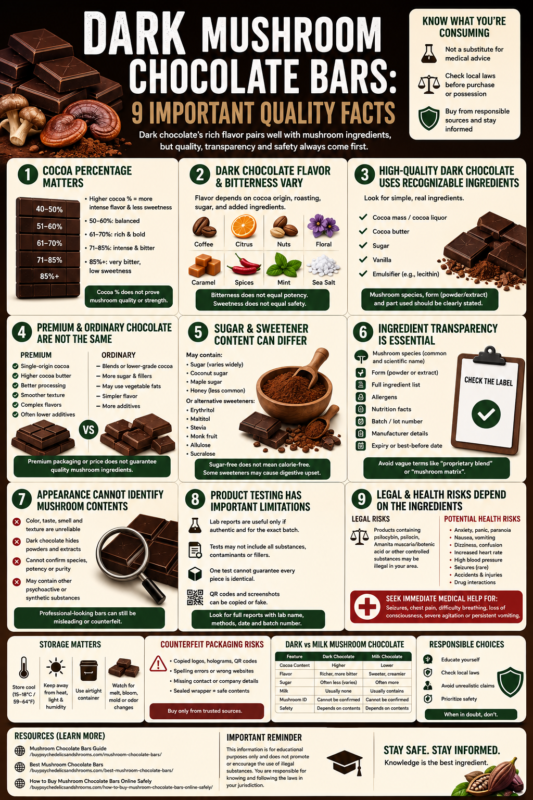
Dark Mushroom Chocolate Bars: 9 Important Quality Facts
Dark mushroom chocolate bars combine dark chocolate with ingredients marketed as mushroom powders, extracts or blends. Some products contain ordinary functional mushrooms, while others make psychoactive, psychedelic or vaguely worded “magic mushroom” claims.
The dark chocolate format is popular because its rich cocoa flavor can complement or conceal earthy and bitter ingredients. However, cocoa percentage, flavor and attractive packaging cannot establish which mushroom species is present or whether a label is accurate.
This guide explains nine important quality facts about dark mushroom chocolate bars, including cocoa percentage, bitterness, ingredient quality, sugar, manufacturer transparency, testing limitations and potential legal and health concerns.
The article is provided for food-safety and public-health education. It does not recommend psychoactive products or provide purchasing, preparation, dosing or consumption instructions.
Table of Contents
- What Are Dark Mushroom Chocolate Bars?
- Fact 1: Cocoa Percentage Matters
- Fact 2: Dark Chocolate Flavor and Bitterness Vary
- Fact 3: High-Quality Dark Chocolate Uses Recognizable Ingredients
- Fact 4: Premium and Ordinary Chocolate Are Not the Same
- Fact 5: Sugar and Sweetener Content Can Differ
- Fact 6: Ingredient Transparency Is Essential
- Fact 7: Appearance Cannot Identify Mushroom Contents
- Fact 8: Product Testing Has Important Limitations
- Fact 9: Legal and Health Risks Depend on the Ingredients
- Storage and Quality Changes
- Counterfeit Packaging and Misleading Claims
- Dark vs Milk Mushroom Chocolate Bars
- Frequently Asked Questions
What Are Dark Mushroom Chocolate Bars?
Dark mushroom chocolate bars are dark chocolate products marketed as containing one or more mushroom-derived ingredients.
The phrase can describe several different product categories:
- Dark chocolate containing lion’s mane
- Dark chocolate containing reishi
- Dark chocolate containing cordyceps
- Dark chocolate containing chaga
- Dark chocolate containing mixed functional mushrooms
- Products claiming psilocybin-producing mushroom ingredients
- Products using Amanita-related ingredients
- Products containing unidentified proprietary blends
These categories should not be treated as interchangeable. Functional mushroom products and products claiming psychoactive effects involve different ingredient, regulatory and health considerations.
For a broader introduction, read our complete mushroom chocolate bars guide.
Fact 1: Cocoa Percentage Matters
Cocoa percentage is one of the most visible characteristics used to compare dark mushroom chocolate bars.
The percentage usually refers to the combined amount of cocoa solids and cocoa butter in the chocolate. A higher percentage generally means there is less room for sugar, milk ingredients and other additions, although recipes vary.
| Cocoa Percentage | Typical Flavor | General Characteristics |
|---|---|---|
| 40%–50% | Mild and relatively sweet | May taste closer to semi-sweet chocolate |
| 51%–60% | Balanced sweetness and cocoa | Common in accessible dark chocolate |
| 61%–70% | Richer and more bitter | Stronger cocoa character |
| 71%–85% | Intense and less sweet | Often preferred by dark-chocolate enthusiasts |
| Above 85% | Very bitter and dry | May have a pronounced roasted aftertaste |
A higher cocoa percentage does not prove that dark mushroom chocolate bars contain better mushroom ingredients. It primarily describes the chocolate portion.
Cocoa percentage also does not confirm active-compound concentration, product purity or even ingredient distribution.
Fact 2: Dark Chocolate Flavor and Bitterness Vary
Not all dark mushroom chocolate bars have the same flavor. Cocoa origin, fermentation, roasting, sugar, vanilla, salt and added flavorings all influence the finished taste.
Dark chocolate may have natural flavor notes resembling:
- Coffee
- Caramel
- Red fruit
- Citrus
- Nuts
- Earth
- Smoke
- Spices
- Flowers
Manufacturers may also add mint, orange, coffee, sea salt, caramel, coconut or nut flavors.
Bitterness should not be treated as evidence that a dark chocolate bar is strong, authentic or rich in a particular mushroom compound. Bitterness may come from cocoa solids, roasted ingredients, coffee, botanical extracts or other additives.
Similarly, a sweet taste does not prove that a product is weak or free from psychoactive ingredients.
Explore more examples in our guide to mushroom chocolate bar flavors.
Fact 3: High-Quality Dark Chocolate Uses Recognizable Ingredients
High-quality dark chocolate often uses a relatively straightforward ingredient list.
Common ingredients include:
- Cocoa mass or cocoa liquor
- Cocoa butter
- Sugar
- Vanilla
- An emulsifier such as soy or sunflower lecithin
Additional ingredients may be used for flavor, texture or dietary requirements.
When evaluating dark mushroom chocolate bars, the label should identify both the chocolate ingredients and the mushroom ingredients clearly.
A more transparent label might state:
- The common mushroom name
- The scientific mushroom name
- Whether the ingredient is a powder or extract
- Which part of the mushroom was used
- Any carrier ingredients
- Allergens
- Manufacturer information
- Batch or lot number
Vague descriptions such as “sacred blend,” “mushroom matrix,” “magic formula” or “proprietary psychoactive blend” do not provide meaningful ingredient transparency.
Fact 4: Premium and Ordinary Chocolate Are Not the Same
Premium dark mushroom chocolate bars may claim to use higher-quality cocoa, better processing or more sophisticated flavor combinations.
Premium chocolate characteristics can include:
- Traceable cocoa origin
- Clearly stated cocoa percentage
- Real cocoa butter
- Single-origin cocoa
- Lower use of artificial flavorings
- Smoother texture
- Balanced sweetness
- Careful roasting and fermentation
Ordinary chocolate may use less expensive cocoa blends, more sugar, confectionery coatings or vegetable fats in place of some cocoa butter.
However, the word “premium” has no universal scientific meaning. It may be used primarily as a marketing term.
A luxury wrapper or high price does not prove that dark mushroom chocolate bars contain verified mushroom ingredients. Chocolate quality and mushroom-ingredient reliability must be assessed separately.
Fact 5: Sugar and Sweetener Content Can Differ
Dark chocolate generally contains less sugar than milk chocolate, but this is not always true.
Some dark mushroom chocolate bars contain substantial sugar to balance the bitterness of cocoa and mushroom ingredients.
Others use alternative sweeteners such as:
- Erythritol
- Maltitol
- Stevia
- Monk fruit
- Allulose
- Sucralose
Sugar-free does not necessarily mean carbohydrate-free or calorie-free.
Some sugar alcohols can cause digestive discomfort, including gas, cramping or diarrhea. People with diabetes or other metabolic conditions should review the complete nutrition label rather than relying on front-of-package claims.
Sweeteners can also mask bitterness and make sensory identification even less reliable.
Fact 6: Ingredient Transparency Is Essential
Ingredient transparency is among the most important quality indicators for dark mushroom chocolate bars.
A useful product label should disclose:
- Every chocolate ingredient
- The mushroom species
- The form of mushroom ingredient
- Flavorings
- Sweeteners
- Preservatives
- Caffeine or stimulants
- Allergens
- Storage instructions
- Manufacturer and distributor
- Batch number
- Expiry or best-before date
Common allergen concerns include milk, soy, peanuts, tree nuts, wheat, gluten, coconut and sesame.
Even dark chocolate marketed as dairy-free may contain traces of milk because of shared manufacturing equipment.
A company should also provide a verifiable business identity and contact method. An anonymous social-media account or encrypted message profile is not equivalent to a traceable food manufacturer.
Fact 7: Appearance Cannot Identify Mushroom Contents
Processed dark mushroom chocolate bars cannot usually be identified through visual examination.
Dark cocoa conceals the color, shape and texture of powdered ingredients. Manufacturers may also add flavorings, fillings and colorants that make identification even more difficult.
Appearance cannot confirm:
- Mushroom species
- Psilocybin content
- Amanita ingredients
- Synthetic psychoactive compounds
- Concentration
- Purity
- Even distribution
- Absence of contaminants
Smell and taste are also unreliable. Strong dark chocolate, mint, orange or coffee flavors can conceal unusual ingredients.
A bar that looks professional may still be counterfeit, incorrectly labeled or produced under uncontrolled conditions.
Fact 8: Product Testing Has Important Limitations
Laboratory testing can provide valuable information about dark mushroom chocolate bars, but only when the report is genuine and connected to the exact product batch.
A useful laboratory report should identify:
- The laboratory
- The exact product tested
- The batch or lot number
- The date of analysis
- The analytical method
- The compounds tested
- The measured results
- A verification method
A screenshot does not prove that a certificate is authentic. Reports can be altered, reused or linked to another batch.
A test may also cover only selected compounds. It may not examine:
- Heavy metals
- Pesticides
- Microbial contamination
- Allergens
- Residual solvents
- Every possible psychoactive substance
Testing one sample does not guarantee that every section of a bar contains an identical mixture.
Uneven distribution may occur when ingredients are not mixed or manufactured consistently.
Fact 9: Legal and Health Risks Depend on the Ingredients
The legal status of dark mushroom chocolate bars depends on what they contain and where they are located.
Bars containing ordinary culinary or functional mushrooms may be lawful when they comply with food and supplement regulations.
Products containing psilocybin, psilocin or other controlled substances may be prohibited. Restrictions can apply to:
- Possession
- Production
- Sale or supply
- Possession with intent to supply
- Importation
- Exportation
Decriminalization in a local area does not necessarily authorize commercial sale.
Potential adverse effects associated with unidentified or psychoactive mushroom products may include:
- Anxiety
- Panic
- Paranoia
- Confusion
- Altered perception
- Nausea
- Vomiting
- Dizziness
- Changes in heart rate
- Changes in blood pressure
- Loss of coordination
- Accidental injury
For authoritative background, consult the National Institute on Drug Abuse guide to psilocybin mushrooms, the DEA psilocybin fact sheet and the FDA investigation of illnesses involving mushroom-branded edibles.
Storage and Quality Changes
Storage conditions can affect the appearance, texture and flavor of dark mushroom chocolate bars.
Potential problems include:
- Melting and re-solidifying
- Fat bloom
- Sugar bloom
- Oxidation
- Flavor deterioration
- Filling separation
- Moisture damage
- Mold in moisture-rich products
Fat bloom can create grey or white streaks when cocoa butter separates and recrystallizes. Sugar bloom may develop when moisture dissolves surface sugar and leaves crystals after drying.
Bloom does not automatically mean that chocolate is moldy, but appearance alone cannot determine every safety issue.
Damaged wrappers, unusual odors, visible moisture, insects, mold or signs of tampering should be treated seriously.
Counterfeit Packaging and Misleading Claims
Counterfeit packaging is a significant concern for unregulated dark mushroom chocolate bars.
Copied packaging may reproduce:
- Logos
- Brand names
- Cartoon artwork
- Holographic labels
- QR codes
- Nutrition panels
- Laboratory-style certificates
Possible warning signs include spelling mistakes, inconsistent fonts, missing contact details and QR codes that lead to unrelated pages.
However, counterfeit packaging can also look polished and convincing.
A sealed wrapper proves only that the wrapper is closed. It does not prove who manufactured or filled the product.
For additional educational guidance, read how mushroom chocolate labels, sellers and safety claims should be evaluated.
Dark vs Milk Mushroom Chocolate Bars
| Feature | Dark Chocolate | Milk Chocolate |
|---|---|---|
| Cocoa flavor | Stronger and more bitter | Milder and creamier |
| Sugar | Often lower, but varies | Often higher |
| Milk ingredients | May be absent or present in traces | Usually present |
| Cocoa percentage | Generally higher | Generally lower |
| Mushroom identification | Cannot be confirmed visually | Cannot be confirmed visually |
| Safety | Depends on complete contents | Depends on complete contents |
Neither style is automatically safer. Chocolate type influences flavor and nutrition, not the reliability of mushroom-related claims.
See our comparison of the best mushroom chocolate bar styles and safety checks for additional context.
Frequently Asked Questions
What are dark mushroom chocolate bars?
Dark mushroom chocolate bars are dark chocolate products marketed as containing functional, psychoactive or unspecified mushroom-derived ingredients.
What cocoa percentage is best?
There is no universal best percentage. Lower percentages are generally sweeter, while higher percentages produce a stronger and more bitter cocoa flavor.
Does high cocoa content mean better mushroom quality?
No. Cocoa percentage describes the chocolate component and does not verify mushroom species, concentration or purity.
Why are mushroom ingredients combined with dark chocolate?
Dark chocolate has a strong flavor that pairs with earthy ingredients and may reduce the perception of bitterness.
Are dark mushroom chocolate bars sugar-free?
Not necessarily. Many contain sugar, while others use alternative sweeteners. The complete label should be checked.
Are dark chocolate mushroom bars dairy-free?
Some are dairy-free, but others contain milk or traces of milk from shared facilities.
Can appearance identify the mushroom?
No. Powdered or extracted ingredients cannot be identified reliably once mixed into dark chocolate.
Does a QR code prove laboratory testing?
No. QR codes may be copied, altered or connected to reports from another product or batch.
Can dark mushroom chocolate bars be counterfeit?
Yes. Packaging, logos, seals and laboratory claims may all be copied.
Are dark mushroom chocolate bars legal?
Legality depends on their contents and jurisdiction. Products containing controlled psychoactive compounds may be prohibited.
What are emergency warning signs?
Seek urgent medical help for seizures, chest pain, difficulty breathing, loss of consciousness, severe agitation, dangerous confusion or persistent vomiting.
Final Thoughts
Dark mushroom chocolate bars vary widely in cocoa percentage, flavor, sugar content, ingredient quality and labeling transparency.
High cocoa content and premium packaging may improve the chocolate experience, but they cannot verify mushroom identity, active compounds or product safety.
The most meaningful quality indicators include a complete ingredient list, clear allergen warnings, traceable manufacturer information, batch details and authentic laboratory documentation.
Consumers should also understand that dark mushroom chocolate bars marketed with psychoactive claims may involve serious health and legal risks.
Appearance, bitterness, price and online popularity should never replace transparent labeling and verifiable evidence.
This content is provided for educational purposes and does not promote or facilitate the purchase or use of illegal substances.
