Aug
Shrooms Visuals are among the most recognizable aspects of a psychedelic experience involving psilocybin mushrooms. People researching psilocybin often wonder what visual changes can occur, whether colors become more intense, why patterns may appear, and how perception can differ from ordinary waking consciousness.
The term Shrooms Visuals generally describes changes in visual perception that can occur after exposure to psilocybin. These changes can include alterations in color, patterns, movement, depth, shape, and the appearance of familiar surroundings. However, experiences vary substantially between individuals, and not everyone experiences the same visual effects.
Psilocybin is a naturally occurring psychedelic compound found in certain species of fungi. After entering the body, psilocybin is converted into psilocin, which interacts with serotonin receptors in the brain. Researchers believe these interactions contribute to changes in perception, cognition, mood, and sensory processing.
Understanding Shrooms Visuals therefore requires more than describing colorful patterns or unusual images. Visual effects can exist on a spectrum, ranging from subtle changes in brightness or texture to much more noticeable alterations in the appearance of objects and surroundings.
This guide explores the science behind Shrooms Visuals, common visual phenomena associated with psilocybin, why perception changes, and how visual effects differ from ordinary vision and other psychedelic experiences.
Table of Contents
- What Are Shrooms Visuals?
- How Psilocybin Can Change Visual Perception
- Changes in Colors and Brightness
- Patterns, Textures, and Geometry
- Movement and Visual Distortions
- Changes in Depth, Size, and Shape
- Closed-Eye Visuals
- Are Shrooms Visuals Hallucinations?
- What Influences Visual Effects?
- What Research Says
- Frequently Asked Questions
What Are Shrooms Visuals?
Shrooms Visuals are changes in visual perception associated with psilocybin-containing mushrooms. These changes can affect how colors, shapes, textures, movement, depth, and objects are perceived.
Some people describe subtle visual enhancement, while others report much more obvious perceptual changes. For example, ordinary textures may appear more detailed, colors may seem unusually vivid, or stationary patterns may appear to move or fluctuate.
Importantly, visual effects do not necessarily mean seeing completely imaginary objects. Psychedelic visual changes can occur while a person remains aware that the underlying environment is still present.
This distinction is useful when discussing Shrooms Visuals because the word “hallucination” can sometimes oversimplify what is happening. Psychedelics can modify the brain’s interpretation of sensory information without necessarily producing a complete replacement of external reality.
How Psilocybin Can Change Visual Perception
To understand Shrooms Visuals, it helps to understand how psilocybin interacts with the brain. Psilocybin itself is converted into psilocin, which interacts with several serotonin receptors, including the 5-HT2A receptor.
The serotonin system plays an important role in perception, cognition, mood, and sensory processing. By altering signaling within these systems, psilocin can change the way the brain processes incoming sensory information.
Researchers studying psychedelic states have found changes in communication between brain networks involved in perception and cognition. These changes may help explain why ordinary visual information can be interpreted differently during a psychedelic experience.
The result is that Shrooms Visuals are not simply an effect occurring inside the eyes. They involve changes in how the brain processes and interprets visual information.
Changes in Colors and Brightness
One commonly reported category of Shrooms Visuals involves changes in the perception of color and brightness. Colors may appear more vivid, saturated, or emotionally noticeable than they normally do.
People may also perceive differences in contrast or brightness. Familiar environments can therefore appear visually different even though the physical objects themselves have not changed.
These changes illustrate an important principle of psychedelic perception: the experience is influenced not only by the information entering the eyes but also by how the brain interprets that information.
Color enhancement can occur alongside other visual effects, including changes in texture, movement, and pattern recognition. The combination can make an ordinary environment appear unusually complex or visually dynamic.
Patterns, Textures, and Geometry
Another frequently discussed feature of Shrooms Visuals is the appearance or enhancement of patterns. Repeating shapes, geometric structures, textures, lines, and symmetrical forms may become more noticeable.
Patterns that are already present in the environment can sometimes appear unusually prominent. For example, textures on walls, floors, fabrics, plants, or natural surfaces may attract greater visual attention.
Some people also describe geometric forms that do not appear to be directly associated with a particular physical object. The precise nature and intensity of these experiences can vary significantly between individuals.
Researchers are interested in these phenomena because they provide an opportunity to study how the brain constructs visual perception. Rather than simply recording an image like a camera, the brain actively interprets sensory information and builds a perceptual representation of the surrounding world.
Movement and Visual Distortions
Another category of Shrooms Visuals involves changes in the perception of movement. Stationary objects may appear to shift, breathe, ripple, or subtly move even though their physical position has not changed.
These visual distortions can occur when the brain’s normal processing of edges, motion, depth, and contrast is altered. A surface that would normally appear completely static may therefore seem more dynamic during a psychedelic experience.
The intensity of these effects can vary substantially. Some people may notice only subtle movement in textures or patterns, while others may experience much more pronounced distortions.
Movement-related Shrooms Visuals can also interact with other perceptual changes. Colors, patterns, depth, and movement may appear to influence one another, creating an unusually dynamic visual experience.
Changes in Depth, Size, and Shape
Shrooms Visuals can also involve changes in how distance, size, shape, and spatial relationships are perceived. Objects may appear unusually close, distant, large, small, flat, or distorted.
Depth perception depends on multiple visual cues processed by the brain. These include perspective, relative size, motion, shading, and the relationship between objects. When psychedelic states alter visual processing, these cues may be interpreted differently.
As a result, a familiar room or outdoor environment can appear unfamiliar even when the physical surroundings have not changed.
These effects demonstrate why psychedelic visual experiences are better understood as changes in perception rather than simply changes in eyesight. The eyes continue receiving information, but the brain may process and interpret that information differently.
Closed-Eye Visuals
Not all Shrooms Visuals depend on looking at the external environment. Some people report visual experiences with their eyes closed, sometimes involving colors, patterns, shapes, or complex imagery.
Closed-eye visual experiences are particularly interesting from a neuroscience perspective because they demonstrate that visual experience does not require ordinary visual input from the surrounding environment.
The visual system remains active even when the eyes are closed. Memories, internal imagery, spontaneous neural activity, and other brain processes can contribute to visual experiences.
During a psychedelic state, changes in communication between brain systems may alter how these internally generated signals are experienced. The result can be imagery that feels unusually vivid or dynamic.
Are Shrooms Visuals Hallucinations?
The word “hallucination” is often used when discussing Shrooms Visuals, but it does not describe every type of psychedelic visual effect equally well.
A hallucination generally refers to perceiving something without an appropriate external sensory stimulus. Psychedelic visual effects can occur on a broader spectrum.
For example, a person might experience:
- More vivid colors
- Enhanced textures
- Moving patterns
- Distorted shapes
- Changes in depth perception
- Visual trails or motion effects
- Geometric imagery
- Complex closed-eye imagery
Some of these experiences involve changes to existing visual information rather than completely fabricated objects or scenes.
Understanding this distinction makes discussions of Shrooms Visuals more scientifically accurate. The visual effects associated with psilocybin can involve alterations in perception, interpretation, attention, and internally generated imagery.
What Influences Visual Effects?
The intensity and character of Shrooms Visuals can vary considerably between individuals. There is no single visual experience that applies universally to everyone who encounters psilocybin.
Researchers consider several factors when studying differences between psychedelic experiences:
- Individual biological differences
- Psychological state
- Expectations
- Environmental surroundings
- Previous psychedelic experiences
- Other substances or medications
- The amount of psilocybin present in the material
The surrounding environment can be particularly important because the brain continues interpreting sensory information throughout the experience. A familiar environment may therefore produce a different subjective experience from an unfamiliar or highly stimulating environment.
Personal expectations can also influence how unusual sensations are interpreted. This is one reason researchers commonly discuss the concepts of set and setting when studying psychedelic experiences.
Visual Effects and Emotional Experience
Shrooms Visuals do not occur independently from the rest of the psychedelic experience. Changes in visual perception can occur alongside changes in mood, thought patterns, attention, and emotional responses.
For example, a particular color, pattern, sound, or environment may feel unusually meaningful or emotionally significant. This does not necessarily mean that the visual information itself has changed physically. Instead, the brain’s interpretation and emotional response to the information may have changed.
This interaction between perception and emotion is one reason psychedelic experiences can feel highly immersive.
Researchers continue investigating how changes in sensory processing interact with changes in brain networks associated with attention, emotion, memory, and self-awareness.
What Research Says About Shrooms Visuals
Scientific research into Shrooms Visuals has helped researchers better understand how psilocybin changes perception. Rather than treating psychedelic visuals as a simple effect of the eyes, researchers examine how psilocybin influences communication between different brain systems involved in sensory processing, attention, and cognition.
Psilocybin is converted into psilocin in the body. Psilocin interacts with serotonin receptors, particularly the 5-HT2A receptor, which is strongly associated with the effects of classic psychedelics.
Brain-imaging research has reported changes in activity and connectivity during psychedelic states. These findings suggest that psychedelic visual experiences may involve changes in the way the brain organizes and interprets incoming sensory information.
This research helps explain why Shrooms Visuals can involve more than simply seeing brighter colors. Perception is an active process in which the brain combines sensory information with expectations, memories, attention, and other internal signals.
How the Brain Builds Visual Perception
To understand Shrooms Visuals, it helps to recognize that ordinary vision is already an active process. The brain does not simply receive a perfect representation of the outside world. Instead, it continuously interprets signals arriving from the eyes.
The brain uses information about edges, contrast, movement, color, depth, and context to construct a coherent representation of the environment.
When psilocybin alters communication between neural systems involved in perception and cognition, this normal process can change. Patterns may become more noticeable, visual boundaries may appear less stable, and ordinary objects can take on unusual perceptual qualities.
This provides a scientific framework for understanding Shrooms Visuals without assuming that every unusual visual experience represents a completely separate reality. The physical environment can remain unchanged while the brain’s interpretation of it changes.
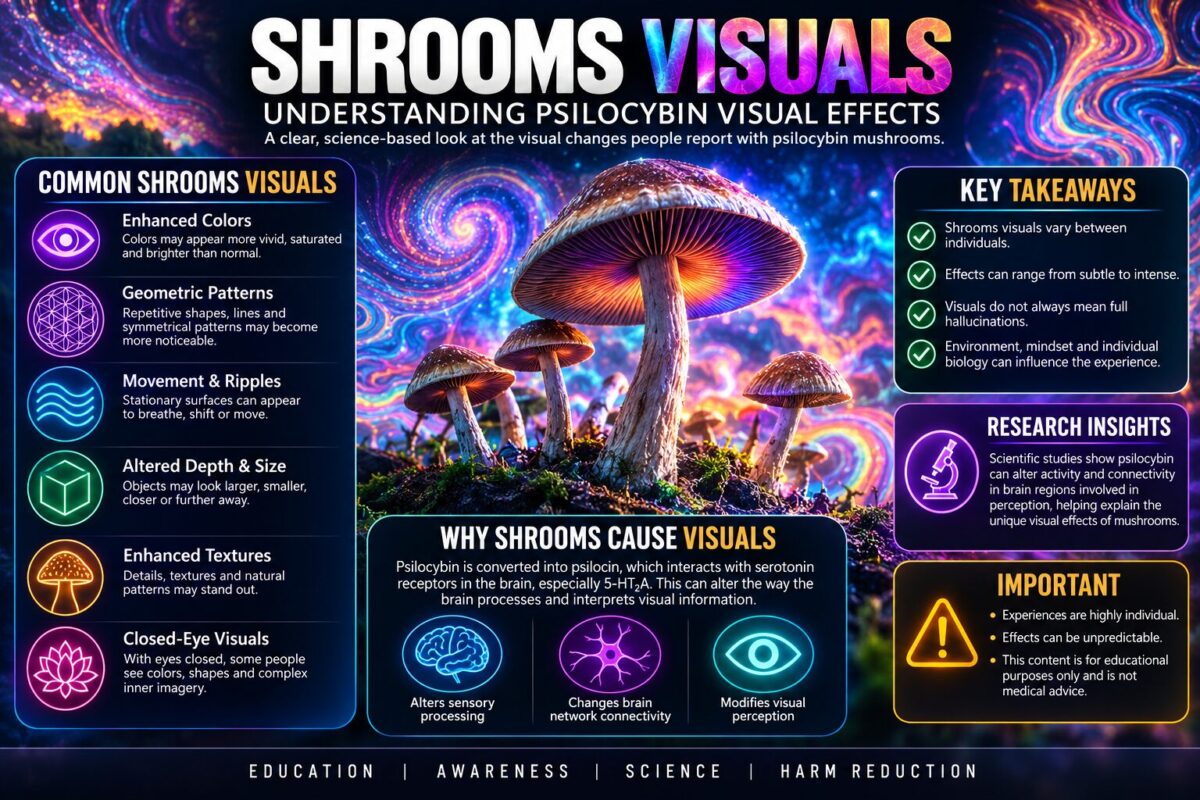
Common Types of Shrooms Visuals
There is considerable variation in psychedelic visual experiences, but several broad categories are frequently described in research and personal reports.
Enhanced Colors
Colors may appear more vivid, saturated, or visually prominent. Ordinary surroundings can therefore seem brighter or more visually stimulating.
Geometric Patterns
Repeating shapes, lines, symmetrical structures, and geometric patterns may become noticeable, particularly in textures and surfaces.
Surface Movement
Stationary surfaces may appear to ripple, breathe, shift, or move subtly despite remaining physically stationary.
Distorted Shapes
Objects can sometimes appear to change size, shape, distance, or proportions as visual processing becomes altered.
Closed-Eye Imagery
With the eyes closed, some people report colors, patterns, shapes, or more elaborate internally generated imagery.
These categories should not be interpreted as a checklist that everyone will experience. Shrooms Visuals can differ substantially between people and even between different experiences involving the same individual.
Shrooms Visuals vs LSD Visuals
Both psilocybin mushrooms and LSD are classified as classic psychedelics and can produce significant changes in visual perception. However, comparing their visual effects does not produce a simple rule about which substance creates stronger or more colorful experiences.
| Feature | Psilocybin | LSD |
|---|---|---|
| Drug class | Classic psychedelic | Classic psychedelic |
| Primary receptor system | Serotonin receptors, including 5-HT2A | Serotonin receptors, including 5-HT2A |
| Visual changes | Can include patterns, colors, movement, and altered depth | Can include patterns, colors, movement, and altered perception |
| Experience | Highly variable | Highly variable |
Individual experiences vary too much to reliably predict that one psychedelic will produce a particular visual style in every person. Expectations, environment, individual biology, and other factors can influence subjective perception.
For readers interested in the broader psychedelic experience, see our educational guide on LSD vs Mushrooms.
Why Visual Intensity Can Vary
The intensity of Shrooms Visuals can differ because psilocybin experiences are influenced by multiple interacting variables. There is no single visual pattern or intensity level that defines every experience.
Individual sensitivity, psychological state, surroundings, expectations, and the chemical characteristics of the mushrooms can all contribute to differences in subjective effects.
This variability is one reason scientific researchers rely on controlled studies rather than assuming that one person’s experience represents everyone else’s.
It is also why online descriptions of psychedelic visuals should be treated as personal accounts rather than guaranteed predictions.
Frequently Asked Questions About Shrooms Visuals
What are Shrooms Visuals?
Shrooms Visuals are changes in visual perception that can occur during a psilocybin experience. They may include changes in colors, patterns, textures, movement, depth, shapes, and internally generated imagery.
What do shrooms visuals look like?
There is no single appearance. Some people report more vivid colors and noticeable textures, while others describe geometric patterns, movement in stationary surfaces, changes in depth, or closed-eye imagery.
Do shrooms make you see things that are not there?
They can produce significant perceptual changes, but not every visual effect is a traditional hallucination. Some experiences involve changes to existing visual information, such as distorted shapes, enhanced patterns, or altered colors.
Why do shrooms cause visual effects?
Psilocybin is converted into psilocin, which interacts with serotonin receptors in the brain, including the 5-HT2A receptor. These interactions can alter sensory processing and communication between brain systems involved in perception.
Can shrooms cause geometric patterns?
Geometric patterns are among the visual phenomena reported during psychedelic experiences. Repeating lines, shapes, textures, and symmetrical structures may become particularly noticeable during an altered state of perception.
Can shrooms affect color perception?
Yes. Some people report that colors appear more vivid, saturated, bright, or visually prominent. These changes reflect altered perception rather than a physical change in the objects themselves.
Can you have visuals with your eyes closed?
Yes. Some people report closed-eye imagery involving colors, patterns, shapes, or more complex internally generated images. These experiences demonstrate that visual perception can involve internally generated brain activity as well as information entering through the eyes.
Are shrooms visuals the same as LSD visuals?
Psilocybin and LSD can both produce changes in visual perception because both are classic psychedelics that interact with serotonin systems. However, individual experiences vary considerably, so there is no universal visual profile for either substance.
Does everyone experience shrooms visuals?
No. Visual effects vary between individuals and can be influenced by biological differences, psychological state, expectations, surroundings, and other factors. Some people may experience relatively subtle visual changes while others report more pronounced effects.
Conclusion
Shrooms Visuals are a broad category of perceptual changes associated with psilocybin experiences. They can involve vivid colors, enhanced textures, geometric patterns, apparent movement, altered depth, distorted shapes, and closed-eye imagery.
These effects are connected to the way psilocybin is converted into psilocin and interacts with serotonin receptors in the brain. Research suggests that psychedelic states can alter communication between neural systems involved in perception, attention, cognition, and sensory processing.
Importantly, Shrooms Visuals do not look identical for everyone. Some people may notice subtle changes in color or texture, while others may experience more complex perceptual alterations. Personal reports therefore should not be treated as universal predictions.
Research into psychedelic perception continues to develop. By studying how psilocybin changes sensory processing and brain connectivity, scientists are gaining broader insight into how the brain constructs our everyday visual experience.
For readers interested in related topics, explore our guides on How Long Do Shroom Trips Last?, Shrooms and Alcohol, and Shrooms and Weed.
Related Mushroom & Psychedelic Guides
- How Long Do Shroom Trips Last?
- How Long Does a High on Shrooms Last?
- Shrooms and Alcohol
- Shrooms and Weed
- Mushroom Pills
- LSD vs Mushrooms
- What Are Hallucinogens?
Authoritative References
PubMed — Peer-Reviewed Research
National Institute on Drug Abuse — Psychedelic and Dissociative Drugs
