
Aug
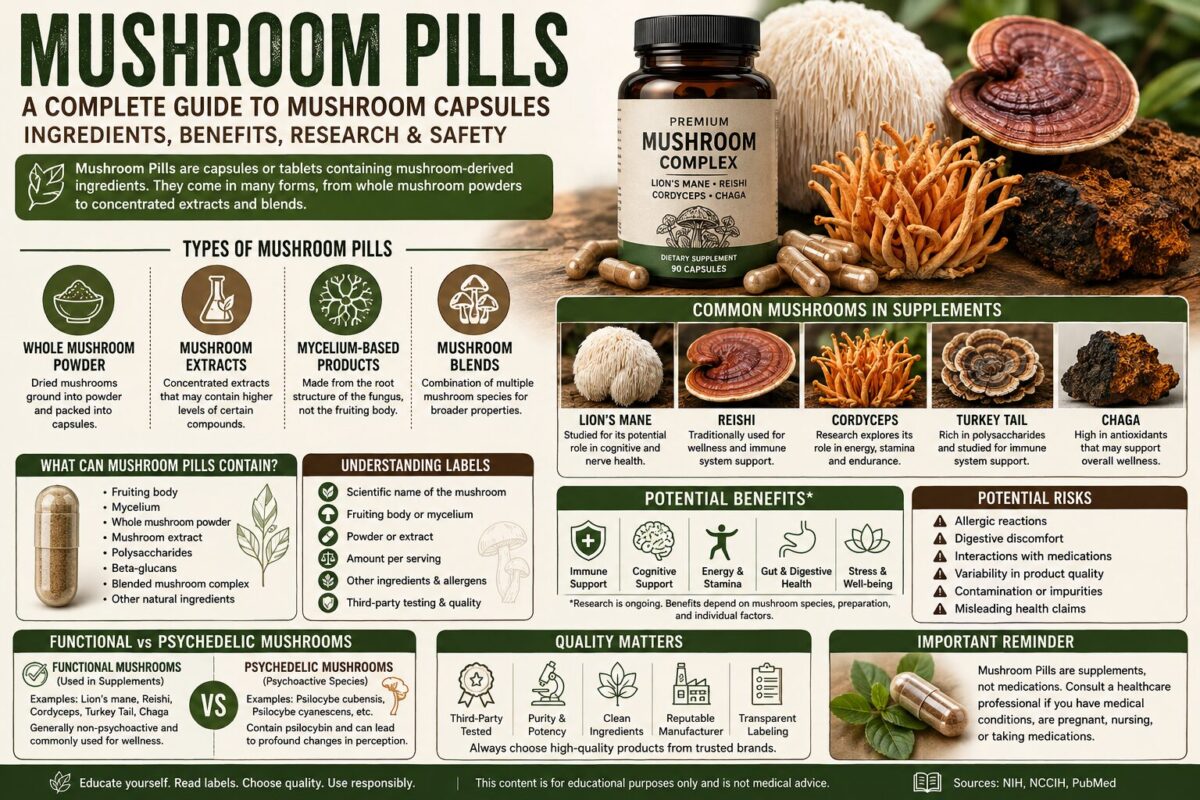
Mushroom Pills are capsules or tablets containing mushroom-derived ingredients, but the term can describe several very different types of products. Some contain powdered whole mushrooms, while others use concentrated mushroom extracts or blends of multiple mushroom species.
Understanding Mushroom Pills requires looking beyond the name on the label. A product described as a mushroom supplement may contain functional mushrooms such as lion’s mane, reishi, cordyceps, or turkey tail, while other products may be marketed using broader mushroom terminology. The actual ingredients and amounts should therefore be checked carefully.
Unlike fresh mushrooms, Mushroom Pills are processed into a concentrated or convenient capsule or tablet format. Processing can involve drying and grinding mushrooms into powder or extracting particular compounds before placing the resulting material into capsules.
This distinction is important because “mushroom supplement” is not a single scientific category. Different mushroom species contain different compounds, and products can vary significantly in their formulation, extraction methods, labeling, and quality.
This guide explains what Mushroom Pills are, the main types available, how mushroom powders differ from extracts, what labels can tell you, what scientific research says, and what consumers should consider when evaluating mushroom-based products.
For a broader introduction to mushrooms and psychedelic education, see our guide to What Are Hallucinogens? and our article on Shrooms Visuals.
Table of Contents
- What Are Mushroom Pills?
- Types of Mushroom Pills
- Whole Mushroom Powder
- Mushroom Extracts
- Common Mushroom Species
- What Can Mushroom Pills Contain?
- Understanding Mushroom Supplement Labels
- What Does Research Say?
- Quality and Product Considerations
- Potential Risks and Considerations
- Frequently Asked Questions
What Are Mushroom Pills?
Mushroom Pills are oral supplement products formulated with ingredients derived from mushrooms. They are commonly available as capsules, although some products may use compressed tablets or other formats.
The ingredients may come from the complete mushroom fruiting body, mushroom mycelium, mushroom powder, or an extract produced from mushroom material. Because these forms are not identical, two products carrying similar names can have substantially different formulations.
Some mushroom products are designed around a single species, while others combine several mushroom ingredients into one formulation. The intended purpose can also differ depending on the product, ranging from general nutritional supplementation to products marketed for specific wellness goals.
For this reason, the phrase Mushroom Pills describes a product format rather than one specific type of mushroom or one standardized ingredient.
Types of Mushroom Pills
There are several broad categories of Mushroom Pills. Understanding these categories makes it easier to interpret product labels and compare formulations.
| Type | Description |
|---|---|
| Whole mushroom powder | Dried mushroom material that has been processed into a powder. |
| Mushroom extract | Mushroom material processed to concentrate selected compounds or components. |
| Mycelium-based product | Uses the vegetative fungal network known as mycelium. |
| Mushroom blend | Combines ingredients from multiple mushroom species. |
These categories can overlap. A capsule may contain more than one type of mushroom ingredient, along with additional ingredients used for formulation or manufacturing.
Consequently, evaluating Mushroom Pills should involve reading the complete ingredient panel rather than relying solely on the product name or marketing language.
Whole Mushroom Powder
Some Mushroom Pills contain mushrooms that have been dried and ground into a powder. This approach provides a relatively straightforward way of placing dried mushroom material into a capsule.
Whole mushroom powders can contain a range of naturally occurring components found in the mushroom material. However, the nutritional and chemical composition can vary depending on the mushroom species, growing conditions, processing methods, and other factors.
The label may identify whether the ingredient comes from the fruiting body or another part of the fungus. This information can be useful when comparing different formulations.
Powdered products should not automatically be assumed to have the same composition as concentrated extracts. The two formats involve different processing approaches and may provide different concentrations of particular compounds.
Mushroom Extracts
Other Mushroom Pills use mushroom extracts. Extraction involves processing mushroom material in a way intended to separate or concentrate particular components.
Extraction methods can vary. Some products use water-based extraction, while others may use different processing techniques depending on the compounds the manufacturer intends to concentrate.
Because extraction changes the composition of the starting material, an extract should not automatically be considered equivalent to the same weight of whole mushroom powder.
This is one reason consumers should examine serving information, ingredient descriptions, extraction details, and other available product information rather than comparing products based solely on the number of capsules in a bottle.
Common Mushroom Species Used in Supplements
Different Mushroom Pills can contain different species, and each species has its own biological characteristics. Commonly encountered functional mushrooms include lion’s mane, reishi, cordyceps, turkey tail, and chaga.
Lion’s Mane
Lion’s mane (Hericium erinaceus) is a distinctive mushroom recognized for its long, tooth-like structures. It is commonly included in mushroom supplements and has attracted scientific interest because researchers have investigated compounds associated with neurological and other biological processes.
Reishi
Reishi mushrooms, including species in the Ganoderma genus, have a long history of traditional use. Modern research has investigated compounds such as polysaccharides and triterpenes found in reishi mushrooms.
Cordyceps
Cordyceps refers to several fungi associated with traditional medicinal practices and modern supplement products. Research has examined compounds produced by different cordyceps species and strains.
Turkey Tail
Turkey tail (Trametes versicolor) is named for its colorful, fan-shaped appearance. It has been studied extensively for compounds such as polysaccharide-based constituents.
Chaga
Chaga (Inonotus obliquus) is a fungus that grows primarily on certain trees in northern climates. Research has examined its antioxidant compounds and other biological constituents.
These examples demonstrate why the phrase Mushroom Pills should not be treated as if it identifies one standardized product. The mushroom species, fungal material, extraction process, and formulation can all differ.
What Can Mushroom Pills Contain?
The ingredients in Mushroom Pills depend on the formulation. A product may contain mushroom powder, an extract, mycelium, or a combination of mushroom-derived ingredients.
Some formulations may also contain non-mushroom ingredients used to create the capsule, improve stability, or combine multiple nutritional components.
Common label terms can include:
- Fruiting body
- Mycelium
- Whole mushroom powder
- Mushroom extract
- Polysaccharides
- Beta-glucans
- Blended mushroom complex
These terms describe different aspects of a product and should not automatically be interpreted as evidence that one formulation is superior to another.
When evaluating Mushroom Pills, the complete ingredient list provides more useful information than broad marketing terms such as “mushroom complex” or “advanced mushroom formula.”
Understanding Mushroom Supplement Labels
Reading the label is one of the most useful ways to evaluate Mushroom Pills. A detailed label can help identify the mushroom species, the type of fungal material used, and the amount provided per serving.
Useful information may include:
- The scientific name of the mushroom
- Whether the ingredient is fruiting body or mycelium
- Whether it is a powder or extract
- The amount per serving
- Other active ingredients
- Inactive ingredients
- Manufacturer information
- Lot or batch information
A product that clearly identifies its ingredients is generally easier to evaluate than one that relies primarily on vague proprietary terminology.
It is also important to distinguish between the amount of raw mushroom material and the amount of an extract. These figures may not represent equivalent quantities because extraction can alter the concentration of particular constituents.
Fruiting Body vs Mycelium
One recurring discussion surrounding Mushroom Pills concerns whether a product uses fruiting bodies or mycelium.
The fruiting body is the reproductive structure commonly recognized as the mushroom. Mycelium is the network of fungal filaments that grows through its substrate.
Both are genuine components of fungi, but their chemical composition can differ. The nutritional and biological characteristics of a supplement therefore depend partly on which fungal material was used.
Consumers should not assume that one category is universally better simply because of marketing claims. Instead, the relevant question is what the specific product contains and what evidence exists for the ingredients and claims being made.
Understanding Extract Claims
Extract-related terminology can make Mushroom Pills labels more difficult to interpret. A manufacturer may describe an extract using a ratio, concentration statement, or standardized compound measurement.
These descriptions can provide useful information, but they need context. An extraction ratio alone does not necessarily tell you the concentration of every biologically active compound in the finished product.
For this reason, transparent labeling is valuable. Consumers can better compare products when manufacturers clearly identify the mushroom species, source material, extraction method, and relevant analytical information.
What Does Research Say About Mushroom Pills?
Scientific research on Mushroom Pills is growing, but the evidence depends heavily on the specific mushroom, preparation, and health claim being investigated. Research on a whole mushroom cannot automatically be applied to every capsule or extract containing that species.
Scientists have investigated mushrooms for a wide range of biological properties, including antioxidant activity, immune-related processes, metabolic effects, and interactions with neurological systems. However, laboratory findings do not automatically demonstrate that a commercial supplement will produce the same effect in humans.
Human clinical studies are particularly important because they can evaluate whether findings observed in laboratory experiments translate into meaningful outcomes in people.
This distinction is important when evaluating Mushroom Pills. Marketing claims may sometimes extend beyond what has been demonstrated by high-quality human research.
Potential Benefits and Research Areas
Different mushroom species have been investigated for different potential biological effects. For example, researchers have examined lion’s mane for compounds associated with neurological processes, while studies of reishi and turkey tail have explored immune-related mechanisms and other biological activities.
However, research findings should be interpreted according to the specific preparation studied. A laboratory experiment using an isolated mushroom compound is not equivalent to taking a commercial capsule containing a mushroom powder.
When reading claims about Mushroom Pills, it is therefore useful to ask three questions:
- Which mushroom species was studied?
- Was the research performed in cells, animals, or humans?
- Was the same type of preparation used in the study and the commercial product?
These questions help separate established evidence from preliminary research and marketing claims.
Quality and Product Considerations
Quality is another important consideration when evaluating Mushroom Pills. The final composition of a supplement can depend on cultivation, harvesting, processing, extraction, storage, and manufacturing practices.
Useful product information can include:
- Full ingredient disclosure
- Scientific mushroom names
- Identification of fruiting body or mycelium
- Extraction information when applicable
- Batch or lot information
- Manufacturer details
- Appropriate quality testing information
Third-party testing can provide additional information about identity, purity, or contamination, depending on what the testing program evaluates.
Consumers should also be cautious with products that make extremely broad health claims without providing meaningful evidence. A polished label does not by itself establish the effectiveness or quality of Mushroom Pills.
Potential Risks and Considerations
Although mushroom supplements are often marketed as natural wellness products, “natural” does not automatically mean risk-free. Mushroom Pills can contain biologically active compounds, and individual responses may vary.
Potential concerns can include:
- Allergic reactions
- Digestive discomfort
- Interactions with medications
- Differences in product composition
- Contamination or quality problems
- Misleading health claims
People taking medications or managing a medical condition should discuss supplements with an appropriately qualified healthcare professional before using them.
It is also important not to confuse functional mushroom supplements with psychedelic mushroom products. These are different categories of products and can involve very different ingredients, effects, and legal considerations.
Functional Mushrooms vs Psychedelic Mushrooms
The term Mushroom Pills can sometimes create confusion because “mushroom” is a broad biological category. A capsule containing lion’s mane or reishi is not the same type of product as one containing a psychedelic mushroom or a psychedelic compound.
| Category | Examples | General Context |
|---|---|---|
| Functional mushrooms | Lion’s mane, reishi, cordyceps | Commonly marketed as dietary or wellness supplements |
| Psychedelic mushrooms | Psilocybin-containing species | Contain psychoactive compounds that can significantly alter perception |
This distinction matters when researching Mushroom Pills because the same broad word—mushroom—can refer to very different products.
Our Shrooms Visuals guide discusses the perceptual effects associated with psilocybin, while this article focuses primarily on mushroom-based supplement products.
Common Misconceptions About Mushroom Pills
Myth: All Mushroom Pills contain the same ingredients.
Fact: Mushroom supplements can contain different species, extracts, powders, mycelium, or combinations of ingredients.
Myth: A mushroom extract is automatically better than mushroom powder.
Fact: Extracts and powders are different preparations. Their properties depend on the mushroom species and processing method.
Myth: Every mushroom supplement has proven health benefits.
Fact: Evidence varies substantially between mushroom species, preparations, and specific health claims.
Myth: Functional mushroom supplements are the same as psychedelic mushrooms.
Fact: These are distinct categories with different ingredients and effects.
Frequently Asked Questions About Mushroom Pills
What are Mushroom Pills?
Mushroom Pills are capsules or tablets containing mushroom-derived ingredients. Depending on the product, they may contain whole mushroom powder, extracts, mycelium, or blends of different mushroom species.
What mushrooms are commonly found in Mushroom Pills?
Common functional mushroom ingredients include lion’s mane, reishi, cordyceps, turkey tail, and chaga. The exact ingredients depend on the individual product and its formulation.
Are Mushroom Pills the same as psychedelic mushrooms?
No. Many Mushroom Pills contain functional mushrooms such as lion’s mane or reishi rather than psychedelic mushrooms. Products containing psilocybin are a separate category with different effects and legal considerations.
What is the difference between mushroom powder and mushroom extract?
Mushroom powder generally consists of dried mushroom material that has been ground into a powder. An extract has undergone additional processing intended to concentrate or separate particular components of the mushroom.
Are mushroom supplements scientifically proven?
Research exists for several mushroom species, but the strength of evidence varies by mushroom, preparation, and health claim. Laboratory findings should not automatically be interpreted as proof that every commercial supplement produces the same effect.
What should you look for on a mushroom supplement label?
Useful information can include the mushroom’s scientific name, whether the product contains fruiting body or mycelium, whether it is a powder or extract, ingredient quantities, other ingredients, manufacturer information, and available quality-testing information.
Can Mushroom Pills cause side effects?
They can. Mushroom-derived supplements may cause unwanted reactions in some individuals, including digestive discomfort or allergic reactions. Potential interactions with medications are another consideration.
Are Mushroom Pills safe for everyone?
Not necessarily. Individual health circumstances, allergies, medications, and the specific ingredients in a product can affect whether a supplement is appropriate. Anyone with relevant medical concerns should consult a qualified healthcare professional before using a supplement.
Why does the type of mushroom matter?
Different mushroom species contain different compounds and have been studied for different biological properties. The research supporting one mushroom cannot automatically be applied to another species or to every mushroom supplement.
Conclusion
Mushroom Pills are a broad category of capsule and tablet products containing ingredients derived from mushrooms. They can contain whole mushroom powders, extracts, mycelium, or blends of several species.
Understanding the specific formulation is essential because mushroom supplements are not standardized into one single category. Lion’s mane, reishi, cordyceps, turkey tail, and other mushrooms have different biological characteristics and research histories.
The evidence surrounding Mushroom Pills also varies. Some mushroom species have been investigated extensively, while other claims remain preliminary or require additional human research. Consumers should therefore distinguish between established evidence, early research, and marketing statements.
It is equally important to distinguish functional mushroom supplements from psychedelic mushrooms. Despite sharing the word “mushroom,” these categories can contain very different compounds and produce very different effects.
For readers interested in related topics, explore our guides on Shrooms Visuals, Mushroom Chocolate Bars, and What Are Hallucinogens?.
Related Mushroom Guides
- Shrooms Visuals
- Mushroom Chocolate Bars
- Mushroom Gummies
- Fresh Mushrooms
- Dried Mushrooms
- What Are Hallucinogens?
Authoritative References
PubMed — Peer-Reviewed Research
National Center for Complementary and Integrative Health — Mushrooms
