
Aug
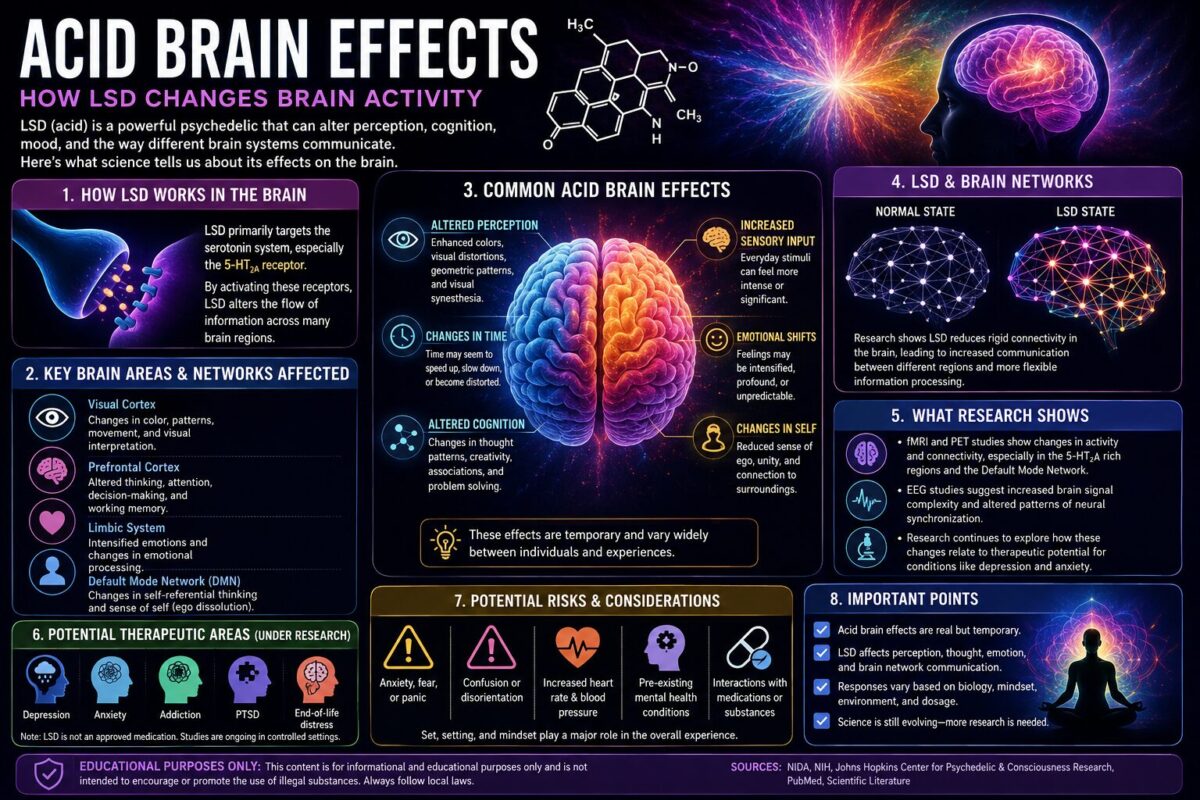
Acid Brain Effects describe the changes in brain activity and information processing associated with LSD, commonly known as acid. LSD is a powerful psychedelic compound that can produce significant changes in perception, cognition, mood, attention, and the way different brain systems communicate.
Understanding Acid Brain Effects requires looking beyond the subjective experience. LSD does not simply create visual changes; it interacts with serotonin receptors and can temporarily alter communication between brain networks involved in perception, attention, emotion, and cognition.
LSD is classified as a classic psychedelic. One of its most important biological actions involves the serotonin system, particularly the 5-HT2A receptor. Scientists believe this receptor activity plays a major role in many of the perceptual and cognitive changes associated with LSD.
Research using brain-imaging techniques has also provided evidence that psychedelic states can change patterns of communication between brain regions. These changes may help explain why ordinary sensory information, thoughts, emotions, and the sense of self can feel different during an LSD experience.
This guide examines Acid Brain Effects from a scientific and educational perspective, including serotonin signaling, brain networks, perception, cognition, emotional processing, research findings, and potential risks.
For a separate discussion about dependence and addiction, see our guide on Is LSD Addictive?.
Table of Contents
- What Are Acid Brain Effects?
- How LSD Interacts With Serotonin
- The 5-HT2A Receptor and LSD
- LSD and Brain Networks
- Effects on Visual Perception
- Effects on Thinking and Cognition
- Effects on Mood and Emotional Processing
- LSD and the Sense of Self
- What Brain Imaging Research Shows
- Potential Risks
- Frequently Asked Questions
What Are Acid Brain Effects?
Acid Brain Effects refer to the neurological and psychological changes associated with LSD exposure. These effects can involve sensory processing, attention, thought patterns, emotions, memory, and the communication between different areas of the brain.
Unlike ordinary changes in mood or attention, psychedelic states can produce unusually broad changes in how information is processed. Sensory signals that would normally be interpreted in predictable ways may be given greater significance or combined differently.
This can contribute to changes in visual perception, unusual associations between ideas, altered time perception, and changes in the sense of self.
Importantly, Acid Brain Effects do not mean that every person experiences identical neurological changes. Individual biology, psychological state, environment, expectations, and other factors can influence the subjective experience.
How LSD Interacts With Serotonin
One of the central features of Acid Brain Effects is LSD’s interaction with the serotonin system. Serotonin is a neurotransmitter involved in numerous functions, including mood, perception, cognition, sleep, and sensory processing.
LSD interacts with multiple serotonin receptors, but its activity at the 5-HT2A receptor is considered particularly important for its psychedelic effects.
Rather than simply increasing serotonin throughout the brain, LSD changes signaling at specific receptor systems. This distinction is important because neurotransmitters do not operate like simple on-and-off switches. Their effects depend on where receptors are located and how different neural circuits interact.
The interaction between LSD and serotonin receptors is therefore one of the primary biological mechanisms researchers examine when studying Acid Brain Effects.
The 5-HT2A Receptor and LSD
The 5-HT2A receptor has received significant attention in psychedelic neuroscience. It is found throughout several brain regions involved in perception, cognition, and higher-order information processing.
When LSD interacts with this receptor system, it can influence the activity of neural circuits involved in interpreting sensory information and constructing conscious experience.
This helps explain why Acid Brain Effects can extend beyond visual perception. Changes in serotonin signaling can influence how information is integrated across multiple cognitive and sensory systems.
Researchers have used pharmacological studies, brain imaging, and other experimental approaches to investigate the relationship between 5-HT2A receptor activity and psychedelic experiences.
LSD and Brain Networks
Another major area of research into Acid Brain Effects involves large-scale brain networks. The brain contains interconnected systems that contribute to attention, sensory processing, memory, decision-making, and self-related thinking.
Under ordinary conditions, these networks tend to communicate in relatively organized patterns. Psychedelic states can temporarily alter these patterns, allowing communication between systems that may normally operate more independently.
Brain-imaging studies have reported changes in functional connectivity during psychedelic states. These findings have contributed to theories that LSD temporarily alters the normal organization of information processing in the brain.
Rather than describing the brain as simply becoming “more active,” modern research suggests that the important changes can involve how activity is organized and how different brain regions communicate.
Effects on Visual Perception
Changes in visual perception are among the most recognizable Acid Brain Effects. LSD can alter the way the brain processes color, movement, patterns, depth, contrast, and other aspects of visual information.
Objects may appear unusually vivid, surfaces can seem to shift or move, and patterns that normally receive little attention may become more noticeable. Some people also report visual phenomena involving geometric shapes or changes in the apparent size and distance of objects.
These experiences do not necessarily mean that the eyes themselves are malfunctioning. Instead, LSD can influence the brain systems responsible for interpreting signals arriving from the visual system.
This distinction is important when studying Acid Brain Effects. Vision depends on continuous interaction between sensory input and higher-level brain processing, so changing that processing can change the resulting perceptual experience.
Effects on Thinking and Cognition
Another important category of Acid Brain Effects involves cognition. LSD can alter attention, associations between ideas, perception of time, and the way people organize thoughts.
Some people report unusually strong connections between unrelated ideas or a tendency for thoughts to become more fluid and associative. Others may experience difficulty maintaining a conventional train of thought.
Researchers have studied these changes because they provide an opportunity to examine how the brain normally maintains stable patterns of thought and information processing.
LSD-related cognitive changes can also influence how people interpret ordinary experiences. A familiar object, conversation, or idea may appear unusually meaningful or significant during an altered state.
Attention and Information Processing
Acid Brain Effects can also involve changes in attention. Normally, the brain continuously filters enormous amounts of sensory information, allowing attention to focus on information considered relevant.
During a psychedelic state, this filtering process may change. Stimuli that would normally remain in the background can become more noticeable, while maintaining attention on a single task may become more difficult.
This altered allocation of attention may contribute to the feeling that ordinary environments contain an unusually large amount of information.
Researchers continue investigating whether these changes in attention are related to broader alterations in communication between brain networks.
Effects on Mood and Emotional Processing
Mood and emotional processing are another significant area of research into Acid Brain Effects. LSD can produce substantial changes in emotional experience, although the direction and intensity of those changes can vary between individuals.
Some research has investigated whether psychedelics can alter emotional responses and the way people process personally meaningful information. These effects have contributed to scientific interest in psychedelic-assisted psychotherapy.
However, psychedelic experiences can also involve anxiety, fear, confusion, or emotional overwhelm. A person’s psychological state and surrounding environment can influence how emotionally intense an experience becomes.
Consequently, Acid Brain Effects should not be described as universally positive or negative. They represent a complex interaction between pharmacology, brain activity, psychological state, and environmental context.
LSD and the Sense of Self
One of the more unusual Acid Brain Effects researchers investigate involves changes in self-perception. Some people report feeling less attached to their usual sense of identity or experiencing a temporary reduction in the boundaries between themselves and their surroundings.
This phenomenon is sometimes discussed using the term “ego dissolution.” It does not necessarily mean that a person loses their identity permanently. Instead, it describes a temporary alteration in how the sense of self is experienced.
Neuroscientists have investigated whether changes in brain networks associated with self-referential thinking may contribute to these experiences.
Research into this area remains active, and scientists continue working to understand how subjective changes in self-awareness relate to measurable changes in brain activity.
Changes in Time Perception
Altered time perception is another reported aspect of Acid Brain Effects. A period of time may seem unusually short or unusually long, even though objective clock time continues normally.
Our perception of time depends on multiple cognitive processes involving attention, memory, sensory information, and internal timing mechanisms. Psychedelic states can modify several of these processes simultaneously.
As a result, subjective time can feel significantly different from ordinary waking experience.
This is another example of how LSD can influence the brain’s interpretation of information rather than physically changing the external environment.
What Brain Imaging Research Shows
Modern brain-imaging research has provided important insights into Acid Brain Effects. Researchers have used techniques such as functional magnetic resonance imaging (fMRI), positron emission tomography (PET), and electroencephalography (EEG) to investigate how LSD changes brain activity and communication.
These studies suggest that psychedelic states can alter communication between brain regions and change the organization of large-scale neural networks. Rather than simply causing the entire brain to become more active, LSD appears to change patterns of activity and connectivity in specific ways.
Researchers have also observed changes in networks involved in self-referential thinking, attention, sensory processing, and higher-level cognition. These findings provide potential neurological explanations for some of the subjective experiences reported during psychedelic states.
However, neuroscience is still developing. Researchers continue to investigate exactly how measurable changes in brain activity correspond to individual subjective experiences.
The Default Mode Network
The default mode network, often abbreviated as the DMN, has received considerable attention in research examining Acid Brain Effects. This network is associated with processes such as self-referential thinking, autobiographical memory, and internal mental activity.
Studies involving psychedelics have reported changes in the normal organization and connectivity of the default mode network. These changes have been discussed in relation to altered self-awareness and experiences sometimes described as ego dissolution.
It is important, however, not to oversimplify the science by claiming that LSD simply “turns off” the default mode network. Brain networks interact dynamically, and research findings are more complex than a single on-or-off mechanism.
Understanding these network changes may eventually help researchers explain how psychedelic compounds can temporarily alter ordinary patterns of consciousness.
Neural Communication and Flexibility
Another area of interest surrounding Acid Brain Effects is the possibility that psychedelics temporarily increase unusual patterns of communication between brain systems.
Under ordinary conditions, brain networks develop relatively stable patterns of communication. During a psychedelic state, researchers have observed changes in connectivity that may allow information to move between systems in less conventional ways.
Some scientists have described this as increased neural flexibility or altered network organization. The concept is still being investigated, and researchers continue examining how these temporary changes relate to perception, cognition, and emotional processing.
These findings are particularly interesting because they may provide clues about how the brain maintains stable conscious experience under ordinary conditions.
Memory and Learning
Memory is another area researchers consider when examining Acid Brain Effects. LSD can influence attention and the way information is processed, which can subsequently affect how experiences are remembered.
During an altered state, attention may shift toward unusual sensory details or emotionally significant thoughts. This can change which aspects of an experience receive the most cognitive processing.
Research into psychedelic states has also examined whether changes in memory processing could contribute to therapeutic applications. However, findings from controlled research should not be interpreted as proof that LSD improves memory or learning in everyday circumstances.
The relationship between psychedelic states, memory, and long-term psychological outcomes remains an active area of scientific investigation.
Physical Brain and Body Responses
Acid Brain Effects are accompanied by physiological changes throughout the body. LSD can affect the autonomic nervous system and may produce changes such as increased heart rate, changes in blood pressure, sweating, pupil dilation, and altered body sensations.
These physiological effects occur alongside changes in perception and cognition. This is why an LSD experience cannot be understood exclusively as a visual or psychological phenomenon.
Individual responses can differ significantly, and other substances or medications may also influence the overall effects. Anyone experiencing a serious or unexpected medical reaction should seek appropriate medical assistance.
What About Long-Term Brain Effects?
Questions about long-term Acid Brain Effects require careful interpretation because research findings do not support simple conclusions about permanent brain changes from LSD.
Scientists continue to investigate the long-term neurological and psychological consequences of psychedelic exposure. Available evidence is complex, and outcomes can depend on factors such as frequency of exposure, individual vulnerability, other substances, and the circumstances surrounding use.
It is therefore inaccurate to make sweeping claims that LSD inevitably causes permanent brain damage, just as it would be inaccurate to claim that LSD has no possible long-term risks for anyone.
Researchers continue studying both potential therapeutic applications and potential adverse outcomes to develop a more complete understanding of psychedelic compounds.
Limitations of Current Research
Understanding Acid Brain Effects also requires recognizing the limitations of psychedelic research. Many studies involve relatively small groups of participants, carefully controlled environments, or specific research protocols.
Results from these studies may not represent every individual or every real-world situation. Expectations, environment, personal history, mental health, and other variables can influence subjective psychedelic experiences.
Researchers therefore continue conducting controlled studies to determine which findings are reliable, which effects are temporary, and which potential applications may warrant further investigation.
Frequently Asked Questions About Acid Brain Effects
What are Acid Brain Effects?
Acid Brain Effects describe the neurological and psychological changes associated with LSD. They can involve perception, cognition, attention, mood, sensory processing, and communication between different brain networks.
How does LSD affect the brain?
LSD interacts with several serotonin receptors, particularly the 5-HT2A receptor. This activity can alter information processing and communication between neural systems involved in perception, cognition, and emotional processing.
Does LSD increase serotonin?
LSD does not simply increase serotonin throughout the brain. Instead, it interacts with serotonin receptors and changes signaling within specific neural systems. The 5-HT2A receptor is especially important to its psychedelic effects.
Can LSD change visual perception?
Yes. Changes in visual perception are among the commonly reported Acid Brain Effects. These can involve colors, patterns, movement, depth, contrast, and the interpretation of sensory information.
Does LSD change brain networks?
Research using brain-imaging techniques has found changes in communication and connectivity between brain regions during psychedelic states. Scientists are particularly interested in networks involved in perception, attention, cognition, and self-referential thinking.
What is LSD’s effect on the default mode network?
Studies have reported changes in the organization and connectivity of the default mode network during psychedelic states. Because this network is associated with self-related processing, these changes have been investigated in relation to altered self-awareness and ego-dissolution experiences.
Can LSD permanently damage the brain?
It is not accurate to make a universal claim that LSD inevitably causes permanent brain damage. Research into long-term neurological and psychological outcomes remains complex, and individual risks can vary.
Can LSD affect emotions?
Yes. LSD can substantially alter emotional processing and mood. Some people experience intensified emotions or unusual emotional insights, while others may experience anxiety, fear, confusion, or emotional distress.
Does LSD change your sense of self?
It can. Some people report temporary changes in self-awareness or a reduced sense of separation between themselves and their surroundings. Researchers often discuss this phenomenon using the term “ego dissolution.”
Conclusion
Acid Brain Effects involve a complex combination of changes in serotonin signaling, perception, cognition, emotional processing, and communication between brain networks. LSD’s interaction with serotonin receptors—particularly the 5-HT2A receptor—is considered central to its psychedelic effects.
Brain-imaging research suggests that LSD can temporarily alter the organization and communication of large-scale neural networks. These changes may help explain altered visual perception, unusual thought patterns, changes in attention, modified emotional experiences, and temporary changes in the sense of self.
At the same time, Acid Brain Effects should not be reduced to a single explanation such as “LSD makes the brain more active.” Current research suggests a more complicated picture involving changes in connectivity, information processing, and network organization.
Long-term effects remain an area of ongoing scientific investigation. Researchers continue studying both potential therapeutic applications and possible risks, while recognizing that individual responses can vary substantially.
For related educational information, explore our guides on Is LSD Addictive?, LSD Trip, Shrooms Visuals, and What Are Hallucinogens?.
Related LSD & Psychedelic Guides
Authoritative References
PubMed — Peer-Reviewed Research
National Institute on Drug Abuse — Psychedelic and Dissociative Drugs
