
Jun
If you are wondering how long does psychedelic mushrooms stay in your system, there are several different questions to separate. The length of a psychedelic experience is not necessarily the same as the amount of time psilocybin or its metabolites remain in the body, and neither automatically represents a laboratory detection window.
Magic mushrooms contain psilocybin, which the body rapidly converts into psilocin. Research into human pharmacokinetics shows that psilocin is absorbed, metabolized, and eliminated over time. Because different tests measure different compounds using different analytical methods, there is no single number that accurately describes how long does psychedelic mushrooms stay in your system for every person or every testing situation.
How Long Does Psychedelic Mushrooms Stay in Your System?
The most accurate answer to how long does psychedelic mushrooms stay in your system is that the answer depends on what “stay in your system” means and what is being tested.
The noticeable psychedelic experience can end while the body is still processing and eliminating drug-related compounds. At the same time, detecting a compound in a biological sample does not automatically mean that a person is still experiencing psychedelic effects.
Psilocybin is rapidly converted into psilocin after oral administration. Recent pharmacokinetic research has reported variation in psilocin elimination half-life between studies, rather than one universal value that applies to every person.
A systematic review and post-hoc analysis reported terminal psilocin half-lives ranging from approximately 1.23 to 4.72 hours across the studies reviewed. A systematic review of psilocin pharmacokinetics provides additional detail on the pharmacokinetic findings reported across the available studies.
These numbers describe pharmacokinetics. They should not be treated as guaranteed drug-testing windows because laboratory detection depends on the specimen, analyte, analytical method, sensitivity, and timing of collection.
Magic Mushrooms, Psilocybin and Psilocin: What Is the Difference?
Understanding the difference between mushrooms, psilocybin, and psilocin helps explain how long does psychedelic mushrooms stay in your system.
Magic mushrooms
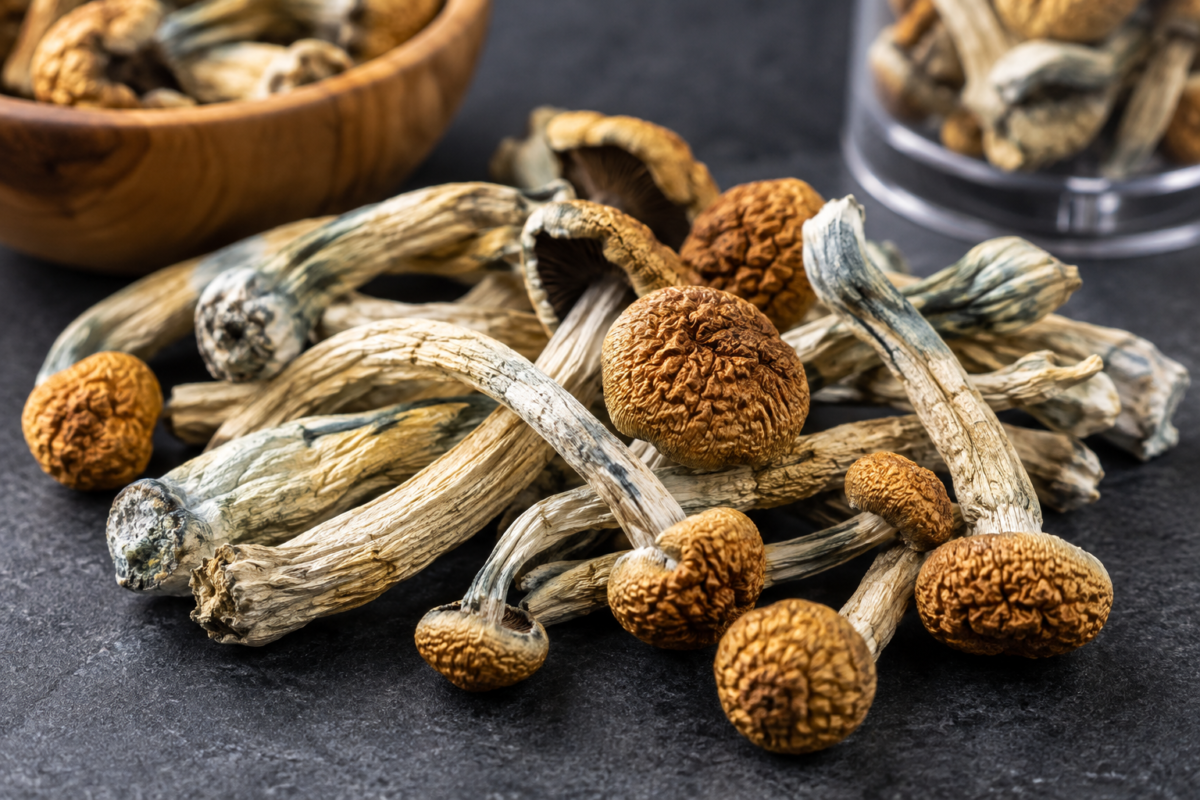
Magic mushrooms are mushrooms containing naturally occurring psychoactive compounds, including psilocybin. Their chemical composition can vary depending on the mushroom and other factors.
For broader background, see the site’s verified magic mushroom resource.
Psilocybin
Psilocybin is the principal psychedelic prodrug associated with psilocybin mushrooms. After ingestion, it is rapidly converted into psilocin.
Research has examined how psilocybin is absorbed, metabolized, and eliminated. A systematic review of psilocybin pharmacokinetics summarizes findings from the available literature.
Psilocin
Psilocin is the active compound associated with the characteristic psychedelic effects of psilocybin. Human pharmacokinetic studies therefore frequently measure psilocin concentrations when examining what happens after psilocybin administration.
This distinction matters because asking how long mushrooms remain in the body is not exactly the same as asking how long psilocybin, psilocin, or their metabolites remain measurable.
What Happens After Psilocybin Is Ingested?
Following oral administration, psilocybin is rapidly converted to psilocin. Human studies summarized in recent systematic reviews show that psilocin reaches peak plasma concentrations relatively early after administration, although the precise timing varies between studies.
Psilocin is then extensively metabolized. Research has identified several metabolites and conjugated forms that occur during the body’s processing of the compound.
Controlled human research has also examined plasma concentrations and subjective effects following oral administration. A controlled human pharmacokinetic study provides primary research data on these measures.
This explains why how long does psychedelic mushrooms stay in your system cannot be answered simply by looking at the duration of noticeable effects.
The subjective experience and the body’s pharmacokinetic processes are related but different measurements.
How Long Does Psilocin Stay in the Body?
Human research does not establish one universal psilocin half-life for every individual.
A systematic review and post-hoc analysis reported terminal half-lives between approximately 1.23 and 4.72 hours across the studies it evaluated. Another systematic review found generally short elimination half-lives measured in hours.
A controlled human pharmacokinetic study also found relatively short elimination half-lives for psilocin following oral psilocybin administration.
A half-life, however, should not be interpreted as the exact time a substance will remain detectable.
What does half-life mean?
Half-life describes the time required for the concentration of a substance to decrease by approximately half under the conditions being studied.
It does not mean that the substance has completely disappeared after one half-life.
More importantly, laboratory detection depends on the analytical threshold and the particular compound or metabolite being measured. Therefore, pharmacokinetic half-life and a drug-testing detection window are not interchangeable.
How Long Do Effects Last Compared With How Long the Substance Stays in Your System?
This distinction is central to understanding how long does psychedelic mushrooms stay in your system.
Controlled human research has found that subjective effects from oral psilocybin can last several hours. The body’s processing of psilocybin and psilocin continues according to pharmacokinetic processes that are measured separately.
| Question | What it means |
|---|---|
| How long do the effects last? | How long noticeable subjective effects continue. |
| How long does psilocin remain in the body? | How long the compound continues to be processed and eliminated. |
| How long can it be detected? | How long a particular testing method can identify a target compound or metabolite. |
These measurements should not be treated as interchangeable.
How Long Can Psilocybin or Psilocin Be Detected in Urine?
Specialized laboratory research has demonstrated that psilocin and related conjugated material can be measured in human urine following psilocybin administration.
One controlled human study collected urine for 24 hours after psilocybin administration and measured psilocin using a sensitive analytical method. The researchers found that free psilocin concentrations were highest during the earlier collection periods and subsequently declined.
Research has specifically examined urinary psilocin excretion following oral psilocybin administration. Research on urinary psilocin excretion provides additional detail on urinary measurements.
The same research demonstrated that conjugated psilocin-related material can be relevant when analyzing urine, meaning that the analytical method can affect what is measured.
These findings do not establish a universal urine detection window for every person or every laboratory test.
The answer to how long does psychedelic mushrooms stay in your system therefore depends partly on what the laboratory is looking for and how sensitive its analytical method is.
Can Psilocybin or Psilocin Be Detected in Blood?
Yes. Research laboratories can measure psilocin in plasma using sensitive analytical techniques.
Human pharmacokinetic studies routinely measure plasma concentrations to study the absorption and elimination of psilocin.
However, the fact that a research laboratory can measure psilocin does not mean that every routine blood test automatically screens for it.
Blood concentrations also change over time. The timing of sample collection therefore matters when interpreting a laboratory measurement.
Do Standard Drug Tests Detect Psilocybin?
Whether a drug test detects psilocybin depends on the test panel and analytical method.
Drug screens are designed to detect particular substances or classes of substances. A test that does not include a particular analyte is different from specialized toxicology testing that is specifically designed to look for it.
For that reason, it is too broad to claim that “drug tests do not detect magic mushrooms.” The more accurate statement is that detection depends on the test being performed.
Relevant distinctions include:
- Routine screening panels targeting specified substances.
- Specialized toxicology testing for particular compounds.
- Research assays capable of measuring psilocin or related metabolites with sensitive analytical methods.
If an important medical, employment, or legal testing question is involved, the relevant testing provider or qualified professional is the appropriate source for information about the actual test being used.
What Can Affect Detection?
There is no reliable formula that can guarantee an individual’s exact detection time from body weight, water consumption, or another single factor.
Timing
The amount of time between administration and sample collection can significantly affect measured concentrations.
Analyte being measured
A laboratory may target psilocin, conjugated metabolites, or another specific analyte. Different targets can have different detection characteristics.
Analytical sensitivity
Laboratory techniques have different detection and quantification limits. More sensitive analytical methods can identify lower concentrations.
Individual variation
Human pharmacokinetic studies demonstrate variation between participants, meaning that one person’s measured concentrations cannot automatically be applied to another person.
Dose
Research has reported dose-related differences in measured psilocin concentrations. Dose alone, however, cannot be used to predict an individual’s exact testing result.
Common Myths About Clearing Psilocybin From the Body
Myth 1: Drinking excessive water removes psilocybin immediately
There is no established method that guarantees immediate elimination of psilocybin or psilocin. Excessive water consumption can itself be dangerous.
Myth 2: Sweating removes psilocybin quickly
There is no reliable evidence that exercise or sweating provides a guaranteed method for rapidly eliminating psilocybin.
Myth 3: A particular food guarantees a negative test
No food can reliably guarantee a particular laboratory result. Detection depends on the test, analyte, analytical method, and timing.
Myth 4: The end of the psychedelic experience means everything is gone
The end of noticeable effects and the complete elimination of every measurable compound are different concepts.
Myth 5: Every drug test checks for psilocybin
Drug tests target specified analytes and panels. A routine screening panel and specialized toxicology analysis are not necessarily designed to detect the same substances.
Important Safety Considerations
If someone is experiencing severe confusion, extreme agitation, loss of consciousness, seizures, difficulty breathing, chest pain, or another medical emergency after taking a substance, seek urgent medical assistance rather than relying on an internet detection timeline.
The fact that several hours have passed does not automatically establish that someone is safe to drive or perform hazardous activities.
Combining psychoactive substances can also alter the overall risk. If someone becomes seriously unwell after taking multiple substances, healthcare professionals should be told what was taken when possible.
For questions involving a medical procedure, prescribed medication, employment testing, or another important health situation, a qualified healthcare professional or the relevant testing provider can provide advice based on the actual circumstances.
Frequently Asked Questions
How long does psychedelic mushrooms stay in your system?
There is no single universal detection period. Psilocybin is rapidly converted to psilocin, and human research reports relatively short psilocin half-lives, but laboratory detection depends on the specimen, analyte, analytical method, and timing.
How long does psilocybin stay in your system?
Psilocybin is rapidly converted into psilocin after oral administration. Research therefore commonly examines psilocin and its metabolites when studying the body’s handling of psilocybin.
How long do psychedelic mushrooms stay in your system compared with how long the effects last?
The two measurements are different. Subjective psychedelic effects can last several hours, while the body continues processing and eliminating the relevant compounds according to their pharmacokinetics.
Can psilocybin be detected in urine?
Specialized laboratory research has demonstrated that psilocin and related material can be measured in urine after psilocybin administration. The exact detection characteristics depend on the analytical method and target compound.
Can psilocybin be detected in blood?
Psilocin can be measured in plasma using sensitive laboratory analytical methods. This does not mean that every routine blood test screens for psilocybin.
Do standard drug tests detect magic mushrooms?
It depends on the test panel. Drug tests are designed to detect specified substances, while specialized toxicology testing can use different methods to identify particular compounds.
Does dose affect how long psilocybin remains measurable?
Dose can influence measured psilocin concentrations, but dose alone cannot establish an individual’s exact detection window.
Does drinking water make psilocybin leave the body faster?
There is no reliable evidence that excessive water consumption provides a guaranteed rapid-clearance method. Excessive water intake can be dangerous.
Does the end of a mushroom experience mean psilocybin is completely gone?
No. The end of noticeable effects does not prove that all compounds or metabolites have completely disappeared from the body.
Why is there no exact answer to how long does psychedelic mushrooms stay in your system?
Because “stay in your system” can refer to pharmacokinetics, metabolism, elimination, or laboratory detection. These are related but different measurements.
Conclusion
The best answer to how long does psychedelic mushrooms stay in your system is that there is no single number that applies to every person, specimen, and testing method.
Psilocybin is rapidly converted into psilocin after ingestion. Human pharmacokinetic studies generally show relatively rapid absorption and elimination, although reported pharmacokinetic parameters vary across studies.
Detection is a separate question. Specialized research methods can measure psilocin and related material in biological samples, but the ability to detect a compound depends on the target analyte, specimen, analytical technique, sensitivity, and timing.
For that reason, an evidence-based answer should avoid promising a universal number of hours or days. If the question concerns medical care, employment testing, or another important real-world decision, the specific testing provider or a qualified healthcare professional is a more appropriate source than a generic online detection chart.
