
 2026 Guide: Buy LSD in Canada Safely & Discreetly Online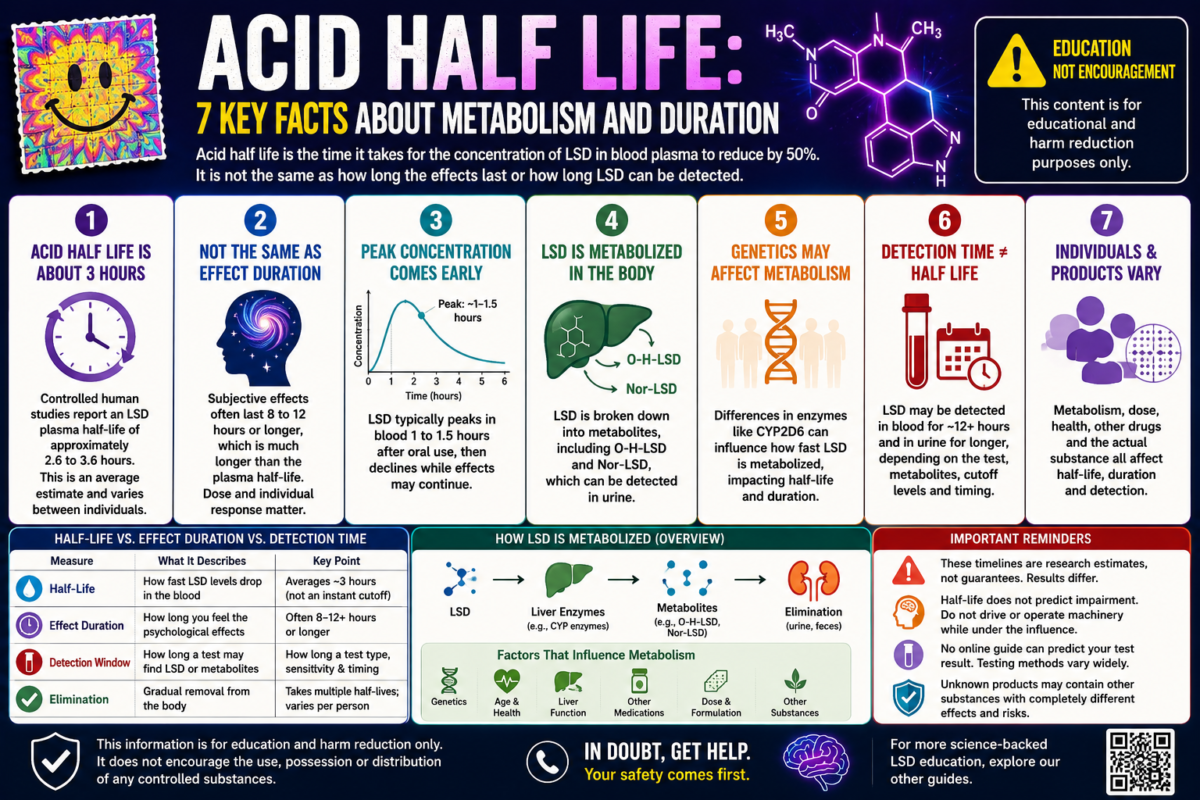
Jun
Acid Half Life: 7 Key Facts About Metabolism and Duration
Acid half life refers to the time required for the concentration of LSD in blood plasma to decrease by approximately half. Controlled human studies have generally reported an LSD plasma half-life of roughly three hours, although individual results and study methods vary.
The acid half life should not be confused with how long a person feels the effects. LSD’s subjective effects can continue for considerably longer than the compound’s estimated plasma half-life. Detection time is another separate measurement because sensitive laboratory tests may identify LSD or its metabolites after the most noticeable effects have ended.
This educational guide explains seven important facts about LSD metabolism, elimination, effect duration and testing. It does not provide advice for using LSD or avoiding drug tests.
Table of Contents
- What Does Acid Half Life Mean?
- 7 Key Acid Half Life Facts
- Half-Life Versus Duration of Effects
- How LSD Is Metabolized
- How Long Elimination May Take
- LSD Detection Time Explained
- Why Results Differ Between People
- Health and Emergency Awareness
- Frequently Asked Questions
What Does Acid Half Life Mean?
The term acid half life is a pharmacokinetic measurement. It describes how long it takes for the measured concentration of LSD in plasma to fall to approximately half its previous level.
For example, one controlled study reported a plasma half-life of approximately 2.6 hours after oral doses administered under clinical conditions. Another study reported an initial elimination half-life of approximately 3.6 hours, followed by a slower terminal phase in some participants.
These figures do not mean that all LSD has left the body after three hours. Drug elimination occurs gradually over several half-lives rather than ending at one exact point.
The results also come from controlled research using verified formulations. They cannot confirm the contents, strength or behaviour of an unidentified substance represented as acid.
7 Key Acid Half Life Facts
1. The Average Plasma Half-Life Is Around Three Hours
Published human studies generally place the acid half life within a range of roughly 2.6 to 3.6 hours. The exact estimate depends on the dose, formulation, analytical method and mathematical model used by researchers.
A value near three hours is therefore a useful scientific estimate, but it is not a personal countdown that applies identically to everyone.
2. Half-Life Is Not the Same as Effect Duration
The noticeable effects of LSD can last much longer than the estimated acid half life. In one controlled study, average subjective effects lasted approximately 8.2 hours after one studied dose and 11.6 hours after a larger studied dose.
This difference occurs because drug effects are influenced by more than the amount circulating in plasma at one moment. Receptor activity, dose, individual sensitivity and psychological factors may all affect the experience.
Our related guide explains how long LSD may last in greater detail.
3. LSD Concentrations Usually Peak Before Effects End
Controlled pharmacokinetic studies have reported peak plasma concentrations approximately one to one-and-a-half hours after oral administration. The concentration then declines while subjective effects may continue for several additional hours.
Consequently, the acid half life cannot be used alone to predict when someone will feel completely normal again.
4. LSD Is Converted Into Metabolites
The body processes LSD through metabolic pathways that produce several compounds. One of the most important metabolites identified in toxicological analysis is 2-oxo-3-hydroxy-LSD, commonly abbreviated as O-H-LSD.
O-H-LSD may be useful in urine testing because it can be present at higher concentrations than unchanged LSD. Metabolism does not occur at exactly the same speed in every person.
Readers interested in the drug’s neurological activity can review how LSD works in the brain.
5. Genetics May Influence LSD Metabolism
Research suggests that differences in enzymes involved in drug metabolism may affect LSD concentrations and duration. In particular, CYP2D6 activity has been studied as one possible contributor to individual variation.
People with reduced activity of a relevant enzyme may process a compound more slowly. This could influence plasma concentration, subjective effects and the measured acid half life.
Genetics is only one factor. Health, other medications and study conditions may also contribute to differences.
6. Detection Time Is Different From Half-Life
An acid half life estimate does not provide a guaranteed detection window. Laboratory detection depends on the specimen, testing technology, cutoff level, timing and whether the test measures unchanged LSD or a metabolite.
Some studies have measured LSD in plasma for approximately 12 hours or longer under controlled conditions. Reviews have also reported that LSD or its metabolites may sometimes be detected in urine for longer periods using specialized testing.
These findings should not be used to predict whether an individual test will be positive or negative. Testing practices differ, and no online timetable can guarantee a result.
7. Unknown Products Make Predictions Less Reliable
Any discussion of acid half life assumes that the substance involved is genuinely LSD. An unregulated product may contain another compound, an unexpected mixture or an inaccurately represented amount.
A substitute substance may have a completely different half-life, effect duration and risk profile. Appearance, price, slang and seller claims cannot establish chemical identity.
See our guides covering street names for LSD, different types of LSD and why reported information about how much acid costs can be unreliable.
Acid Half Life Versus Duration of Effects
The acid half life and the duration of subjective effects describe different processes:
| Measurement | What It Describes | Important Limitation |
|---|---|---|
| Plasma half-life | How quickly measured LSD concentration falls in plasma | Does not directly predict when all effects will end |
| Subjective duration | How long perceptual or psychological effects are experienced | Varies between people and circumstances |
| Detection window | How long a test may identify LSD or a metabolite | Depends on test type, sensitivity and timing |
| Complete elimination | Progressive removal of the compound from the body | Cannot be reduced to one universal deadline |
A person may continue experiencing altered perception, emotion or judgement even after several hours of elimination. Residual tiredness, emotional sensitivity or difficulty concentrating may also continue after the most intense effects have subsided.
Our educational overview of the effects of LSD explains these experiences and their potential risks.
How Is LSD Metabolized?
LSD metabolism mainly occurs through enzymatic processes that transform the parent compound into metabolites. Scientific reviews have identified several metabolic pathways, including oxidation and hydroxylation.
O-H-LSD is one of the main metabolites commonly discussed in toxicology. Nor-LSD is another reported metabolite. Their presence may help laboratories identify prior LSD exposure even when concentrations of unchanged LSD are low.
The acid half life reflects the decline of the measured parent compound under defined study conditions. It does not mean metabolism happens through only one pathway or at one fixed rate.
The following factors may influence metabolism:
- Genetic enzyme differences
- Age and general health
- Liver function
- Other medications or substances
- The administered formulation
- Individual physiological variation
- Analytical methods used in the study
A comprehensive scientific review of LSD metabolism and its identified metabolites provides further technical information.
How Long Does LSD Take to Leave the Body?
There is no single exact time that applies to every person. As a general pharmacokinetic principle, the amount of a compound decreases progressively with each half-life.
After one acid half life, approximately half of the measured concentration remains. After another half-life, approximately half of that remaining concentration is left. This pattern continues, but biological elimination is not always perfectly uniform.
Researchers have observed an initial faster decline followed by a slower terminal phase in some studies. This is why multiplying one half-life by a fixed number produces only a rough theoretical estimate rather than a guaranteed personal result.
It is also important to separate elimination from impairment. Someone should not drive, operate machinery or make safety-sensitive decisions while experiencing altered perception or judgement.
LSD Detection Time Explained
LSD detection time depends heavily on the sample and laboratory method. LSD is active at very small amounts, and its concentrations can be difficult to measure without sensitive specialized analysis.
Blood or Plasma Testing
Controlled studies have quantified LSD in plasma for approximately 12 hours, with some research discussing possible detection for longer depending on dose and analytical sensitivity.
Urine Testing
Urine testing may look for LSD and metabolites such as O-H-LSD. Research reviews have reported longer detection possibilities in urine than in plasma, but results depend strongly on the assay and cutoff.
Hair Testing
Hair analysis involves different limitations, including environmental contamination, hair characteristics and laboratory methodology. It is not appropriate to assume that every hair test includes LSD or that all laboratories use the same standards.
The acid half life must therefore not be treated as a drug-testing timetable. Detection cannot be reliably predicted from a general article, and this guide does not provide test-evasion advice.
Why Acid Half Life Results Differ Between People
Although studies provide average values, the measured acid half life may vary between individuals. Differences may relate to metabolism, dose, formulation and biological characteristics.
Factors researchers may consider include:
- Enzyme activity
- Body composition
- Liver and kidney health
- Age
- Other medicines
- Other substances
- Timing of blood collection
- Laboratory sensitivity
These factors are another reason that an average of about three hours should be understood as a research estimate rather than a guaranteed personal result.
Does Storage Change Acid Half Life?
Storage and biological half-life are different concepts. Storage affects whether a compound degrades before exposure, while the acid half life describes how its concentration declines in the body after administration.
Heat, light, moisture and unknown storage history may affect chemical stability, but they do not create a predictable biological half-life for an unidentified product.
Our separate educational article answers does LSD expire and explains why stability should not be confused with metabolism.
Health and Emergency Awareness
Knowing the acid half life does not make an unknown exposure predictable or safe. LSD may cause intense changes in perception, emotion and judgement, and another substance sold under the same name may produce different effects.
Seek urgent medical assistance if someone experiences:
- Seizures
- Loss of consciousness
- Difficulty breathing
- Chest pain
- Severe agitation
- Dangerous behaviour
- Extreme confusion
- Overheating or serious physical distress
Do not wait for an estimated half-life to pass when severe symptoms are present. Tell emergency professionals what may have been taken, when exposure occurred and whether other substances may be involved.
For additional health information, read Is LSD Safe?.
Frequently Asked Questions
What is the average acid half life?
Controlled human studies generally report an LSD plasma half-life of approximately 2.6 to 3.6 hours. Individual values and study methods differ.
Is acid half life the same as how long LSD lasts?
No. Half-life measures the decline of LSD concentration in plasma. Subjective effects may last approximately 8 to 12 hours or longer in some circumstances.
How long does LSD remain active?
Controlled studies have reported subjective effects lasting several hours beyond the estimated plasma half-life. Duration varies with dose, individual response and other factors.
How is LSD metabolized?
LSD is transformed through several metabolic pathways. O-H-LSD and nor-LSD are among the metabolites identified in toxicological research.
Can LSD be detected after its effects end?
Yes. A sensitive laboratory test may identify LSD or a metabolite after the strongest subjective effects have ended. Detection depends on the specimen and testing method.
Does drinking water change acid half life?
There is no reliable evidence that ordinary water consumption meaningfully accelerates LSD metabolism. Excessive water intake can itself be dangerous.
Can acid half life predict a drug-test result?
No. A half-life estimate cannot guarantee whether a particular test will be positive or negative. Testing sensitivity, specimen type, timing and metabolism all differ.
Does expired LSD have a different half-life?
Chemical degradation before exposure and metabolism inside the body are separate issues. An unidentified or degraded substance may not behave predictably.
Final Thoughts
The average acid half life reported in controlled research is approximately three hours, with published estimates commonly ranging from about 2.6 to 3.6 hours. This does not mean that subjective effects end after three hours or that the compound becomes immediately undetectable.
Effect duration, metabolism, elimination and detection time are related but distinct concepts. Individual biology, formulation, dose and laboratory methods can all influence the results.
This article is intended for education, public awareness and harm reduction. It does not encourage the purchase, possession or use of controlled substances and does not provide drug-test evasion advice.
