Jun
Acid Dosage Chart: 8 Vital Safety Facts and Warning Signs
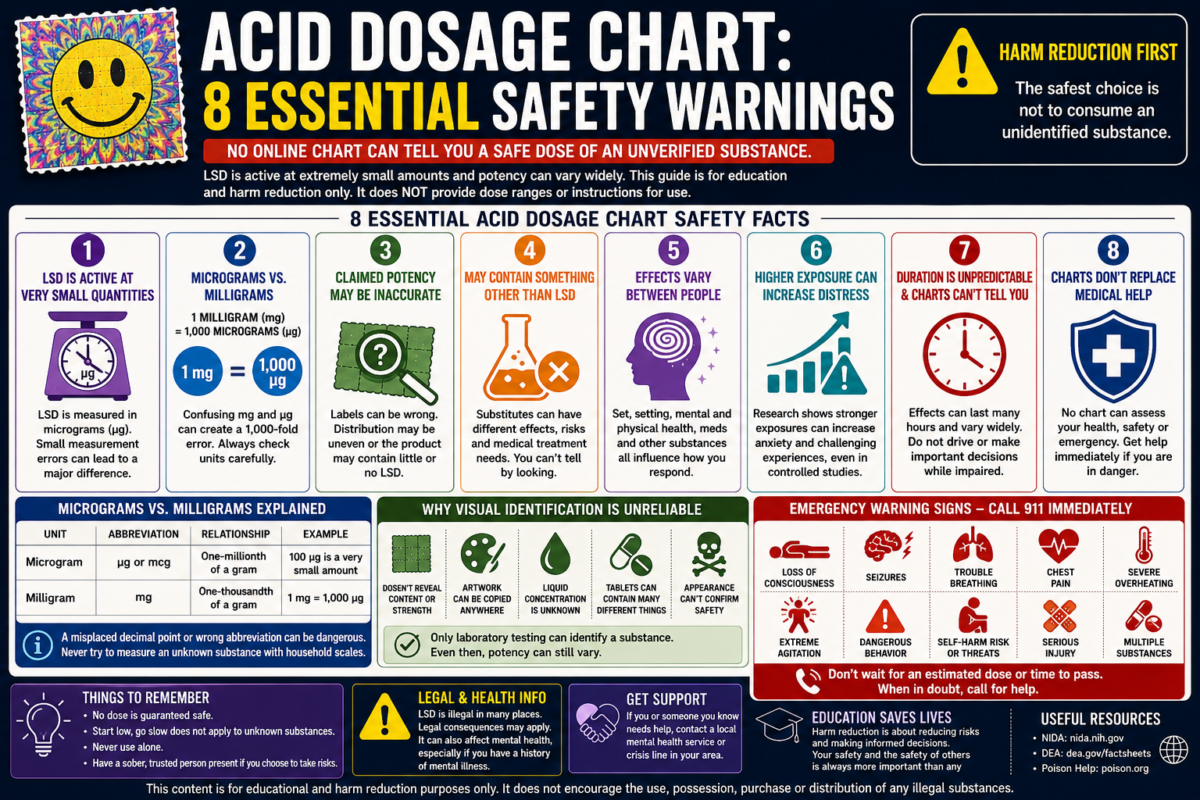
An acid dosage chart may appear to offer clear and predictable information, but no online chart can determine a safe amount of an unidentified substance. LSD is active at extremely small quantities, illicit products are not subject to consistent quality control, and claimed potency may differ greatly from the actual contents.
This guide does not provide dose ranges or instructions for taking LSD. Instead, it explains why dosing information can be unreliable, how micrograms differ from milligrams, why visual identification is ineffective and when an adverse reaction requires urgent medical assistance.
The safest approach is not to consume an unidentified substance. This article is intended only for public education, poisoning prevention and harm reduction.
Table of Contents
- Why an Acid Dosage Chart Has Serious Limitations
- 8 Essential Acid Dosage Chart Safety Facts
- Micrograms Versus Milligrams
- Why LSD Potency Can Vary
- Why Visual Identification Is Unreliable
- Effects, Duration and Metabolism
- Emergency Warning Signs
- How to Respond to a Suspected Adverse Reaction
- Frequently Asked Questions
Why an Acid Dosage Chart Has Serious Limitations
The main limitation of an acid dosage chart is that it usually assumes the substance is genuine LSD and that its concentration is known. Neither assumption can be safely made with an unregulated product.
Blotter paper, liquid, gel-like pieces and tablets can contain different concentrations or entirely different substances. Artwork, packaging, colour and seller descriptions cannot verify chemical identity.
Even when a substance has been confirmed in a clinical study, responses may vary because of individual sensitivity, health history, medications, surroundings and psychological state. Controlled research is performed with verified formulations, medical screening and professional supervision. It should not be treated as a guide for unsupervised use.
For these reasons, an acid dosage chart should never be understood as a guarantee of safety, potency or expected effects.
8 Essential Acid Dosage Chart Safety Facts
1. LSD Is Active at Very Small Quantities
LSD is discussed scientifically in micrograms rather than ordinary gram-sized quantities. This makes measurement errors particularly serious because a seemingly small numerical misunderstanding can represent a major difference.
A household scale is not designed to measure microgram quantities accurately. An online acid dosage chart cannot correct an inaccurate label, uneven distribution or an unknown concentration.
2. Micrograms and Milligrams Are Not Interchangeable
A microgram is one-thousandth of a milligram. In unit notation:
- 1 milligram equals 1,000 micrograms.
- 1 microgram equals 0.001 milligrams.
Confusing the abbreviations µg and mg creates a thousand-fold difference. This is one reason an acid dosage chart copied without context can be dangerous.
The purpose of explaining this conversion is poisoning prevention, not dosing guidance. Do not attempt to measure an unknown substance using consumer equipment.
3. Claimed Potency May Be Inaccurate
An unregulated seller may state that a product contains a particular amount, but the claim may not be supported by laboratory analysis. Potency may also be uneven across pieces of blotter or within a liquid.
A printed label, logo or product name does not prove concentration. A supposedly low-potency item could contain more than claimed, while another may contain little or no LSD.
Therefore, an acid dosage chart cannot reliably predict effects when the starting amount is unknown.
4. A Product Represented as LSD May Contain Something Else
Some substances may be marketed or described as acid despite containing a different psychoactive compound. A substitute may have a different onset, duration, toxicity profile and response to medical treatment.
Appearance cannot distinguish between LSD and another compound placed on similar-looking paper. Our guide to street names for LSD also explains why slang terms provide no chemical verification.
5. Effects Can Differ Between Individuals
Controlled studies show that the effects of LSD vary with exposure and between participants. Individual response may be influenced by:
- Mental and physical health
- Personal sensitivity
- Other medicines or substances
- Surroundings and emotional state
- Previous experiences
- Actual chemical identity and potency
An acid dosage chart cannot account for every biological, psychological and environmental variable.
6. Stronger Exposure Can Increase Distress
Controlled clinical research has found dose-dependent differences in LSD’s subjective effects. In one study, the higher investigated exposure produced greater ego dissolution and significant anxiety compared with a lower studied exposure.
That research took place under controlled conditions with screened participants. It does not establish a safe recreational dose and should not be converted into unsupervised instructions.
Our educational overview of the effects of LSD discusses perceptual, emotional and physical effects in more detail.
7. Effect Duration Is Not Determined by a Chart Alone
Effects may continue for many hours and can outlast the period of highest blood concentration. Duration depends on exposure, individual response and the substance involved.
The article explaining how long LSD may last covers onset, peak effects and residual experiences. Our acid half life guide explains why plasma half-life, effect duration and detection time are different measurements.
An acid dosage chart cannot provide an exact personal timeline.
8. Medical Emergencies Should Not Be Managed With Online Charts
An online chart cannot assess consciousness, breathing, body temperature, heart rhythm, injuries or dangerous behaviour. A severe reaction requires professional evaluation.
Do not wait for an estimated dose or half-life to pass if someone is unconscious, having a seizure, struggling to breathe or behaving dangerously. Contact emergency services immediately.
Micrograms Versus Milligrams: Why the Difference Matters
Unit confusion is one of the most important issues in any discussion of an acid dosage chart. LSD research commonly describes quantities in micrograms, written as µg or sometimes mcg. Milligrams are written as mg.
| Unit | Abbreviation | Relationship |
|---|---|---|
| Microgram | µg or mcg | One-millionth of a gram |
| Milligram | mg | One-thousandth of a gram |
| Conversion | 1 mg | 1,000 µg |
A misplaced decimal point or confused abbreviation can create a thousand-fold error. Information copied from social media, forums or poorly edited websites may omit units or use them incorrectly.
This is why a responsible acid dosage chart article should emphasize unit awareness without instructing readers to calculate or administer a dose.
Why LSD Potency Can Vary
Potency variation can result from inaccurate labeling, uneven distribution, chemical degradation or substitution with another substance. The original product may also have been misrepresented from the beginning.
Factors that may affect what a product actually contains include:
- Absence of regulated manufacturing controls
- Inconsistent application to carrier material
- Unknown concentration in liquids
- Environmental degradation
- Contamination
- Substitution with another compound
- False or exaggerated seller claims
Our guide answering does LSD expire explains how light and other environmental conditions may affect stability. However, careful storage cannot make an unknown product genuine or predictable.
Price is equally unreliable. The article discussing how much acid costs explains why cost cannot establish identity, quality or potency.
Why Visual Identification Is Unreliable
No acid dosage chart can determine potency from a picture. The size, colour or artwork of blotter paper does not reveal how much of any substance is present.
Visual identification fails because:
- Similar paper can contain different substances.
- The same artwork may be copied repeatedly.
- Distribution across paper may be uneven.
- Liquids can have unknown concentrations.
- Tablet colour and shape provide no chemical proof.
- A product can contain multiple compounds.
The same warning applies to street names, packaging and supposed brand identities. Chemical appearance is not an alternative to professional laboratory analysis.
Our guide to the reported forms and types of LSD explains common terminology without treating appearance as verification.
Effects, Duration and Metabolism
LSD may produce altered perception, changes in time awareness, emotional intensity, confusion, anxiety and impaired judgement. Physical effects may include increased heart rate, higher blood pressure, dilated pupils, nausea or vomiting.
These effects can create secondary dangers. A person experiencing distorted perception or panic may fall, enter traffic, become lost or make unsafe decisions.
The National Institute on Drug Abuse provides broader research information about psychedelic and dissociative drugs. The DEA hallucinogens fact sheet also outlines possible psychological and physical effects.
Because metabolism and effect duration vary, an acid dosage chart cannot tell a reader exactly when impairment has ended. Someone experiencing effects should not drive, operate machinery, swim alone or make safety-sensitive decisions.
Emergency Warning Signs
Call emergency services immediately if a person:
- Collapses or cannot be awakened
- Has a seizure
- Has difficulty breathing
- Experiences chest pain
- Shows severe overheating
- Displays extreme agitation or violent behaviour
- Is dangerously confused or cannot recognize their surroundings
- Attempts self-harm or threatens another person
- Has sustained an injury
- May have taken several substances
Poison Control advises calling emergency services when someone collapses, has a seizure, has trouble breathing or cannot be awakened. An acid dosage chart should never be used to decide whether those symptoms are serious enough for help.
Readers in the United States can access confidential case-specific guidance through webPOISONCONTROL. Outside the United States, contact the local poison centre or emergency service.
How to Respond to a Suspected Adverse Reaction
While waiting for professional assistance:
- Move the person away from traffic, water, heights and sharp objects.
- Reduce noise, bright lights and unnecessary stimulation.
- Speak calmly and avoid arguing about what the person is experiencing.
- Do not leave the person alone.
- Do not force food, drinks or other substances.
- Do not encourage vomiting.
- Place an unconscious but breathing person on their side when safe to do so.
- Follow instructions from emergency or poison-control professionals.
Provide responders with any available information, including what may have been taken, when the exposure occurred, symptoms observed and whether other substances or medicines may be involved.
Do not delay seeking help because of fear of embarrassment or uncertainty about the dose. The estimated amount shown in an acid dosage chart cannot replace a medical assessment.
Legal and Mental-Health Considerations
LSD is controlled or prohibited in many jurisdictions. Legal consequences may apply to possession, purchase, importation or distribution. Readers should consult current official laws for their location.
Psychedelic experiences may also involve severe fear, anxiety or paranoia. People with existing mental-health vulnerabilities may face additional risks, and combining substances can make reactions harder to predict.
Read Is LSD Safe? for more general health and risk information.
Frequently Asked Questions
Can an acid dosage chart tell me what amount is safe?
No. An online chart cannot verify chemical identity, potency, individual sensitivity, medical history or interactions. No amount of an unidentified illicit substance can be guaranteed safe.
Why does an acid dosage chart use micrograms?
LSD research commonly describes quantities in micrograms because the compound is active at very small amounts. One milligram equals 1,000 micrograms, making unit confusion particularly dangerous.
Can blotter size indicate potency?
No. Paper dimensions, thickness, colour and artwork cannot show how much of a substance is present or whether it contains LSD.
Does darker artwork mean stronger acid?
No. Printed designs and ink colours are decorative. They provide no reliable information about chemical identity or strength.
Can two tabs from the same sheet have different potency?
Uneven distribution may occur in unregulated products. Visual similarity does not establish equal concentration.
Does a higher price mean higher potency?
No. Price is a seller claim and cannot confirm strength, purity or authenticity.
Can LSD effects last longer than expected?
Yes. Duration varies, and an unidentified product may contain another substance with a different timeline. Do not drive or perform dangerous activities while effects continue.
When should emergency services be contacted?
Call immediately if someone collapses, has a seizure, cannot breathe normally, cannot be awakened, experiences chest pain, becomes dangerously agitated or shows signs of a serious medical emergency.
Can someone sleep off a severe reaction?
Do not assume unconsciousness or extreme drowsiness is normal. A person who cannot be awakened requires immediate emergency assistance.
Can drinking water reduce LSD effects?
Water does not reliably stop psychedelic effects or accelerate metabolism. Excessive water intake can also be harmful.
Final Thoughts
An acid dosage chart cannot determine a safe quantity of an unverified substance. Claimed potency may be inaccurate, LSD can be confused with other compounds and visual appearance cannot establish chemical identity.
The most important lessons are to understand the thousand-fold difference between micrograms and milligrams, recognize the limitations of seller claims and seek immediate medical assistance when serious warning signs appear.
This article is provided strictly for education, poisoning prevention and harm reduction. It does not provide dosing instructions or encourage the possession, purchase or use of controlled substances.
