
Jun
Purple Microdot: 9 Facts About Appearance, Size and Risks
Purple microdot is an informal term associated with a very small tablet represented as containing LSD. The word “purple” usually describes the tablet’s reported colour, while “microdot” refers to its small tablet-like form.
Colour, shape and size cannot confirm what a tablet contains. A purple microdot could contain LSD, another psychoactive compound, several substances or no active ingredient at all. Even two tablets that look identical may have different chemical contents or strengths.
This educational guide explains what microdots are, why appearance is unreliable and which warning signs may require urgent medical assistance. It does not provide instructions for purchasing, identifying, dosing or consuming an illegal substance.
Table of Contents
- What Is a Purple Microdot?
- 9 Important Purple Microdot Facts
- What Is the Typical Microdot Size?
- Can LSD Be Identified by Appearance?
- Risks of Unknown Tablets
- Microdots Versus Blotter and Other Forms
- Why Potency Claims Are Unreliable
- Emergency Warning Signs
- Frequently Asked Questions
What Is a Purple Microdot?
A purple microdot is generally described as a tiny purple tablet represented as LSD. Historical drug-information materials use the term “microdot” for small tablets associated with LSD.
The National Institute on Drug Abuse has described microdots as tablets produced from LSD in crystalline form. However, that general description does not prove that any tablet called a microdot actually contains LSD.
The term may be used differently between regions and generations. It can refer to:
- A small tablet claimed to contain LSD
- A coloured tablet associated with psychedelic culture
- A street name used without chemical verification
- An unidentified tablet sold or discussed as acid
Our guide to street names for LSD explains why informal names cannot establish chemical identity.
9 Important Purple Microdot Facts
1. Microdot Describes a Form, Not Verified Contents
The word microdot describes a very small tablet-like form. It does not automatically identify the chemical inside it.
A purple microdot may be represented as LSD, but only suitable laboratory analysis could establish what substances are present. Seller claims, packaging and appearance are not scientific evidence.
2. Purple Usually Refers Only to Colour
The word purple normally refers to the tablet’s visible colour. Colour may come from dye, coating, inactive ingredients or another material.
There is no dependable rule that connects purple colouring with a particular strength, formulation or chemical identity. A darker colour does not mean a tablet is stronger, and a lighter colour does not make it safer.
3. There Is No Universal Microdot Size
People searching for microdot size LSD may expect one standard measurement. There is no dependable universal size because unregulated tablets are not produced under consistent pharmaceutical manufacturing standards.
Microdots are generally described as very small tablets, but size may vary according to the material, manufacturing method and source. Small size cannot prove that a tablet contains LSD.
4. Similar-Looking Tablets Can Contain Different Substances
Two tablets may share the same colour, size and shape while containing different ingredients. Designs can be copied, reused or imitated.
A purple microdot should therefore not be identified by comparing it with photographs online. An image cannot reveal chemical contents, contamination or potency.
5. Potency Cannot Be Judged Visually
Tablet size and colour provide no dependable information about potency. A tiny tablet could contain an unknown concentration, while a larger tablet may contain mostly inactive material.
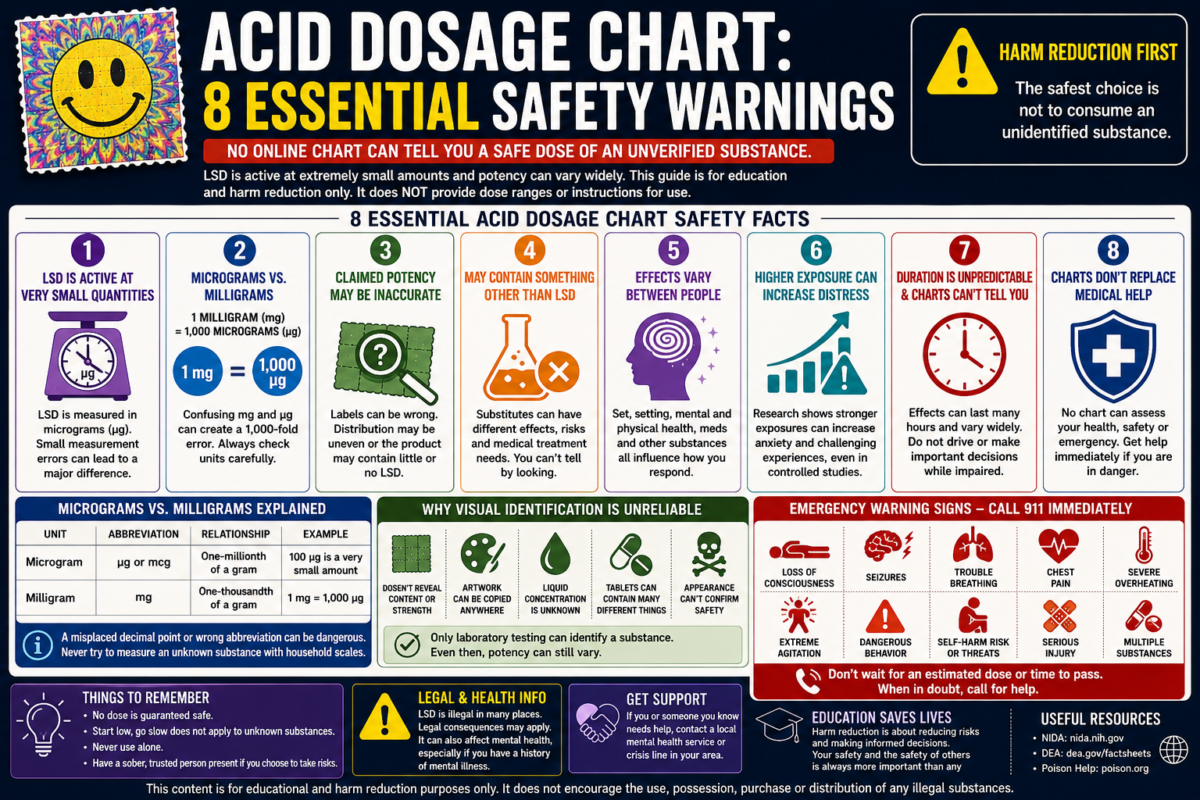
Our acid dosage chart safety guide explains why claimed strength, visual appearance and online charts cannot determine a safe amount.
6. Unknown Tablets May Contain More Than One Substance
An unidentified tablet may contain:
- LSD
- Another psychoactive compound
- Several active substances
- Inactive fillers
- Unexpected contaminants
- No LSD at all
This uncertainty makes the effects and medical risks difficult to predict.
7. Price Does Not Confirm Authenticity
A high price does not prove that a purple microdot is genuine, pure or strong. A low price does not necessarily mean the product is weak.
Price is simply a claim within an unregulated market. Read our article explaining how much acid costs and why reported prices vary.
8. Age and Storage History May Be Unknown
The age of an unidentified tablet may be impossible to verify. Exposure to heat, moisture, air or light may also be unknown.
Even when a tablet looks unchanged, its chemical contents and history remain uncertain. Our guide answering does LSD expire explains the difference between stability, appearance and verified chemical identity.
9. Severe Reactions Require Professional Help
An online article or image cannot assess a medical emergency. If someone collapses, has a seizure, struggles to breathe or cannot be awakened, emergency services should be contacted immediately.
Do not wait for an assumed substance to wear off. Another compound may have been involved, and symptoms can change quickly.
What Is the Typical Microdot Size?
There is no regulated or universal measurement for a purple microdot. The term generally means a tablet that is noticeably smaller than ordinary pharmaceutical tablets.
Searches for microdot size LSD can be misleading because size alone does not answer the important questions:
- What chemical is present?
- How much of it is present?
- Is the concentration evenly distributed?
- Are contaminants present?
- Has the tablet degraded?
- Does it contain several substances?
Placing an unknown tablet beside a coin, ruler or photograph may show its dimensions, but it cannot establish authenticity or strength.
Can LSD Be Identified by Appearance?
No. LSD cannot be reliably identified by colour, artwork, size, tablet shape or packaging.
The Drug Enforcement Administration describes LSD as appearing in several forms, including tablets, blotter paper, gelatin squares and liquid. The existence of multiple forms makes visual identification especially unreliable.
A purple microdot may resemble photographs historically associated with LSD, but resemblance is not chemical proof.
Visual identification fails because:
- Colours and shapes can be copied.
- Different substances may use similar tablet forms.
- Tablets may contain mixtures.
- Potency cannot be seen.
- Contamination may not be visible.
- Online photographs may be mislabeled.
See our guide to the reported forms and types of LSD for more educational background.
Risks of Unknown Tablets
The greatest concern with a purple microdot is not its colour. The primary concern is that its contents may be unknown.
Possible risks include:
- Unexpected psychological effects
- Severe anxiety or panic
- Confusion and impaired judgement
- Unknown interactions with medicines
- Exposure to another drug
- Contamination
- Inaccurate potency claims
- Delayed medical treatment because of mistaken identification
A person who believes they took LSD may provide incorrect information to medical professionals when the product actually contains another compound. Whenever possible, describe it as an unknown tablet represented as LSD rather than assuming its identity.
Purple Microdot Versus Blotter and Other Forms
A purple microdot differs mainly in physical presentation from blotter paper or liquid represented as LSD.
| Reported Form | General Appearance | Main Identification Limitation |
|---|---|---|
| Microdot | Very small tablet | Colour and size cannot confirm contents |
| Blotter | Small piece of absorbent paper | Artwork does not show potency or identity |
| Gel-like square | Small transparent or coloured piece | Appearance cannot verify the chemical |
| Liquid | Clear or coloured fluid | Concentration and identity may be unknown |
None of these forms should be treated as authentic based only on appearance. Street terminology describes how something looks or is presented, not what laboratory testing would find.
Why Purple Microdot Potency Claims Are Unreliable
Claims about purple microdot strength may come from sellers, anonymous discussions, old reports or repeated internet descriptions. These sources may not be based on laboratory analysis.
Potency claims can be unreliable because:
- The original amount may be unknown.
- The tablet may contain another substance.
- The chemical may be unevenly distributed.
- The tablet may have degraded.
- Units may be misunderstood.
- Seller claims may be exaggerated.
LSD is commonly discussed in micrograms rather than milligrams. Confusing those units creates a thousand-fold difference. This does not mean people should attempt to measure unknown tablets; ordinary household equipment cannot reliably measure such tiny quantities.
Read our acid half life guide to understand why metabolism, duration and detection time are different concepts.
Possible Effects and Health Concerns
If a purple microdot genuinely contains LSD, possible effects may include altered perception, changes in time awareness, emotional intensity, anxiety, confusion and impaired judgement.
If it contains another substance, the effects may be completely different. This is why symptoms cannot always identify what was taken.
Our educational pages explain the reported effects of LSD, how long LSD effects may last and broader considerations covered in Is LSD Safe?.
No online description can predict an individual reaction. Health history, mental state, other medicines and unknown substances can all influence the outcome.
Emergency Warning Signs
Call emergency services immediately if someone who may have taken a purple microdot:
- Collapses
- Has a seizure
- Has trouble breathing
- Cannot be awakened
- Experiences chest pain
- Shows severe overheating
- Becomes dangerously agitated
- Threatens self-harm or harm to others
- Has suffered a serious injury
- May have taken several substances
While waiting for help, move the person away from traffic, water, heights and sharp objects when it is safe to do so. Reduce unnecessary noise and stimulation, speak calmly and follow instructions from emergency professionals.
Do not force food or drink, encourage vomiting or give another substance in an attempt to counteract the effects.
Historical Background of Purple Microdot Terminology
The term purple microdot developed from informal descriptions of very small coloured tablets associated with LSD. Historical drug-awareness publications use the word “microdot” for a tablet form, but the colour-based wording is not a scientific product classification.
Names based on colour, artwork or appearance often spread through popular culture and informal conversations. Over time, a particular description may become widely repeated even when the products carrying that name have no consistent composition.
The National Institute on Drug Abuse report on hallucinogens and dissociative drugs discusses microdots as one historical form associated with LSD. This information provides useful terminology, but it does not mean that every small tablet called a microdot contains LSD.
A purple microdot should therefore be understood as an informal visual description. It is not a regulated brand, verified chemical formulation or reliable indicator of potency.
Why Colour-Based Identification Is Misleading
Colour is one of the first details people notice when looking at a tablet. However, colour usually comes from dyes, coatings, fillers or other inactive materials. It does not reveal the active chemical inside.
A purple appearance may be reproduced by many unrelated manufacturers or individuals. Two tablets with an identical shade can contain completely different ingredients. Similarly, tablets containing the same substance may have different colours.
Colour-based identification is unreliable because:
- Dyes can be purchased and reused by different producers.
- Photographs may alter colour because of lighting or camera settings.
- Online images may be incorrectly labelled.
- Tablet coatings can fade with age or moisture.
- Different chemicals may be pressed into similar-looking tablets.
- Contaminants and mixtures are usually invisible.
For these reasons, describing something as a purple microdot gives no dependable information about its chemical identity, strength or safety.
Why Online Images Cannot Confirm a Purple Microdot
Image searches may show photographs labelled as microdots, LSD tablets or acid. These images can be useful for understanding historical terminology, but they cannot authenticate a tablet found in real life.
Photographs do not show:
- The chemical composition of the tablet
- The concentration of any active ingredient
- Whether substances are evenly distributed
- Whether contaminants are present
- How the tablet was manufactured
- Its age or storage history
The DEA image reference for LSD illustrates that LSD has historically appeared in several physical forms. Official photographs are educational examples rather than tools for identifying an unknown substance.
A person should not assume that a tablet is a genuine purple microdot merely because it resembles an image from a government page, news article or discussion forum.
What Laboratory Testing Can and Cannot Establish
Professional laboratory analysis may identify chemicals within a submitted sample. Depending on the method used, testing may also estimate concentration or reveal unexpected compounds.
However, even laboratory testing has limitations. A result applies to the material tested and may not represent every tablet from the same package. Unregulated products can have uneven ingredient distribution, meaning one tablet may differ from another.
Testing also cannot make an illegal or unknown product safe. It does not account for a person’s medical history, mental-health vulnerabilities, medications or possible interactions.
Consumer photographs, seller-provided documents and screenshots of supposed laboratory reports are not the same as independent analysis. Reports can be edited, reused or associated with a different sample.
The safest conclusion is that visual claims about a purple microdot should not be treated as chemical evidence.
Counterfeit Labels and Reused Names
Informal product names can be copied easily. A seller may use a familiar colour, symbol or nickname to create the impression that a tablet belongs to a known batch.
Counterfeit presentation may include:
- Reused colour descriptions
- Copied logos or symbols
- Imitated packaging
- Fabricated laboratory reports
- False claims about purity
- Unverified strength statements
- Copied customer reviews
A familiar name does not establish a consistent source. There is no official manufacturer responsible for every tablet described as a purple microdot.
The DEA classifies LSD as a potent hallucinogen and explains that illegal products may be encountered in different forms. Readers can review the DEA hallucinogens fact sheet for official information about hallucinogenic substances and potential effects.
Unknown Tablets and Drug Interactions
An unknown tablet may interact with prescription medicines, non-prescription drugs, alcohol or other substances. The risk becomes harder to assess when the tablet’s ingredients are uncertain.
Possible concerns include:
- Changes in heart rate or blood pressure
- Severe agitation or confusion
- Unexpected sedation
- Overheating
- Seizures
- Loss of coordination
- Increased risk of injury
- Unpredictable psychological effects
A person may believe they encountered a purple microdot containing LSD when the tablet actually contains another substance with a different interaction profile.
Medical professionals should be told that the substance is unknown. Guessing the identity may delay appropriate treatment or lead responders to overlook other possible compounds.
Protecting Children and Animals From Unknown Tablets
Small, brightly coloured tablets may resemble sweets, vitamins or ordinary medicine. This creates an additional risk for children and animals.
If an unidentified tablet is discovered:
- Do not leave it on an open surface.
- Prevent children or pets from touching or swallowing it.
- Avoid tasting or smelling it.
- Wash hands after accidental handling.
- Contact local poison-control or public-health professionals for guidance.
- Seek immediate help if accidental ingestion may have occurred.
Do not assume that the small size of a purple microdot means exposure would be harmless. Some psychoactive compounds are active in very small quantities.
Information to Give Emergency Professionals
When contacting emergency services or poison-control specialists, provide clear and honest information. Useful details may include:
- The person’s age and approximate weight
- When the suspected exposure occurred
- How many unknown tablets may be involved
- Current symptoms
- Other medicines or substances taken
- Existing health conditions
- Any available packaging or photographs
Do not delay the call while attempting to identify the tablet online. A photograph labelled purple microdot cannot determine which substance was involved or how the reaction should be treated.
In the United States, Poison Control provides immediate exposure guidance. Emergency services should be called when someone collapses, has a seizure, struggles to breathe or cannot be awakened.
Responding to Severe Fear or Psychological Distress
Unknown psychedelic substances may cause panic, paranoia, confusion or intense changes in perception. A distressed person may not understand their surroundings and may react unpredictably.
While professional help is being arranged:
- Reduce bright lights, loud sounds and unnecessary activity.
- Speak calmly using simple sentences.
- Avoid arguing about what the person believes they are seeing.
- Keep them away from roads, balconies, water and dangerous objects.
- Do not leave them alone.
- Do not restrain them unless necessary to prevent immediate harm.
- Follow instructions given by emergency professionals.
Severe psychological distress can become a medical emergency, particularly when self-harm, aggression, overheating or an unknown mixture is involved.
Why Accurate Education Matters
Educational content about a purple microdot should reduce uncertainty rather than create false confidence. A responsible guide should make clear that colour, size, shape, price and terminology cannot establish what an unknown tablet contains.
Accurate education can help readers:
- Recognize misleading identification claims
- Understand why potency cannot be judged visually
- Avoid confusing online photographs with laboratory evidence
- Identify serious medical warning signs
- Provide better information to emergency responders
- Protect children and animals from accidental exposure
The purpose of discussing purple microdot terminology is not to promote its use. It is to explain why unregulated tablets carry unpredictable risks and why professional help matters when a suspected exposure occurs.
Frequently Asked Questions
What is a purple microdot?
A purple microdot is an informal description for a tiny purple tablet represented as containing LSD. The name does not verify its chemical contents.
What size is an LSD microdot?
Microdots are generally described as very small tablets, but no universal regulated size exists. Dimensions cannot confirm identity or potency.
Does purple colour mean a microdot contains LSD?
No. Purple is only a visible colour. It provides no scientific evidence about chemical identity, purity or strength.
Can a purple microdot be identified from a photograph?
No. Photographs cannot reveal active ingredients, concentration, contaminants or substitution with another substance.
Are microdots stronger than blotter?
Physical form cannot reliably determine potency. A seller’s comparison is not a laboratory result.
Can two microdots that look alike have different contents?
Yes. Similar-looking tablets may contain different chemicals or different concentrations.
Can an old purple microdot still look normal?
Yes. Appearance cannot establish chemical stability or storage history. A normal-looking tablet may still have unknown contents.
Does price prove that a microdot is genuine?
No. Price does not verify chemical identity, purity, potency or safety.
When should emergency help be requested?
Call immediately if someone collapses, has a seizure, struggles to breathe, cannot be awakened or shows another serious medical warning sign.
Final Thoughts
A purple microdot is an informal name for a small purple tablet represented as LSD. The colour, size and shape do not confirm what the tablet contains.
There is no universal microdot size, and online images cannot verify authenticity or potency. Unknown tablets may contain different compounds, mixtures or contaminants and can cause unpredictable reactions.
This article is provided strictly for education, poisoning prevention and harm reduction. It does not encourage the possession, purchase, identification, dosing or use of controlled substances.
