
Aug
LSD trip is one of the most widely searched topics in psychedelic education, yet it remains surrounded by myths, misconceptions, and conflicting information. Some people associate an LSD trip with colorful visuals and altered perception, while others wonder about its duration, psychological effects, and the science behind how it changes consciousness. Understanding what actually happens requires looking beyond popular culture and examining the available scientific evidence.
Lysergic acid diethylamide (LSD) is a potent psychedelic compound first synthesized in 1938 by Swiss chemist Albert Hofmann. Although it became well known during the 1960s, researchers continue studying how LSD temporarily changes communication between different regions of the brain, leading to altered perception, emotions, thinking, and sensory processing. Modern neuroscience has significantly expanded our understanding of why an LSD trip feels so different from ordinary consciousness.
An LSD trip is far more than simply “seeing things.” Many people report changes in visual perception, emotional awareness, creativity, self-reflection, and the way they experience time. Others describe profound philosophical thoughts, heightened appreciation of music and art, or a stronger awareness of their surroundings. At the same time, experiences can differ dramatically depending on factors such as mindset, environment, dosage, and individual biology.
Because no two experiences are exactly alike, it is impossible to predict precisely how an individual will experience an LSD trip. Scientific research suggests that psychological state before the experience, commonly referred to as set, together with the surrounding environment, known as setting, can play an important role in shaping the overall experience.
If you’re new to this topic, you may also find our educational guides on History of LSD, Types of LSD, and How LSD Works helpful before exploring the different stages of an LSD trip.
Throughout this comprehensive guide, you’ll learn:
- What an LSD trip actually is
- How LSD affects the brain
- The complete timeline from onset to comedown
- Common visual, emotional, and cognitive effects
- Factors that influence the overall experience
- Potential risks and safety considerations
- How LSD compares with other psychedelics
- Frequently asked questions supported by current research
This article is intended for educational purposes only and does not encourage or promote illegal drug use.
Table of Contents
- What Is an LSD Trip?
- How LSD Affects the Brain
- Complete LSD Trip Timeline
- The Four Main Stages of an LSD Trip
- Visual and Sensory Effects
- Psychological and Emotional Effects
- What Influences an LSD Trip?
- Potential Risks and Safety Considerations
- LSD vs Other Psychedelics
- Frequently Asked Questions
- Final Thoughts
What Is an LSD Trip?
An LSD trip describes the temporary changes in perception, thinking, mood, and sensory awareness that occur after LSD interacts with the brain. Rather than creating an entirely new reality, LSD changes how the brain processes information, allowing sights, sounds, emotions, and thoughts to be experienced in ways that differ from normal waking consciousness.
Scientists classify LSD as a classic psychedelic because it primarily acts on serotonin receptors, particularly the 5-HT2A receptor. Activation of these receptors changes communication between several large-scale brain networks, resulting in altered perception and cognition. Research using modern brain imaging techniques has shown that regions of the brain that normally communicate separately may become more interconnected during an LSD trip, which may help explain why people often report unusual associations, enhanced creativity, and changes in self-awareness.
Although many people associate an LSD trip with visual hallucinations, the experience usually extends much further than vision alone. Individuals may notice changes in:
- Visual perception
- Auditory processing
- Emotional awareness
- Thought patterns
- Sense of time
- Creativity
- Self-reflection
- Connection with the surrounding environment
The intensity of an LSD trip varies considerably between individuals. Even when two people consume similar amounts under comparable circumstances, differences in genetics, mental state, previous experience, and environment can produce remarkably different subjective experiences.
To better understand why these changes occur, it’s helpful to first examine what happens inside the brain after LSD is introduced into the body.
How LSD Affects the Brain
One of the most fascinating aspects of an LSD trip is how dramatically it can change perception without causing a person to lose consciousness. Modern neuroscience has helped researchers better understand why this happens, although many questions remain unanswered.
LSD primarily interacts with serotonin receptors throughout the brain, especially the 5-HT2A receptor. Serotonin is a neurotransmitter involved in regulating mood, learning, memory, attention, sleep, and sensory processing. By stimulating these receptors, LSD temporarily changes the way different brain regions communicate with one another.
Brain imaging studies have shown that during an LSD trip, networks that normally operate independently begin sharing information more freely. Researchers believe this increased connectivity may contribute to altered perception, enhanced imagination, unusual thought patterns, and the feeling that ordinary boundaries between thoughts and senses become less defined.
Scientists also suggest that LSD temporarily reduces activity within the brain’s Default Mode Network (DMN), a collection of brain regions associated with self-reflection, autobiographical memory, and the sense of personal identity. Reduced activity in this network may help explain why some individuals report experiencing changes in self-awareness or feeling deeply connected to their surroundings.
For a more detailed scientific explanation, you can read our guide on How Does LSD Work?.
How Long Does It Take for LSD to Start Working?
The exact onset varies from person to person, but many individuals begin noticing subtle changes within approximately 20 to 90 minutes. Factors such as metabolism, stomach contents, individual sensitivity, and dosage can all influence how quickly the first effects appear.
Early signs that an LSD trip is beginning may include:
- Heightened awareness of colors and sounds
- Mild changes in perception
- A feeling of anticipation
- Enhanced curiosity
- Changes in mood
- Greater appreciation of music or visual art
These early sensations gradually become more noticeable as the experience progresses toward its peak.
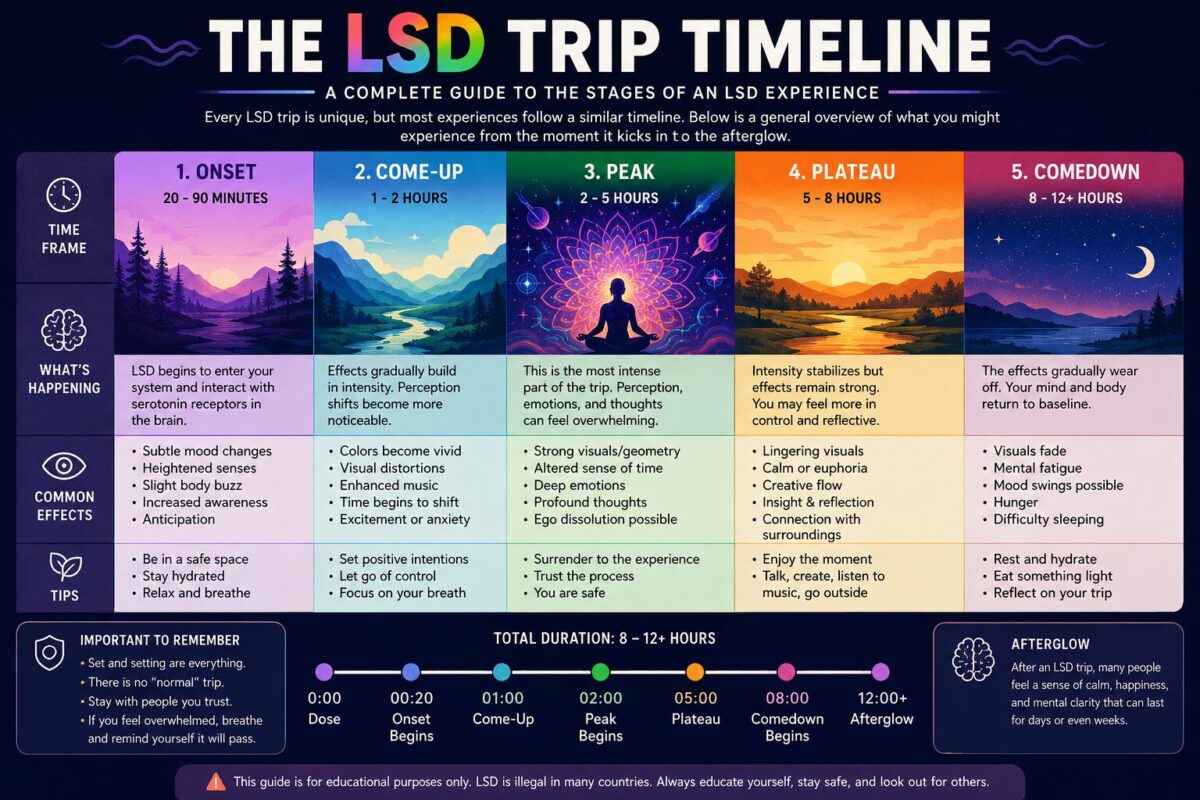
Complete LSD Trip Timeline
Although every LSD trip is different, researchers generally describe a fairly consistent progression from onset through comedown. The timeline below provides a broad educational overview rather than an exact prediction for every individual.
| Stage | Approximate Time | What Commonly Happens |
|---|---|---|
| Onset | 20–90 minutes | Subtle sensory changes and mood shifts begin. |
| Come-Up | 1–2 hours | Visual effects gradually increase while perception changes. |
| Peak | 2–5 hours | Most intense psychological and visual effects. |
| Plateau | 5–8 hours | Effects stabilize but remain noticeable. |
| Comedown | 8–12+ hours | Gradual return toward normal perception. |
If you’d like a more detailed discussion of duration, see our article on How Long Does LSD Last?.
The Four Main Stages of an LSD Trip
1. Onset
The onset marks the beginning of an LSD trip. During this stage, many people notice that ordinary perception begins changing in subtle ways. These changes often develop gradually rather than occurring all at once.
Common experiences during the onset include:
- Greater sensory awareness
- Enhanced appreciation of colors
- Slight visual distortions
- Increased emotional sensitivity
- Growing anticipation
- Changes in body awareness
Some individuals feel calm and curious during this period, while others may feel nervous simply because they recognize that the psychedelic effects are beginning.
2. Come-Up
As the LSD trip continues, the experience enters what many people describe as the come-up. During this stage, changes in perception become more noticeable, and thoughts may begin flowing differently than they do during normal waking consciousness.
People commonly report:
- Brighter and more vivid colors
- Patterns appearing more noticeable
- Greater emotional responsiveness
- Enhanced curiosity
- Changes in depth perception
- Increased appreciation for music and nature
The transition from onset to peak is gradual, and no precise moment separates the two stages.
3. Peak
The peak is generally considered the most intense portion of an LSD trip. During this period, alterations in perception, cognition, and emotion are often at their strongest.
Individuals have reported:
- Complex geometric patterns
- Moving or breathing surfaces
- Altered perception of time
- Powerful emotional experiences
- Creative thinking
- Deep personal reflection
- Changes in the perception of self
Although the peak is often associated with vivid visuals, psychological changes frequently play an equally important role in shaping the overall experience.
Many people also describe this stage as feeling much longer than it actually is because an LSD trip commonly alters the brain’s perception of time.
4. Plateau
After the peak begins to subside, most people enter what researchers often describe as the plateau phase. During this portion of an LSD trip, visual and psychological effects usually remain noticeable, but many individuals report that the experience feels more stable and easier to navigate than the peak.
Although the psychedelic effects continue, people may feel more comfortable interacting with their surroundings, reflecting on their thoughts, or appreciating music, art, and nature.
Common experiences during the plateau include:
- Continued visual distortions
- Enhanced appreciation for colors and patterns
- More organized thinking compared to the peak
- Greater emotional balance
- Ongoing introspection
- Continued changes in time perception
Many researchers believe this stage provides an opportunity for deeper reflection because the experience often feels less overwhelming while remaining psychologically engaging.
5. Comedown
The final stage of an LSD trip is commonly referred to as the comedown. During this period, perception gradually begins returning toward its normal baseline, although some psychological effects may continue for several hours.
The transition is usually gradual rather than sudden. Visual effects often become less noticeable first, followed by a gradual normalization of thoughts, emotions, and sensory perception.
Common experiences reported during the comedown include:
- Reduced visual effects
- Mental fatigue
- Emotional reflection
- Feeling physically tired
- Difficulty falling asleep immediately afterward
- Continued contemplation about the experience
Even after the primary effects have diminished, many individuals spend hours or days reflecting on what they experienced during their LSD trip.
Our educational guide on How Long Does LSD Last? explains the duration of each stage in greater detail.
Visual and Sensory Effects During an LSD Trip
Visual changes are perhaps the most widely recognized aspect of an LSD trip, but they represent only one part of a much broader alteration in perception. Rather than creating completely imaginary scenes, LSD changes how the brain processes incoming sensory information.
Researchers believe these effects result from altered communication between visual processing regions and other interconnected areas of the brain.
Common Visual Changes
Although experiences differ significantly, people commonly report:
- More vibrant and saturated colors
- Moving geometric patterns
- Trails following moving objects
- Textures appearing to ripple or breathe
- Enhanced appreciation of artwork
- Changes in depth perception
- Objects appearing unusually detailed
- Light sources appearing brighter than normal
These visual changes vary widely between individuals and should not be considered universal experiences.
Changes in Hearing
An LSD trip may also influence auditory perception.
Many people report that:
- Music feels more emotionally engaging
- Small background sounds become easier to notice
- Certain instruments seem unusually detailed
- Environmental sounds appear richer
This heightened sensory awareness helps explain why music is frequently discussed in scientific studies involving psychedelic experiences.
Changes in Time Perception
One of the most frequently reported psychological effects of an LSD trip involves the perception of time.
Some individuals describe minutes feeling like hours, while others experience long periods that seem to pass almost instantly. Researchers continue studying why psychedelics temporarily alter the brain’s internal processing of time.
Psychological and Emotional Effects
Beyond visual changes, an LSD trip often produces significant psychological effects. These experiences can range from subtle shifts in thinking to profound changes in emotional awareness.
Commonly reported emotional changes include:
- Increased empathy
- Greater appreciation of beauty
- Deep personal reflection
- Enhanced creativity
- Curiosity about philosophical questions
- Changes in self-awareness
- Heightened emotional sensitivity
Some people also report difficult emotions, including temporary anxiety, confusion, or fear. Researchers emphasize that emotional responses vary considerably between individuals and are strongly influenced by mindset and surroundings.
If you’d like to understand the science behind these changes, our article on How Does LSD Work? explores the neurological mechanisms in greater detail.
What Influences an LSD Trip?
Every LSD trip is unique. While LSD affects the brain in predictable biological ways, researchers agree that no two experiences are exactly alike. A combination of psychological, environmental, and biological factors helps determine how intense or mild an experience may feel.
Understanding these influences is important because they help explain why two individuals can have completely different experiences even when exposed to similar amounts of LSD.
1. Mindset (Set)
One of the most important factors influencing an LSD trip is a person’s mindset before the experience begins. Researchers commonly refer to this as “set.”
Mindset includes:
- Current emotional state
- Stress levels
- Personal expectations
- Previous experiences
- General mental well-being
Individuals who begin an experience feeling anxious, overwhelmed, or emotionally distressed may perceive the effects differently than someone who begins in a calm and positive frame of mind.
2. Environment (Setting)
The surroundings where an LSD trip occurs are commonly known as the setting. This concept has been discussed extensively in psychedelic research for decades.
Environmental factors include:
- Lighting
- Noise levels
- Music
- Weather
- Familiarity with the location
- People present
- Overall comfort
A comfortable, familiar environment may contribute to a more positive subjective experience, whereas unfamiliar or stressful surroundings may increase emotional discomfort for some individuals.
3. Individual Brain Chemistry
Every brain is different. Genetics, metabolism, personality, and natural differences in neurochemistry all influence how an LSD trip is experienced.
Scientists continue investigating why some individuals appear more sensitive to psychedelic compounds than others.
4. Previous Psychedelic Experience
Someone with previous experience may interpret certain psychological or visual changes differently than someone encountering them for the first time.
Researchers note that familiarity with altered states of consciousness may influence expectations, although every LSD trip remains unpredictable.
5. Dosage
The amount of LSD consumed is another important factor influencing intensity. In scientific literature, increasing doses are generally associated with stronger perceptual and psychological changes, although responses vary considerably between individuals.
If you’d like to understand dosage terminology, our educational guide on Acid Dosage Chart provides additional information.
Potential Risks and Safety Considerations
Like many psychoactive substances, an LSD trip carries potential risks. Although many experiences are described as positive or insightful, researchers emphasize that responses vary widely and difficult experiences can occur.
Psychological Risks
Some individuals may experience:
- Temporary anxiety
- Confusion
- Panic
- Fear
- Paranoia
- Emotional distress
These reactions are sometimes referred to as a “challenging experience” or “bad trip.” Researchers believe mindset and environment may influence the likelihood of these experiences, although they cannot predict them with certainty.
Physical Effects
Although LSD is not generally associated with the same physical risks as many other substances, temporary physical changes may occur during an LSD trip, including:
- Dilated pupils
- Increased heart rate
- Elevated blood pressure
- Sweating
- Reduced appetite
- Trembling
These effects vary considerably between individuals.
Hallucinogen Persisting Perception Disorder (HPPD)
Researchers continue studying a rare condition known as Hallucinogen Persisting Perception Disorder (HPPD). Individuals with HPPD may continue experiencing certain visual disturbances after psychedelic use.
Although uncommon, HPPD remains an active area of scientific research.
Mental Health Considerations
Scientific organizations generally advise that individuals with certain psychiatric conditions should exercise caution, as psychedelic substances may increase psychological risks in susceptible individuals.
If someone experiences severe distress or a medical emergency, immediate assistance from local emergency medical services should be sought.
For additional educational information, visit our guide on Is LSD Safe?.
LSD Trip vs Other Psychedelic Experiences
Although LSD is one of the best-known psychedelics, it differs from compounds such as psilocybin mushrooms and DMT in several important ways.
| Substance | Typical Duration | Common Characteristics |
|---|---|---|
| LSD | 8–12+ hours | Long-lasting visual, emotional, and cognitive changes |
| Psilocybin Mushrooms | 4–6 hours | Visual effects with strong emotional and introspective experiences |
| DMT | 5–20 minutes (inhaled) | Extremely intense but very short immersive experiences |
You can continue learning by exploring our related educational guides:
Frequently Asked Questions About an LSD Trip
How long does an LSD trip usually last?
An LSD trip commonly lasts between 8 and 12 hours, although the exact duration varies depending on factors such as metabolism, dosage, and individual biology. Some after-effects, such as difficulty sleeping or continued reflection, may persist beyond the primary experience.
For a complete timeline, read our guide on How Long Does LSD Last?.
What does an LSD trip feel like?
An LSD trip can involve changes in visual perception, emotions, thinking patterns, creativity, and the perception of time. Experiences differ greatly from person to person, making it impossible to predict exactly how any individual will respond.
Does everyone experience hallucinations?
No. Although visual changes are commonly reported, not everyone experiences vivid hallucinations. Some people mainly notice changes in mood, sensory awareness, or thought patterns rather than dramatic visual effects.
Can an LSD trip change time perception?
Yes. Altered perception of time is one of the most frequently reported characteristics of an LSD trip. Minutes may seem much longer or shorter than they actually are.
Can two people have the same LSD trip?
No. Individual biology, expectations, surroundings, previous experiences, and numerous psychological factors make every LSD experience unique.
Is an LSD trip the same as a mushroom trip?
No. Although both LSD and psilocybin mushrooms are classic psychedelics, they differ in chemical structure, duration, intensity, and the subjective experiences they may produce.
You can compare them in our article on LSD vs Psilocybin.
How does LSD affect the brain?
LSD primarily interacts with serotonin receptors, especially the 5-HT2A receptor, temporarily changing communication between different brain regions. Scientists continue studying these mechanisms to better understand consciousness and perception.
Learn more in our guide on How Does LSD Work?.
Is LSD addictive?
Current scientific evidence suggests that LSD is not generally associated with the same pattern of compulsive use seen with many other substances. However, researchers continue studying its long-term psychological effects and patterns of use.
You may also enjoy our educational guide on Is LSD Addictive?.
Final Thoughts
An LSD trip is one of the most complex and widely studied psychedelic experiences. Rather than simply producing visual effects, LSD temporarily alters the way the brain processes sensory information, emotions, memories, and thoughts. These changes can influence perception, creativity, self-awareness, and the experience of time in ways that continue to interest neuroscientists and psychologists around the world.
Although researchers have made significant progress in understanding how LSD works, many aspects of the psychedelic experience remain active areas of scientific investigation. Every LSD trip is influenced by a combination of biology, mindset, environment, and individual differences, making each experience unique.
Whether you’re interested in the history of LSD, its effects on the brain, or the latest scientific research, learning from evidence-based educational sources provides a more accurate understanding than relying on myths or popular misconceptions.
If you’d like to continue learning, explore our related educational resources below.
Related LSD Guides
- History of LSD
- Types of LSD
- How Does LSD Work?
- LSD Effects
- How Long Does LSD Last?
- Is LSD Safe?
- Acid Dosage Chart
- LSD Microdosing
- LSD vs Psilocybin
- DMT vs LSD
- Does LSD Expire?
- Street Names for LSD
Authoritative References
National Institute on Drug Abuse (NIDA)
Johns Hopkins Center for Psychedelic & Consciousness Research

Pingback: Acid Trip: 7 Powerful Facts You Should Know
Pingback: LSD Reddit: 7 Helpful Insights You Should Know