
Aug
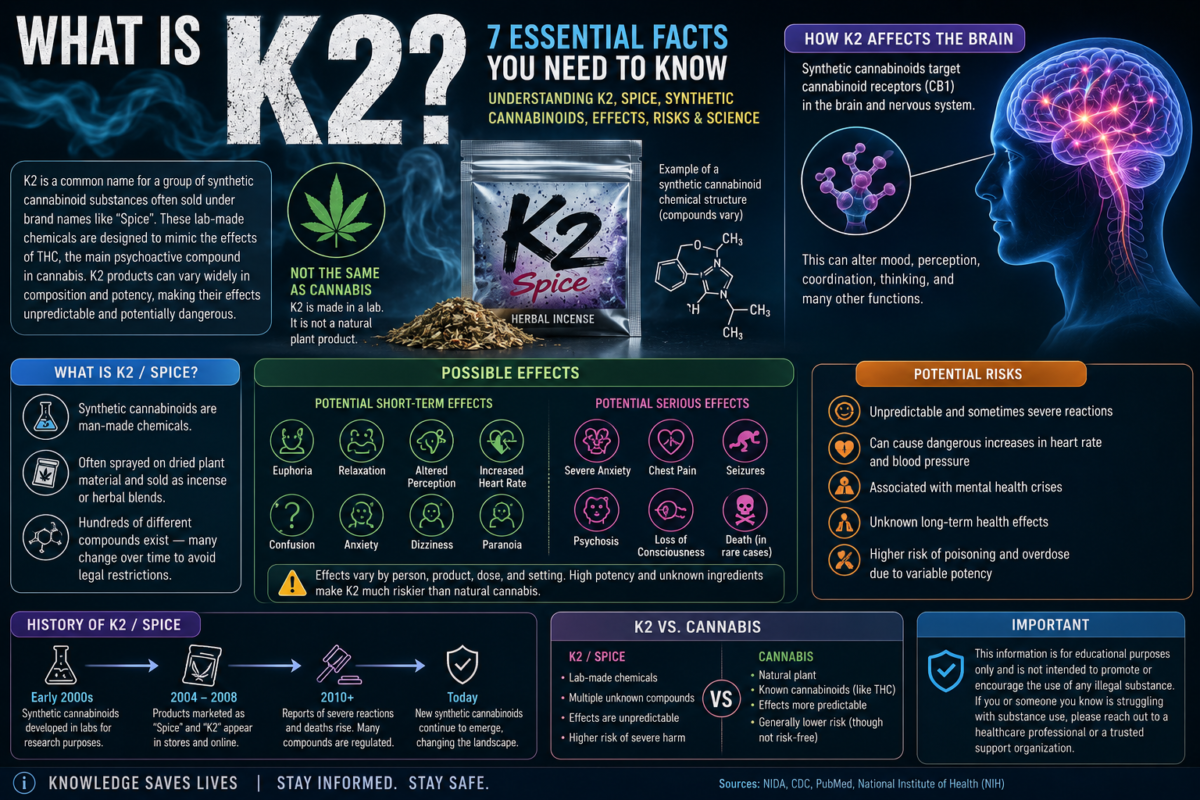
What is K2? K2 is a common name associated with a group of laboratory-made substances known as synthetic cannabinoids. The term is also connected with names such as “Spice,” although products sold under these labels can contain different chemicals and their composition can change over time.
Unlike naturally occurring cannabis, synthetic cannabinoids are manufactured chemicals designed to interact with cannabinoid receptors in the body. Some can produce effects that resemble aspects of cannabis, but their chemistry and pharmacological behavior can be substantially different.
The question what is K2 therefore cannot be answered simply by calling it “synthetic marijuana.” That description can create the misleading impression that K2 behaves like ordinary cannabis. In reality, synthetic cannabinoid products can have unpredictable effects, and their contents may not be obvious from a product name or appearance.
This comprehensive guide explains what is K2, what the name K2 means, how it relates to Spice and synthetic cannabinoids, how these substances interact with the brain, potential effects and risks, their history, and why researchers and public-health organizations treat them differently from natural cannabis.
Table of Contents
- What Is K2?
- What Does K2 Mean?
- What Is K2 Spice?
- What Are Synthetic Cannabinoids?
- Is K2 the Same as Cannabis?
- How K2 Interacts With the Brain
- K2 Effects
- Why K2 Effects Can Be Unpredictable
- Potential Health Risks
- History of K2 and Spice
- Scientific Research
- Common Misconceptions
- Frequently Asked Questions
What Is K2?
What is K2? K2 is an informal name commonly used for products containing synthetic cannabinoids. These chemicals are created in laboratories and are designed to interact with cannabinoid receptors, particularly receptors involved in the body’s endocannabinoid system.
The term K2 does not necessarily identify one single chemical. Instead, it has historically been used as a broad label for products containing various synthetic cannabinoid compounds.
This distinction is extremely important. A product called K2 at one point in time may not contain the same active chemical as another product sold under the same name. Manufacturers and illicit suppliers can also change formulations, making assumptions based on branding unreliable.
Researchers therefore generally discuss the individual synthetic cannabinoid involved rather than treating K2 as though it were one standardized substance.
What Does K2 Mean?
The meaning of K2 depends heavily on context. In drug-related discussions, K2 generally refers to synthetic cannabinoid products, while the term can have completely different meanings in unrelated subjects.
In the context of psychoactive substances, K2 became associated with products marketed or described as alternatives to cannabis. The name became particularly recognizable through news coverage, public-health warnings, and discussions about unusual reactions associated with synthetic cannabinoid exposure.
Because K2 is a slang or product-category term rather than a precise chemical name, it should not be interpreted as a guarantee of a particular molecular composition.
What Is K2 Spice?
K2 Spice is terminology commonly used to describe synthetic cannabinoid products. “Spice” became another widely recognized name for this category of substances.
The names K2 and Spice are sometimes used interchangeably, but neither term necessarily identifies one specific chemical. Different products can contain different synthetic cannabinoids, and formulations can change.
This variability is one reason the effects associated with K2 or Spice can differ considerably from one product or exposure to another.
What Are Synthetic Cannabinoids?
Synthetic cannabinoids are laboratory-made chemicals that interact with cannabinoid receptors. Their development has allowed scientists to investigate the endocannabinoid system and how different chemical structures affect cannabinoid receptors.
Some synthetic cannabinoids were originally developed as research tools. Others later appeared in commercial or illicit products marketed under names such as K2 or Spice.
It is important not to assume that all synthetic cannabinoids have the same effects. Chemical structure, receptor activity, potency, metabolism, and other characteristics can differ substantially between compounds.
Is K2 the Same as Cannabis?
No. K2 and natural cannabis are not chemically identical.
Cannabis contains naturally occurring cannabinoids, including THC and other compounds. K2 refers to products associated with synthetic cannabinoids, which are laboratory-made substances with their own molecular structures and pharmacological properties.
Although both can affect cannabinoid receptors, this does not mean their effects or risks are interchangeable.
Calling K2 “synthetic marijuana” can therefore be misleading. The comparison describes a broad intended effect rather than demonstrating that the two substances are pharmacologically equivalent.
How K2 Interacts With the Brain
To understand what is K2, it is useful to understand the endocannabinoid system. This biological signaling system contains cannabinoid receptors that participate in processes involving mood, memory, appetite, pain perception, and other physiological functions.
Synthetic cannabinoids can interact with cannabinoid receptors and alter signaling within this system. The strength and character of those interactions depend on the particular chemical involved.
Some synthetic cannabinoids can produce strong receptor activity, which helps explain why their effects may be substantially different from what someone expects based solely on comparisons with cannabis.
K2 Effects
The effects associated with K2 can vary significantly because products may contain different synthetic cannabinoid compounds and may have uncertain composition.
Reported effects can include altered perception, changes in mood, confusion, agitation, drowsiness, impaired coordination, anxiety, or other changes in behavior and cognition.
Physical effects can also occur because cannabinoid receptors are involved in multiple physiological processes. Heart rate, blood pressure, coordination, and other bodily functions can be affected.
The variability of synthetic cannabinoid products makes it difficult to predict an individual’s response simply from the name K2.
Why K2 Effects Can Be Unpredictable
One of the most important things to understand when asking what is K2 is that the term does not describe one standardized pharmaceutical product. Synthetic cannabinoid products can contain different chemicals, and the concentration or composition may vary.
This variability can make the effects difficult to predict. Two products carrying similar names may contain different active compounds, while products containing the same broad category of synthetic cannabinoids can differ in potency and biological activity.
Individual factors also matter. A person’s age, health, medications, previous exposure to psychoactive substances, and environmental circumstances can influence how a synthetic cannabinoid affects them.
Consequently, experiences associated with K2 should not be assumed to represent the effects of every synthetic cannabinoid.
Physical Effects of K2
The physical effects associated with K2 can involve several body systems because cannabinoid receptors participate in numerous physiological processes.
Reported reactions can include changes in heart rate, blood pressure, coordination, alertness, and muscle activity. Some people may experience dizziness, nausea, sweating, or unusual sensations.
More serious reactions have also been reported with some synthetic cannabinoid exposures. These can involve severe agitation, seizures, loss of consciousness, cardiovascular problems, or other medical emergencies.
The severity and combination of effects can depend on the particular chemical involved and the circumstances surrounding exposure.
Psychological Effects of K2
Synthetic cannabinoids can also affect psychological and cognitive functions. Depending on the substance and individual response, reported experiences can include changes in perception, confusion, anxiety, agitation, paranoia, or unusual behavior.
Some people may experience sedation or reduced alertness, while others can become extremely restless or distressed.
These effects illustrate why describing K2 simply as “synthetic cannabis” does not adequately explain its potential psychological profile.
Why Synthetic Cannabinoid Potency Matters
Another important part of understanding what is K2 is recognizing that synthetic cannabinoids can differ substantially in their interactions with cannabinoid receptors.
A naturally occurring cannabinoid and a laboratory-made cannabinoid may both interact with the same receptor system while producing different levels of receptor activation. Structural differences between individual synthetic cannabinoids can also affect how strongly and how long they interact with biological targets.
This variation is one reason scientists study individual compounds rather than assuming that every substance sold under the K2 or Spice label has identical pharmacological properties.
Potential Health Risks
The potential health risks associated with K2 are an important part of understanding the substance. Because synthetic cannabinoid products can vary in composition, the potential effects may also vary considerably.
Reported adverse reactions can involve the cardiovascular, neurological, gastrointestinal, and psychological systems. Some exposures have been associated with severe symptoms requiring emergency medical attention.
The unpredictable nature of some synthetic cannabinoid products is particularly concerning because a person may not know which specific compound is present or how strongly it may interact with cannabinoid receptors.
When a Reaction May Require Medical Attention
A severe reaction to a synthetic cannabinoid should be treated as a medical concern rather than something to simply observe at home.
Warning signs can include severe confusion, loss of consciousness, seizures, difficulty breathing, extreme agitation, chest pain, or other rapidly worsening symptoms.
When someone develops a serious or potentially life-threatening reaction after taking an unknown substance, prompt professional medical evaluation is appropriate. The exact symptoms and circumstances should be communicated to healthcare professionals whenever possible.
K2 and Dependence
Another important question surrounding K2 is whether repeated exposure can contribute to problematic use or dependence.
Dependence refers to adaptations that can occur when the body becomes accustomed to repeated exposure to a substance. It is different from simply experiencing an effect or occasionally using a substance.
Some synthetic cannabinoids have been associated with patterns of repeated use and withdrawal-related symptoms. Because the category includes many chemically different compounds, however, the characteristics of dependence can differ between substances.
For that reason, researchers generally avoid treating every synthetic cannabinoid as though it has exactly the same dependence profile.
Synthetic Cannabinoid Withdrawal
People who repeatedly use some synthetic cannabinoids may experience unpleasant symptoms after stopping. The nature and severity of withdrawal can vary according to the particular substance, frequency of exposure, and individual factors.
Possible symptoms can include irritability, anxiety, sleep disturbance, restlessness, nausea, or other physical and psychological changes.
Anyone experiencing significant or worsening symptoms after stopping a psychoactive substance should consider seeking professional medical advice rather than attempting to diagnose the cause independently.
Why K2 Products Can Change Over Time
The history of K2 demonstrates why product names should not be treated as fixed chemical identities. Synthetic cannabinoid manufacturers have historically introduced new compounds as regulations and market conditions changed.
A new chemical may be structurally different from an earlier compound while still being marketed under a familiar product category or name.
This creates an important distinction between a brand or street name and a chemical identity. Scientific classification depends on the actual molecular structure and pharmacological characteristics of a substance, not simply the name printed on packaging.
Can K2 Be Identified by Appearance?
Appearance is not a reliable way to determine whether an unknown material contains a particular synthetic cannabinoid.
Color, texture, packaging, branding, or other visual characteristics cannot establish molecular identity. Different chemicals can look similar, while materials with similar names can contain different substances.
Reliable chemical identification requires appropriate analytical methods performed under suitable conditions.
K2 vs Natural Cannabis
Although K2 is sometimes described as an alternative to cannabis, the comparison should be approached carefully.
Natural cannabis contains a complex mixture of naturally occurring cannabinoids and other plant compounds. K2 refers to synthetic cannabinoid products containing laboratory-made chemicals.
The fact that both can interact with cannabinoid receptors does not make them chemically equivalent. Their molecular structures, receptor activity, metabolism, duration, and potential adverse effects can differ.
This is why the phrase “synthetic marijuana” can oversimplify an important scientific distinction.
What Scientists Study About K2
Researchers studying synthetic cannabinoids examine their molecular structures, receptor interactions, metabolism, pharmacological effects, toxicity, and potential health consequences.
Laboratory research can help scientists determine how individual compounds interact with cannabinoid receptors. Clinical and public-health research can then examine how these molecular properties relate to observed effects and adverse events.
This multidisciplinary approach is particularly important because the term K2 encompasses a broad and changing group of substances rather than one uniform chemical.
Why K2 Is a Public-Health Concern
Understanding what is K2 is important from a public-health perspective because the term can create a false impression of consistency.
When people encounter a product marketed under a familiar name, they may assume that its effects will be predictable based on previous experiences or information found online. With synthetic cannabinoids, that assumption can be unreliable.
Public-health education therefore focuses on the distinction between product names and chemical identity, as well as the potential for serious and unpredictable reactions.
The History of K2 and Spice
The history of K2 is connected to the broader development of synthetic cannabinoids and scientific research into the endocannabinoid system. Synthetic cannabinoid compounds were initially investigated in legitimate scientific settings, including research into cannabinoid receptors and their biological functions.
Over time, some synthetic cannabinoid compounds appeared in products marketed under names such as K2 and Spice. These products were often promoted as alternatives to cannabis, but their chemical composition could vary considerably.
The changing nature of synthetic cannabinoid products became an important public-health issue because new compounds could appear under familiar names, making it difficult for consumers to know exactly what chemicals were present.
From Laboratory Research to Public-Health Concern
The story of K2 illustrates an important distinction between scientific research and recreational drug markets. Synthetic cannabinoids can be valuable research tools because they allow scientists to investigate cannabinoid receptors and related biological pathways.
However, a compound developed for laboratory research does not automatically have the same safety profile as cannabis or any other familiar substance.
As different synthetic cannabinoids entered illicit markets, researchers and public-health agencies began documenting a wide range of effects and adverse reactions.
Understanding the Endocannabinoid System
To understand what is K2, it helps to understand the biological system targeted by synthetic cannabinoids.
The endocannabinoid system is a network of receptors, signaling molecules, and enzymes involved in numerous physiological processes. It participates in functions related to mood, memory, appetite, pain perception, immune activity, and other aspects of biological regulation.
Cannabinoid receptors are important components of this system. Synthetic cannabinoids can interact with these receptors and alter signaling, but different compounds can interact with them in different ways.
Why Different Synthetic Cannabinoids Behave Differently
Not all synthetic cannabinoids have identical molecular structures or pharmacological properties. Even when two compounds interact with the same receptor, their strength, duration, and pattern of receptor activity can differ.
This is one reason the broad term K2 can be scientifically imprecise. It may refer to products containing different chemicals with substantially different biological characteristics.
Researchers therefore study individual compounds separately whenever possible rather than assuming that one synthetic cannabinoid represents the entire category.
The Chemistry Behind K2
The chemicals associated with K2 belong to a broad group of laboratory-made cannabinoid compounds. Their molecular structures can differ substantially from naturally occurring cannabinoids found in cannabis.
Chemical structure influences how a compound interacts with biological receptors, how it is metabolized, and how long its effects may persist.
Because the category contains many different compounds, there is no single molecular formula or chemical structure that can accurately represent every substance referred to as K2.
Why Chemical Variation Matters
When the composition of a product is uncertain, predicting its effects becomes much more difficult.
A person may encounter a product marketed under the same general name but containing a different synthetic cannabinoid from one encountered previously. Differences in potency, receptor activity, metabolism, and concentration can therefore change the resulting experience.
This chemical variability is one of the central reasons public-health researchers emphasize that K2 should not be treated as a standardized substance.
K2 and Mental Health
Synthetic cannabinoid exposure can affect perception, mood, cognition, and behavior. Some people may experience anxiety, confusion, paranoia, agitation, or other significant psychological changes.
Severe reactions can sometimes require urgent medical attention. Because the term K2 can encompass multiple chemicals, researchers cannot assume that every synthetic cannabinoid produces the same psychological profile.
People experiencing severe confusion, extreme agitation, loss of consciousness, seizures, difficulty breathing, or other serious symptoms after exposure to an unknown substance should seek urgent medical assistance.
Legal and Regulatory Changes
The legal history of K2 has been complicated by the introduction of new synthetic cannabinoid compounds. When particular chemicals became subject to regulation, chemically different compounds could subsequently appear.
This created challenges for lawmakers and public-health authorities because regulating one molecule did not necessarily eliminate every chemically distinct substance in the broader category.
Legal rules also vary between jurisdictions. Anyone researching the current legal status of a specific synthetic cannabinoid should consult the laws and official guidance applicable to their location.
Why K2 Became Widely Known
K2 became widely recognized through media coverage, public-health warnings, and reports describing unusual or severe reactions associated with synthetic cannabinoid products.
The name became especially prominent because it was used as a recognizable label for a category of products rather than a single standardized pharmaceutical compound.
This history helps explain why searches such as what is K2, what’s K2, and what is a K2 can lead to information about a broad range of synthetic cannabinoids.
Common Misconceptions About K2
K2 is simply synthetic cannabis
The comparison is incomplete. Synthetic cannabinoids are chemically distinct from the naturally occurring cannabinoids found in cannabis, and their pharmacological effects can differ.
K2 always contains the same chemical
No. K2 is a broad informal term associated with different synthetic cannabinoid products and does not identify one universal molecule.
K2 is harmless because it is sold as an alternative to cannabis
A marketing description does not establish safety. Some synthetic cannabinoid exposures have been associated with severe adverse reactions.
You can identify K2 by its appearance
Appearance cannot reliably establish chemical identity. Laboratory analysis is required to determine what an unknown material contains.
Why Accurate Information About K2 Matters
The question what is K2 is more complicated than a simple dictionary definition because K2 is not one standardized chemical compound.
A useful scientific explanation must distinguish between the informal product name, synthetic cannabinoid chemistry, receptor pharmacology, individual effects, and potential health risks.
Understanding these distinctions can help readers evaluate online claims more critically and avoid assuming that a familiar name guarantees a predictable chemical composition.
Related Educational Reading
For broader information about psychoactive substances and their effects, explore the educational resources available throughout our site. Internal links in this article should remain limited to relevant URLs already present in your sitemap so that the site’s topical structure stays clean and avoids unnecessary link repetition.
Frequently Asked Questions About What Is K2?
What is K2?
What is K2? K2 is a commonly used name for products associated with synthetic cannabinoids. These are laboratory-made chemicals designed to interact with cannabinoid receptors. K2 is not one single standardized chemical compound, so products using the name can differ in composition.
What is K2 Spice?
K2 Spice is terminology associated with synthetic cannabinoid products. “K2” and “Spice” are often used as broad informal names rather than precise chemical classifications.
What’s K2?
In drug-related discussions, what’s K2 generally means asking about synthetic cannabinoid products. The term should not be interpreted as identifying one specific molecule because different products can contain different synthetic cannabinoids.
What is a K2 drug?
A K2 drug generally refers to a product associated with synthetic cannabinoids. These laboratory-made substances can interact with cannabinoid receptors but may have substantially different pharmacological properties from natural cannabis.
Is K2 the same as marijuana?
No. K2 and natural cannabis are chemically different. Cannabis contains naturally occurring cannabinoids, while K2 refers to products associated with synthetic cannabinoid compounds. Their effects and risks can therefore differ.
Why is K2 sometimes called synthetic marijuana?
K2 has sometimes been described as “synthetic marijuana” because certain products were marketed as alternatives to cannabis. However, the phrase can be misleading because synthetic cannabinoids are chemically distinct from the naturally occurring compounds in cannabis.
What are synthetic cannabinoids?
Synthetic cannabinoids are laboratory-made compounds that interact with cannabinoid receptors. They are a broad chemical category rather than one specific substance, and different compounds can have substantially different effects.
Can K2 have different effects from cannabis?
Yes. Synthetic cannabinoids can interact with cannabinoid receptors differently from naturally occurring cannabinoids. Differences in molecular structure, potency, metabolism, and receptor activity can contribute to different effects.
Why can K2 effects be unpredictable?
The term K2 can refer to products containing different synthetic cannabinoid compounds. Their concentrations and chemical compositions may vary, making effects difficult to predict based solely on the product name.
What are the potential risks of K2?
Potential adverse reactions associated with synthetic cannabinoids can include severe anxiety, confusion, agitation, cardiovascular effects, seizures, loss of consciousness, and other serious symptoms. The specific risks depend partly on the compound involved and the circumstances of exposure.
Can someone become dependent on K2?
Repeated exposure to some synthetic cannabinoids can be associated with problematic use and dependence. Withdrawal-related symptoms have also been reported with some compounds. Because synthetic cannabinoids are chemically diverse, their dependence profiles are not necessarily identical.
Can you tell what K2 contains by looking at it?
No. Color, texture, packaging, branding, and other visual characteristics cannot reliably establish the chemical identity of an unknown substance. Appropriate analytical testing is needed for definitive identification.
Why does K2 chemistry change?
K2 is a broad informal term rather than the name of one molecule. Different synthetic cannabinoids have appeared in products over time, meaning the chemical associated with a product name can change.
Is K2 legal?
The legal status of synthetic cannabinoids varies by jurisdiction and can change as individual compounds become regulated. Current laws and official government guidance should be consulted for a specific location.
Conclusion
So, what is K2? K2 is a broad informal term associated with synthetic cannabinoid products rather than one standardized chemical substance.
Understanding this distinction is essential because synthetic cannabinoids can differ considerably in molecular structure, receptor activity, potency, metabolism, and effects. The term K2 therefore cannot reliably predict what chemical is present or exactly how an individual will respond.
K2 is also different from natural cannabis. Although both synthetic cannabinoids and cannabis can interact with cannabinoid receptors, their chemistry and pharmacological properties are not necessarily equivalent.
The most useful way to understand K2 is through its chemistry, pharmacology, history, and potential health effects rather than relying on informal labels or appearance. Scientific information and appropriate medical guidance are more reliable than assumptions based on product names.
Related Educational Topics
- What Are Hallucinogens? Types, Effects, Risks & Research
- Psychedelics for Beginners
- Beginner Guide to Psychedelics
- Cannabis Concentrates
Further Scientific Reading
National Institute on Drug Abuse — Synthetic Cannabinoids
