Jun
History of DMT: 12 Defining Milestones From Tradition to Modern Science
History of DMT is not simply the story of a molecule discovered in a twentieth-century laboratory. It includes longstanding Indigenous knowledge of psychoactive plants, the development of Amazonian ceremonial preparations, early chemical identification, human experiments, international prohibition and renewed scientific interest.
Western chemistry gave N,N-dimethyltryptamine its modern scientific name and molecular description, but Indigenous communities in South America had already developed sophisticated cultural, medicinal and spiritual relationships with DMT-containing plants and preparations.
This educational article follows the history of DMT from traditional plant knowledge to contemporary neuroscience and clinical research. It does not provide instructions for extracting, preparing, purchasing or consuming DMT.
Table of Contents
- A Brief History of DMT
- 12 Defining Milestones in DMT History
- Indigenous Knowledge Before Modern Chemistry
- Ayahuasca and Amazonian Traditions
- Traditional Snuffs and DMT-Containing Plants
- 1931: The First Laboratory Synthesis
- Recognition of DMT in Plant Material
- 1950s: Stephen Szára and Human Research
- DMT Research During the 1960s
- The Legal Turning Point of 1971
- Why Human Research Slowed
- The Return of Human DMT Research
- Modern Brain and Consciousness Research
- Contemporary Clinical Interest
- Cultural Respect and Research Ethics
- History of DMT Timeline
- How DMT History Is Documented
- Indigenous Knowledge and DMT History
- Archaeological Evidence
- From Ethnobotany to Chemistry
- Richard Manske and 1931
- Stephen Szára and Human Research
- Endogenous DMT Research
- DMT and Counterculture
- How Prohibition Changed Research
- The 1990s Research Revival
- Modern Neuroscience
- Clinical Trials and Future Research
- Frequently Asked Questions
A Brief History of DMT
The history of DMT can be understood through three overlapping histories:
- Indigenous and traditional knowledge
- Modern chemical and medical research
- Legal and political control
These histories did not begin at the same time. Indigenous people knew and used psychoactive botanical preparations long before scientists isolated or synthesized the compound now called N,N-dimethyltryptamine.
The modern scientific timeline usually highlights:
- Traditional use of DMT-containing plants in South America
- Laboratory synthesis in 1931
- Identification in plant materials during the mid-twentieth century
- Human psychedelic research beginning in the 1950s
- Expansion of interest during the 1960s
- Legal control during the early 1970s
- A reduction in approved human research
- The revival of controlled studies during the 1990s
- Modern neuroimaging and clinical investigation
For a broader introduction to the compound, visit our complete DMT guide.
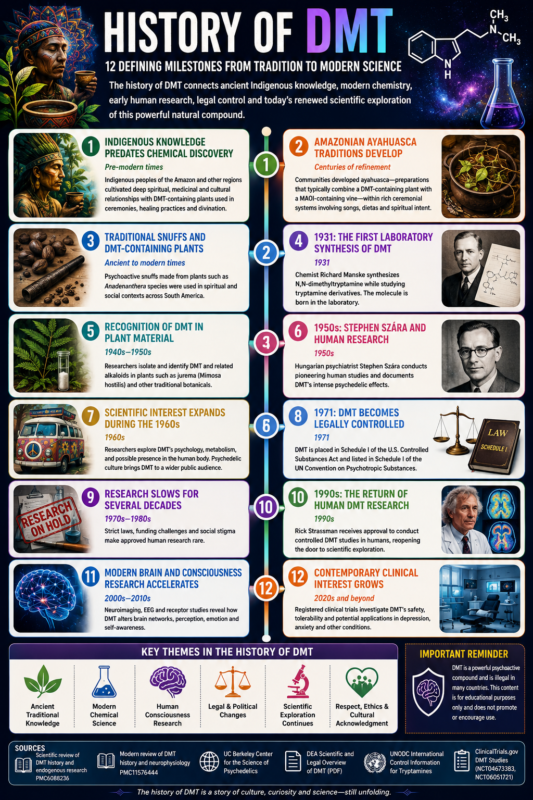
12 Defining Milestones in the History of DMT
1. Indigenous Knowledge Predated Chemical Identification
The history of DMT begins before the molecule had a scientific name. Indigenous communities across parts of South America developed detailed knowledge of plants used in ceremonial, healing and spiritual settings.
This knowledge was transmitted through cultural practice rather than modern chemical analysis. Communities understood that particular plants, preparation traditions and ceremonial contexts produced distinct effects even though they did not describe those effects using receptor pharmacology or molecular formulas.
2. Amazonian Ayahuasca Traditions Developed Over Generations
Ayahuasca refers to a diverse family of Amazonian preparations rather than one universal recipe or tradition. Different communities use different plant combinations, names, songs, ceremonies and healing practices.
Many commonly studied preparations include a DMT-containing plant and a vine containing beta-carboline alkaloids. Modern chemistry later helped explain how these components interact, but traditional knowledge identified the functional relationship long before laboratory pharmacology did.
3. DMT-Containing Snuffs Also Had Traditional Roles
Not every traditional DMT-related preparation was ayahuasca. Archaeological, ethnobotanical and historical evidence describes the use of psychoactive snuffs prepared from plants such as species associated with the Anadenanthera genus.
These traditions demonstrate that Indigenous relationships with DMT-containing plants were geographically and culturally diverse.
4. Richard Manske Synthesized DMT in 1931
A major milestone in the scientific history of DMT occurred in 1931, when chemist Richard Manske synthesized N,N-dimethyltryptamine while studying tryptamine-related compounds.
At the time, the compound’s powerful psychedelic effects were not yet established. Its synthesis was a chemical achievement rather than the immediate discovery of a new psychoactive drug.
5. Researchers Connected DMT With Natural Plant Sources
During the 1940s and 1950s, researchers increasingly investigated psychoactive plants used in South America. Brazilian scientist Oswaldo Gonçalves de Lima isolated an alkaloid from jurema material in the 1940s and called it nigerine.
The historical details are more complicated than the simple statement that pure DMT was conclusively identified in 1946. Later work was needed to clarify the chemical identity of plant alkaloids and establish DMT’s occurrence in particular botanical materials.
6. Stephen Szára Demonstrated Human Psychedelic Effects
In the mid-1950s, Hungarian psychiatrist and chemist Stephen Szára investigated DMT in humans and reported its intense psychedelic properties.
His work helped transform DMT from a chemical curiosity into a subject of psychiatric and consciousness research.
Early reports described changes involving:
- Visual perception
- Body image
- Mood
- Time perception
- Thought and communication
- Awareness of the environment
Research standards during this era differed considerably from modern clinical-trial requirements.
7. Scientific Interest Expanded During the 1960s
Researchers during the 1960s investigated DMT’s psychological effects, metabolism and relationship to other tryptamine psychedelics.
The compound attracted attention partly because of its unusually rapid and intense subjective effects compared with longer-acting psychedelics.
Scientists also began exploring whether DMT occurred naturally in human and animal tissues. These investigations helped create the continuing debate about whether endogenous DMT has a meaningful biological role.
8. Psychedelic Culture Increased Public Attention
During the 1960s, psychedelics became increasingly visible outside laboratories. DMT entered countercultural discussion alongside LSD, mescaline and psilocybin.
Public fascination sometimes moved faster than scientific understanding. Dramatic personal stories, spiritual interpretations and media coverage contributed to DMT’s cultural reputation.
This period also produced exaggerated claims that remain common today, including unsupported statements about dreams, birth, death and the pineal gland.
9. DMT Became Internationally and Federally Controlled
The year 1971 was a major legal turning point in the history of DMT. The United States placed DMT under Schedule I of the Controlled Substances Act, and DMT was included in Schedule I of the United Nations Convention on Psychotropic Substances.
These legal frameworks sharply restricted possession, manufacture, distribution and research outside authorized systems.
Legal control did not erase traditional use or scientific interest, but it substantially changed the conditions under which DMT could be studied.
10. Human Research Declined for Several Decades
After the political and legal changes surrounding psychedelics, approved human research became much more difficult.
Contributing factors included:
- Strict scheduling
- Regulatory burdens
- Funding difficulties
- Institutional caution
- Public controversy
- Changing scientific priorities
Research did not disappear completely. Work continued in pharmacology, animal studies, analytical chemistry and ethnobotany, but large-scale human investigation became uncommon.
11. Controlled Human Research Returned in the 1990s
A new chapter in the history of DMT began when psychiatrist Rick Strassman received approval to conduct controlled human DMT studies at the University of New Mexico.
His research examined physiological responses, subjective effects and dose-related changes under medical supervision.
The studies helped demonstrate that carefully regulated human psychedelic research could resume within modern ethical and legal frameworks.
Strassman’s later popular writing also brought DMT to a much larger audience, although scientific evidence should be distinguished from personal and metaphysical interpretations.
12. Modern Science Is Studying DMT Again
Contemporary DMT research uses methods unavailable to earlier investigators, including:
- Electroencephalography
- Functional brain imaging
- Computer-based consciousness measures
- Modern receptor pharmacology
- Structured psychological assessments
- Randomized and controlled clinical designs
Researchers are investigating brain-network activity, perception, emotion, consciousness, safety and possible therapeutic applications.
This renewed interest remains experimental. DMT has not become an approved general treatment simply because clinical studies are underway.
Indigenous Knowledge Before Modern Chemistry
A responsible account of the history of DMT should not describe Indigenous preparations as primitive versions of modern pharmaceuticals.
Indigenous knowledge systems may integrate:
- Botanical identification
- Healing practices
- Spiritual beliefs
- Community relationships
- Ritual leadership
- Music and chanting
- Dietary and behavioural traditions
- Intergenerational teaching
These traditions differ across communities and cannot be reduced to one universal “ayahuasca culture.”
Modern researchers increasingly recognize the importance of cultural context, intellectual ownership and avoiding the extraction of Indigenous knowledge without acknowledgement or benefit.
Ayahuasca and Amazonian Traditions
Ayahuasca has been used in parts of the Amazon for ceremonial, divinatory, religious and healing purposes. The term can refer to different botanical preparations and cultural traditions.
The modern scientific explanation often emphasizes two categories of plant compounds:
- DMT from certain leaves or other plant materials
- Beta-carboline alkaloids from Banisteriopsis caapi or related sources
The beta-carbolines inhibit monoamine oxidase, allowing orally consumed DMT to remain active. This biochemical explanation emerged long after communities developed the botanical knowledge needed to create the preparations.
Ayahuasca should not be treated as chemically identical to isolated DMT. It contains multiple active compounds and exists within cultural systems that differ greatly from laboratory administration.
Traditional Snuffs and DMT-Containing Plants
Historical accounts and archaeological findings indicate that South American communities also used psychoactive botanical snuffs.
Plants associated with these traditions include species from genera such as Anadenanthera and Virola. Depending on the plant and preparation, the chemical profile may involve DMT, 5-MeO-DMT, bufotenine or other alkaloids.
This distinction is important because historical use of a psychoactive plant does not automatically prove that DMT was the only active chemical involved.
1931: The First Laboratory Synthesis
Richard Manske’s 1931 work marks the beginning of DMT’s documented history in modern organic chemistry.
Manske was studying tryptamine derivatives rather than attempting to create a psychedelic product. The synthesis demonstrated that DMT could be described as a specific molecule within the tryptamine family.
The compound’s molecular formula is C12H16N2. Its structure contains an indole ring connected to an ethylamine side chain with two methyl groups attached to the terminal nitrogen.
Read our DMT structure guide for a detailed chemistry explanation.
Recognition of DMT in Plant Material
The natural-product history of DMT developed gradually. Researchers studying jurema, Anadenanthera and other psychoactive plants isolated alkaloids that were later identified more precisely.
Historical summaries sometimes present one discovery date as completely definitive. In reality, early samples, naming practices and analytical methods created uncertainty.
Important developments included:
- Isolation of psychoactive alkaloids from traditional plant materials
- Improved chemical-analysis methods
- Comparison with synthesized DMT
- Identification in multiple botanical species
- Detection in ayahuasca preparations
This gradual process connected traditional botanical knowledge with modern alkaloid chemistry.
1950s: Stephen Szára and Human DMT Research
Stephen Szára’s experiments are central to the modern history of DMT because they documented its psychedelic effects in humans.
His reports helped establish that DMT could cause rapid changes in visual experience, body perception, emotion and thinking.
The work opened new questions:
- How does DMT affect serotonin-related systems?
- Why are its acute effects comparatively brief?
- How does it compare with LSD and mescaline?
- Does DMT occur naturally in the human body?
- Could it model unusual states of consciousness?
Many of these questions remain part of modern research, although the available technology and ethical standards have changed dramatically.
DMT Research During the 1960s
During the 1960s, DMT was investigated within a broader wave of psychedelic research. Scientists explored its psychology, metabolism and possible connections to psychiatric states.
Some theories from that period suggested that naturally occurring psychedelic compounds might contribute to psychosis. These hypotheses generated research interest but did not become a complete explanation of schizophrenia or other psychiatric disorders.
The 1960s also increased public attention. DMT’s cultural identity developed through a mixture of scientific literature, underground use, spiritual interpretation and media stories.
The Legal Turning Point of 1971
DMT’s legal status changed dramatically in the early 1970s. In the United States, DMT was placed in Schedule I under federal law.
Internationally, DMT became one of the tryptamines listed in Schedule I of the 1971 Convention on Psychotropic Substances.
Schedule I control generally placed strict limits on:
- Non-authorized possession
- Manufacture
- Distribution
- Import and export
- Clinical availability
- Research outside licensed systems
National laws differ, and legal treatment of DMT-containing plants or religious ayahuasca use may involve additional constitutional, statutory or judicial questions.
Readers should consult current local law rather than assuming one country’s rules apply everywhere.
Why Human DMT Research Slowed
The reduction in human psychedelic research was not caused by one factor alone. Legal control, political controversy and institutional concern all played roles.
Researchers faced difficulties involving:
- Obtaining regulatory approval
- Securing controlled substances
- Finding funding
- Obtaining institutional support
- Recruiting participants
- Managing public controversy
This period left important gaps in knowledge about long-term outcomes, individual differences and potential medical applications.
The Return of Human DMT Research
During the 1990s, Rick Strassman conducted approved DMT studies involving screened volunteers and medical monitoring.
The research examined:
- Subjective intensity
- Physical responses
- Heart rate and blood pressure
- Differences between administered amounts
- The reliability of reported effects
This work became influential both scientifically and culturally. It demonstrated renewed institutional willingness to study DMT, while popular discussion surrounding the research introduced spiritual and speculative interpretations.
Scientific findings should be separated carefully from claims that cannot be tested or confirmed.
Modern Brain and Consciousness Research
Modern research is examining how DMT changes electrical activity, brain connectivity, sensory processing and self-awareness.
Human studies suggest changes involving:
- Serotonin 5-HT2A receptor signalling
- Communication among large-scale brain networks
- Neural signal diversity
- Visual processing
- Emotional intensity
- The ordinary sense of identity
These findings help answer questions about brain mechanisms but do not verify supernatural interpretations of subjective experiences.
Read how DMT works for a detailed explanation of receptors, perception and brain networks.
Contemporary Clinical Interest
The latest chapter in the history of DMT involves controlled studies examining safety, tolerability, pharmacokinetics and possible therapeutic effects.
Areas under investigation include:
- Major depressive disorder
- Treatment-resistant depression
- Generalized anxiety disorder
- Neuroplasticity
- Emotional processing
- The relationship between subjective experience and clinical response
Registered trials do not prove that a treatment works. Research must establish safety, effectiveness, suitable patient selection and appropriate clinical procedures.
DMT remains an investigational substance rather than a generally approved psychiatric medicine.
Cultural Respect and Research Ethics
Contemporary research creates ethical questions that extend beyond laboratory safety.
Important concerns include:
- Recognition of Indigenous knowledge
- Respect for cultural and religious practices
- Avoiding inaccurate claims of Western discovery
- Benefit sharing
- Commercial use of traditional knowledge
- Environmental pressure on important plants
- Responsible representation in media
Describing ayahuasca only as a delivery system for DMT can erase the cultural, spiritual and botanical complexity of Indigenous practices.
A balanced history should recognize both modern scientific contributions and the much older knowledge systems that preceded them.
History of DMT Timeline
| Period | Historical Development |
|---|---|
| Pre-modern period | Indigenous communities develop ceremonial and medicinal relationships with psychoactive South American plants. |
| 1931 | Richard Manske first synthesizes DMT in a laboratory. |
| 1940s–1950s | Scientists isolate and identify DMT-related alkaloids in South American plant material. |
| 1950s | Stephen Szára documents DMT’s psychedelic effects in humans. |
| 1960s | Psychological, metabolic and endogenous-DMT research expands. |
| 1971 | DMT comes under strict United States and international control. |
| 1970s–1980s | Approved human psychedelic research becomes uncommon. |
| 1990s | Controlled human DMT research resumes in the United States. |
| 2000s–2010s | Interest grows in ayahuasca, neuroscience and endogenous DMT. |
| 2020s | Brain-imaging studies and registered clinical trials expand. |
Frequently Asked Questions
When did the history of DMT begin?
The cultural history predates modern chemistry because Indigenous communities used DMT-containing plants and preparations long before the molecule was synthesized or named scientifically.
Who first synthesized DMT?
Chemist Richard Manske first synthesized DMT in 1931.
When was DMT identified in plants?
Research beginning in the 1940s and continuing through the 1950s connected DMT with South American plant materials. The exact discovery narrative is complex because early samples and chemical identifications were not always conclusive.
Who first studied DMT’s effects in humans?
Stephen Szára conducted influential human experiments during the 1950s and documented its psychedelic effects.
Was DMT discovered in ayahuasca?
DMT was synthesized before it was conclusively identified in ayahuasca-related plants. Indigenous communities had used the plants long before scientists identified the molecule.
When did DMT become illegal in the United States?
DMT was placed in Schedule I under the United States Controlled Substances Act in 1971.
Is DMT controlled internationally?
Yes. DMT is included in Schedule I of the United Nations Convention on Psychotropic Substances of 1971.
When did modern human DMT research restart?
Approved controlled human studies resumed in the United States during the 1990s through research led by Rick Strassman.
Is DMT currently being studied medically?
Yes. Researchers are examining its safety, pharmacology, brain effects and possible applications in conditions such as depression and anxiety. This research remains experimental.
Does modern science fully understand DMT?
No. Researchers understand important receptor and brain-network mechanisms, but many questions about individual experiences, long-term outcomes and potential clinical use remain unresolved.
How the History of DMT Is Documented
The history of DMT has been reconstructed from several different types of evidence. These include Indigenous oral traditions, ethnobotanical reports, archaeological discoveries, chemistry publications, psychiatric studies, legal records and modern clinical-trial databases.
No single source tells the entire story. Scientific papers may document laboratory milestones but overlook cultural traditions. Historical travel accounts may describe ceremonial practices while misunderstanding their meaning. Popular books may make the history of DMT accessible to wider audiences but sometimes mix established evidence with speculation.
Reliable historical research therefore compares:
- Peer-reviewed scientific literature
- Ethnobotanical scholarship
- Indigenous testimony and cultural records
- Original chemistry publications
- Government scheduling documents
- International drug-control treaties
- Registered clinical studies
- Modern neuroscience research
A detailed scientific review of the history, pharmacology and endogenous research surrounding DMT provides a useful overview of how the compound moved from chemistry laboratories into psychiatric and consciousness research.
Indigenous Knowledge in the History of DMT
Any accurate history of DMT must begin by recognising that chemical discovery and cultural discovery are not the same thing. The molecule received a scientific name during the twentieth century, but human relationships with DMT-containing plants are much older.
Indigenous knowledge involved more than recognising that certain plants produced unusual experiences. Traditional systems could include botanical classification, ceremonial leadership, healing practices, songs, community responsibilities and rules governing when particular preparations were appropriate.
Different peoples developed distinct relationships with psychoactive plants. It is therefore misleading to describe all Amazonian traditions as one uniform practice. The history of DMT includes many communities, languages and belief systems rather than one universal tradition.
Modern writing should avoid claiming that Western scientists “discovered” the effects of plants already understood within Indigenous cultures. Scientists identified molecules and biological mechanisms using modern methods, but they did not originate the older botanical knowledge.
Archaeological Evidence and the Early History of DMT
Archaeology contributes another layer to the history of DMT. Researchers have studied ancient snuffing equipment, botanical residues, ceremonial objects and preserved human remains to investigate psychoactive-plant use in South America.
Such findings may provide evidence that particular communities used psychoactive botanical preparations, but archaeological interpretation has limits. A pipe, tray or container cannot always reveal the exact chemical used, and residue may contain several compounds.
Researchers must distinguish among:
- Evidence that an object was used ceremonially
- Evidence of a particular plant species
- Evidence of a particular alkaloid
- Assumptions based only on an object’s appearance
The history of DMT should therefore describe archaeological findings carefully rather than treating every ancient snuffing object as conclusive proof of isolated DMT use.
From Ethnobotany to Modern Chemistry
Ethnobotanists, botanists and chemists gradually connected traditional plant preparations with specific alkaloids. This process was not immediate. Early researchers often worked with limited analytical equipment, incomplete botanical identification and samples that could degrade during transport.
The scientific history of DMT developed through several overlapping tasks:
- Identifying the correct plant species
- Separating alkaloids from complex plant material
- Comparing isolated compounds with laboratory standards
- Determining molecular formulas
- Studying biological and psychological effects
Names assigned to early plant extracts were sometimes revised when improved analytical methods became available. This is why historical claims about the “first isolation” of DMT can vary between sources.
The UC Berkeley Center for the Science of Psychedelics overview of DMT provides an accessible summary of the molecule’s cultural and scientific development.
Richard Manske’s Role in the History of DMT
Richard Manske’s 1931 synthesis is one of the clearest dates in the modern history of DMT. Manske produced the molecule during research into tryptamine derivatives.
This event established DMT as a defined chemical compound, but it did not immediately reveal its psychedelic importance. At that point, researchers had not yet developed the body of human evidence that would later make DMT famous.
Manske’s work illustrates an important feature of scientific history: a compound may be synthesized long before its biological significance is understood.
The laboratory milestone also helped later researchers compare plant-derived alkaloids with a known chemical reference. This contributed to the gradual identification of DMT in natural materials.
Stephen Szára and the Human History of DMT Research
Stephen Szára’s work during the 1950s changed the scientific history of DMT by demonstrating its powerful psychological effects in humans.
His experiments documented rapid changes in perception, thought, body awareness and emotion. These observations encouraged researchers to compare DMT with LSD, mescaline and other psychoactive compounds.
Szára’s research took place before many modern ethical and methodological standards were fully established. Contemporary studies generally require:
- Formal ethics approval
- Documented informed consent
- Medical and psychiatric screening
- Adverse-event procedures
- Standardised outcome measurements
- Independent regulatory oversight
This difference is important when evaluating the history of DMT. Early studies were scientifically influential, but their procedures should not automatically be treated as models for modern research.
The History of Endogenous DMT Research
During the mid-twentieth century, researchers began investigating whether DMT occurs naturally in humans and other animals. Detecting the compound in biological material led to theories about possible physiological roles.
Some researchers proposed connections between endogenous DMT and psychosis, dreams or unusual states of consciousness. These ideas became highly influential in popular culture.
However, the history of DMT also contains repeated examples of speculation being presented more confidently than the evidence allows. Detecting a compound in the body does not prove that it is produced in psychedelic quantities or that it causes dreams, birth experiences or near-death phenomena.
Modern research continues to examine DMT synthesis, metabolism and possible biological functions, but many questions remain unresolved.
DMT in Counterculture and Popular Media
The cultural history of DMT changed significantly during the 1960s and later decades. DMT moved beyond specialised research literature and entered underground psychedelic culture.
Writers, artists and public speakers described DMT using psychological, spiritual and metaphysical language. These accounts shaped public expectations and helped establish recurring themes involving alternate realities, entities and extraordinary knowledge.
Personal reports are historically important because they influence culture, but they are not the same as controlled scientific evidence. A person’s interpretation may be sincere and meaningful without proving an external or supernatural explanation.
The history of DMT should therefore distinguish among:
- Measured pharmacological effects
- Subjective experiences
- Cultural interpretations
- Religious beliefs
- Untested metaphysical claims
How Prohibition Changed the History of DMT
Legal control transformed the history of DMT by changing who could possess, manufacture and study the compound.
In the United States, Schedule I classification created strict regulatory requirements. International control under the 1971 Convention on Psychotropic Substances influenced national laws around the world.
The DEA’s scientific and legal overview of DMT summarises its controlled status and basic pharmacological information.
Prohibition affected research through:
- More complicated licensing procedures
- Restricted access to research material
- Increased institutional caution
- Reduced funding opportunities
- Public stigma surrounding psychedelic science
These barriers did not eliminate scientific interest, but they contributed to a long period during which approved human studies were rare.
The 1990s Revival in the History of DMT
The resumption of controlled human studies in the 1990s represents a major turning point in the history of DMT. Rick Strassman and colleagues conducted approved research involving screened participants and medical monitoring.
The studies examined physiological changes and subjective effects under regulated conditions. They also helped demonstrate that human psychedelic research could be conducted within modern legal and ethical frameworks.
The work became widely known through popular books and documentaries. This increased public interest, although popular interpretations sometimes extended beyond what the original data could establish.
The research revival paved the way for later studies using brain imaging, electroencephalography and more structured psychological measurements.
Modern Neuroscience in the History of DMT
Recent decades have added sophisticated brain research to the history of DMT. Scientists can now examine electrical activity, blood-flow-related signals and communication between large-scale brain networks.
Modern studies investigate:
- Serotonin-receptor involvement
- Visual-processing changes
- Neural signal diversity
- Altered network connectivity
- Changes in emotional processing
- Changes in self-awareness
A modern review of DMT history and neurophysiology describes how contemporary neuroscience has expanded on earlier psychological and pharmacological research.
Read our guide explaining how DMT works in the brain for more detail about receptors, perception and neural networks.
Clinical Trials and the Future History of DMT
Contemporary clinical trials represent the newest stage in the history of DMT. Researchers are investigating whether controlled DMT administration may have therapeutic potential for certain mental-health conditions.
Registered research includes studies involving depression, anxiety, safety, tolerability and pharmacokinetics. The ClinicalTrials.gov record for a DMT depression study illustrates how modern investigations are formally registered and monitored.
Clinical interest does not establish that DMT is an approved or proven treatment. Trials must answer questions about:
- Effectiveness
- Adverse reactions
- Participant selection
- Medication interactions
- Psychological support
- Long-term outcomes
- Appropriate clinical settings
The future history of DMT will depend on the quality of this evidence, regulatory decisions and the ethical treatment of both research participants and Indigenous knowledge.
Expanded History of DMT Summary
The history of DMT combines ancient botanical knowledge, Indigenous ceremonial traditions, twentieth-century chemistry, psychiatric experimentation, legal prohibition and modern neuroscience.
The scientific timeline includes Richard Manske’s 1931 synthesis, Stephen Szára’s human research in the 1950s, expanding investigation during the 1960s, legal control in the early 1970s and the return of approved human studies during the 1990s.
Modern brain-imaging studies and clinical trials have opened another chapter in the history of DMT, but they have not resolved every question about safety, consciousness or therapeutic potential.
A balanced account of the history of DMT must recognise the achievements of modern science without erasing the Indigenous communities whose botanical and cultural knowledge existed long before laboratory identification.
Final Thoughts
The history of DMT connects Indigenous botanical knowledge, twentieth-century chemistry, psychiatric experiments, international prohibition and a modern revival of psychedelic neuroscience.
Richard Manske’s 1931 synthesis and Stephen Szára’s human studies were major scientific milestones, but they did not begin humanity’s relationship with DMT-containing plants.
Contemporary clinical interest represents another stage in an unfinished history. Research is expanding, but DMT remains controlled, experimental and incompletely understood.
This article is provided for historical, scientific and harm-reduction education. It does not encourage the preparation, possession or use of controlled substances.
