Jun
DMT Structure: 9 Revealing Facts About Its Molecular Design
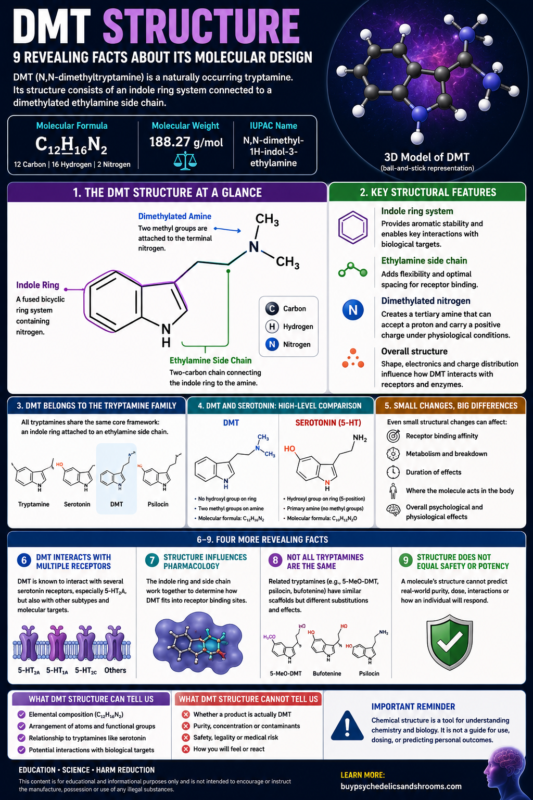
DMT structure refers to the molecular arrangement of N,N-dimethyltryptamine, a naturally occurring tryptamine compound with the molecular formula C12H16N2. The molecule contains an indole ring system attached to a short ethylamine side chain whose terminal nitrogen carries two methyl groups.
This molecular design places DMT within the tryptamine family, which also includes compounds related to serotonin, melatonin and tryptophan. Although these molecules share certain structural features, molecular resemblance does not mean they produce identical effects in the brain or body.
This guide explains DMT structure, molecular formula, the indole framework, its relationship to serotonin and why even small chemical differences may result in very different biological activity. It does not explain chemical synthesis, extraction or preparation.
Table of Contents
- What Is the DMT Structure?
- 9 Revealing DMT Structure Facts
- DMT Molecular Formula
- The Tryptamine Family
- The Indole Ring System
- The Ethylamine Side Chain
- Why “N,N-Dimethyl” Matters
- DMT Structure and Serotonin
- Why Molecular Similarity Does Not Mean Identical Effects
- DMT Structure and Serotonin Receptors
- DMT Compared With Related Tryptamines
- What Structure Alone Cannot Tell Us
- Frequently Asked Questions
What Is the DMT Structure?
The DMT structure is composed of two main regions:
- An indole ring system
- An ethylamine side chain containing a dimethylated nitrogen
The indole region consists of two connected rings: one six-membered benzene-like ring and one five-membered nitrogen-containing ring. Attached to this framework is a two-carbon side chain ending in a tertiary amine.
The abbreviation DMT comes from N,N-dimethyltryptamine. “N,N-dimethyl” means that two methyl groups are attached to the same terminal nitrogen atom.
For a broader overview of effects, forms, duration and safety, visit our complete DMT guide.
9 Revealing DMT Structure Facts
1. DMT Has the Molecular Formula C12H16N2
The molecular formula describes the number of atoms in one neutral DMT molecule:
- 12 carbon atoms
- 16 hydrogen atoms
- 2 nitrogen atoms
A molecular formula tells us which elements are present and how many atoms of each element occur. It does not show how those atoms are connected in three-dimensional space.
2. DMT Belongs to the Tryptamine Family
The DMT structure follows the basic tryptamine pattern: an indole framework connected to an ethylamine chain.
Tryptamines include both naturally occurring biological molecules and psychoactive compounds. Members of the family may share a common structural foundation while differing in their substitutions and biological behaviour.
3. The Indole Ring Is a Central Structural Feature
The indole portion of DMT is a fused bicyclic system. This means that two rings share adjacent atoms.
The indole system contains:
- A six-membered carbon-based aromatic ring
- A five-membered ring containing nitrogen
- A connected system of electrons that contributes to aromatic stability
Indole structures occur in many biologically important molecules, including tryptophan, serotonin and melatonin.
4. DMT Contains a Two-Carbon Side Chain
An ethylamine side chain extends from the indole ring. The two carbon atoms in this chain connect the indole framework to the terminal amine nitrogen.
This spatial arrangement is an important part of the general tryptamine scaffold.
5. Two Methyl Groups Are Attached to the Terminal Nitrogen
The “dimethyl” portion of the name refers to two methyl groups attached to the amine nitrogen. A methyl group consists of one carbon atom bonded to three hydrogen atoms.
Because both methyl groups are attached to nitrogen, the systematic name uses the prefix “N,N-dimethyl.”
6. DMT Is Structurally Related to Serotonin
DMT and serotonin both contain an indole ring and an ethylamine-related side chain. This broad resemblance helps explain why DMT can interact with several serotonin receptor subtypes.
However, serotonin has a hydroxyl group on the indole ring, while DMT does not. Their terminal amine groups are also substituted differently.
7. Similarity Does Not Create Identical Pharmacology
Two molecules can share a basic scaffold but differ in receptor affinity, metabolism, ability to cross biological barriers and duration of action.
Even one added or removed chemical group may affect:
- Shape
- Charge distribution
- Solubility
- Receptor binding
- Metabolism
- Tissue distribution
8. DMT Interacts With More Than One Receptor Type
DMT is often discussed in relation to the serotonin 5-HT2A receptor, which plays an important role in the effects of classic psychedelics.
Research also indicates activity at additional serotonin receptor subtypes and other molecular targets. Therefore, the biological effects of DMT cannot be explained by one receptor alone.
9. A Structural Diagram Does Not Reveal Safety or Potency
A chemical structure shows the arrangement of atoms in an idealised molecule. It does not tell us whether an unidentified powder, liquid or cartridge genuinely contains DMT.
It also cannot determine:
- Product purity
- Concentration
- Contamination
- Individual medical risk
- Medication interactions
- How a person will react
DMT Molecular Formula
The DMT molecular formula is C12H16N2. This compact notation records elemental composition but not molecular connectivity.
| Element | Symbol | Number of Atoms |
|---|---|---|
| Carbon | C | 12 |
| Hydrogen | H | 16 |
| Nitrogen | N | 2 |
The two nitrogen atoms occupy different chemical environments. One lies within the indole ring, while the other is located at the end of the side chain.
These nitrogen atoms do not behave identically because their bonding arrangements and electron environments differ.
The Tryptamine Family
The DMT structure belongs to the tryptamine class. The parent tryptamine framework contains an indole ring attached to an ethylamine side chain.
Members of this broad structural family include:
- Tryptamine
- Serotonin
- Melatonin
- Psilocin
- DMT
- 5-MeO-DMT
- Bufotenine
These molecules should not be treated as interchangeable. Their additional chemical groups affect how they interact with enzymes, transport systems and receptors.
The tryptamine label describes structural ancestry, not a guarantee of identical psychological, physiological or medical effects.
The Indole Ring in DMT Structure
The indole framework is one of the most recognisable features of the DMT structure. It is a fused aromatic system containing nine ring atoms, one of which is nitrogen.
Aromaticity refers to a stable arrangement of shared electrons across the ring system. This gives the indole framework particular chemical and electronic characteristics.
The indole nitrogen carries a hydrogen atom in the neutral molecular representation. It is chemically distinct from the terminal amine nitrogen found on the side chain.
The indole ring also provides a relatively flat aromatic surface that can contribute to molecular recognition within receptor-binding sites.
The Ethylamine Side Chain
The ethylamine side chain consists of two carbon atoms connecting the indole ring to the terminal nitrogen.
This chain gives the molecule flexibility. DMT is not a completely rigid structure, so parts of the molecule can rotate around certain bonds and adopt different conformations.
A receptor does not simply recognise a flat drawing. It interacts with the molecule’s three-dimensional shape, electronic distribution and orientation inside the receptor-binding pocket.
Why “N,N-Dimethyl” Matters
The terminal amine in DMT is substituted with two methyl groups. This makes it a tertiary amine because the nitrogen is bonded to three carbon-containing groups:
- The ethyl side chain
- One methyl group
- A second methyl group
The terminal nitrogen can participate in acid–base chemistry and may carry a positive charge under certain chemical and biological conditions.
This charge state can influence interactions with receptors and other biological molecules.
DMT Structure and Serotonin
DMT and serotonin are structurally related indoleamines. Both contain an indole ring connected to an amine-containing side chain.
| Feature | DMT | Serotonin |
|---|---|---|
| Indole ring | Present | Present |
| Ethylamine-related chain | Present | Present |
| Hydroxyl group on ring | Absent | Present |
| Methyl groups on terminal nitrogen | Two | None |
| Primary biological role | Psychoactive tryptamine and research compound | Endogenous neurotransmitter |
The shared indole–ethylamine framework helps both molecules interact with serotonin-related biological systems. Yet their different substituents alter their physical properties and receptor interactions.
Why Molecular Similarity Does Not Mean Identical Effects
A common misunderstanding is that two molecules with similar drawings must produce the same effects. Chemical biology is much more sensitive than that.
Small structural differences may change:
- Which receptor subtypes are activated
- How strongly a molecule binds
- Whether it activates or blocks a receptor
- How rapidly enzymes break it down
- Whether it crosses biological membranes efficiently
- How long it remains in circulation
- Which tissues it reaches
Serotonin, DMT, psilocin and melatonin all contain related structural elements, but they serve very different biological roles.
Molecular similarity is therefore a clue about possible interactions—not proof of identical pharmacology.
DMT Structure and Serotonin Receptors
The molecular features of DMT allow it to interact with several serotonin receptor subtypes. The 5-HT2A receptor is particularly important in the pharmacology of classic psychedelics.
Within a receptor-binding site, different parts of the DMT structure may contribute to binding through:
- Ionic interactions involving the amine
- Hydrogen-bonding interactions
- Aromatic interactions involving the indole ring
- Shape complementarity
- Hydrophobic contacts
This is a simplified description. Receptor activation involves dynamic three-dimensional interactions between the molecule, receptor protein, surrounding membrane and cellular signalling machinery.
Research indicates that DMT has activity at several serotonin receptors rather than acting exclusively at one target.
DMT Compared With Related Tryptamines
Related tryptamines share the same general scaffold but contain different chemical substitutions.
| Compound | Key Structural Difference |
|---|---|
| DMT | Two methyl groups on the terminal nitrogen |
| 5-MeO-DMT | Methoxy group added at the 5-position |
| Bufotenine | Hydroxyl group added at the 5-position |
| Psilocin | Hydroxyl group at the 4-position |
| Serotonin | Hydroxyl group at the 5-position and different terminal amine substitution |
| Melatonin | Methoxy and acetamide-related substitutions |
These differences may appear small on paper, but they can strongly influence receptor preference, metabolism and biological activity.
DMT should also not be confused with 5-MeO-DMT. They are separate compounds with different molecular formulas and pharmacological profiles.
What the DMT Structure Cannot Tell Us
The DMT structure provides important chemical information, but it cannot answer every safety or identification question.
A molecular diagram cannot establish:
- Whether an unknown substance contains DMT
- The purity of a street product
- The concentration inside a cartridge
- Whether harmful contaminants are present
- Whether a product contains several drugs
- How an individual will respond
- Whether a medication interaction will occur
For information about visual-identification limitations, read what does DMT look like.
For health and interaction concerns, see our guides to DMT safety and DMT drug interactions.
Why the DMT Structure Matters in Chemistry
The DMT structure helps scientists understand how the molecule may interact with enzymes, receptors and biological membranes. Its indole ring provides a stable aromatic framework, while the flexible side chain and terminal amine influence molecular shape, charge and receptor recognition.
Chemists use structural diagrams to compare DMT with serotonin, tryptamine, psilocin and other related compounds. These comparisons can suggest which molecular features may contribute to receptor binding, but they cannot predict a person’s complete psychological or physical response.
The PubChem DMT compound record provides verified information about the molecular formula, chemical identifiers and structural representation of N,N-dimethyltryptamine. The NIDA overview of psychedelic and dissociative drugs provides broader educational information about psychedelic effects and ongoing research.
Understanding the DMT structure is useful for chemistry education, but a molecular diagram cannot confirm the identity of a powder, liquid, cartridge or plant preparation. Real-world products may contain impurities, other psychoactive compounds or contaminants that are not represented in the idealised chemical drawing.
For this reason, molecular structure should be understood as a scientific model rather than a guarantee of purity, safety, strength or biological outcome.
Frequently Asked Questions
What is the molecular formula of DMT?
The molecular formula of N,N-dimethyltryptamine is C12H16N2.
What does the DMT structure contain?
DMT contains an indole ring system connected to a two-carbon side chain ending in a nitrogen with two methyl groups.
Is DMT a tryptamine?
Yes. DMT belongs to the tryptamine family because it contains the characteristic indole–ethylamine framework.
What is an indole ring?
An indole is a fused aromatic system containing a six-membered ring joined to a five-membered nitrogen-containing ring.
What does N,N-dimethyl mean?
It means that two methyl groups are attached to the terminal nitrogen atom of the tryptamine side chain.
Is DMT structurally similar to serotonin?
Yes. Both molecules share an indole and amine-containing framework, but their substitutions differ.
Does structural similarity mean DMT acts exactly like serotonin?
No. Small molecular differences can change receptor binding, metabolism, distribution and biological effects.
Is DMT the same as 5-MeO-DMT?
No. 5-MeO-DMT contains an additional methoxy group and has a distinct pharmacological profile.
Can a molecular diagram prove that a powder is DMT?
No. A diagram represents an ideal molecule and cannot identify an unknown real-world sample.
Does DMT act only at the 5-HT2A receptor?
No. Although 5-HT2A is important, research indicates that DMT interacts with several serotonin receptor subtypes and other molecular targets.
Final Thoughts
DMT structure consists of an indole ring attached to an ethylamine side chain with two methyl groups on the terminal nitrogen. Its molecular formula is C12H16N2.
DMT belongs to the tryptamine family and shares a broad structural framework with serotonin and several other biologically active molecules. However, molecular similarity does not mean identical receptor activity, metabolism, safety or psychological effects.
This article is provided for chemistry education and public-health information. It does not explain the synthesis, extraction or preparation of controlled substances.
