
Aug
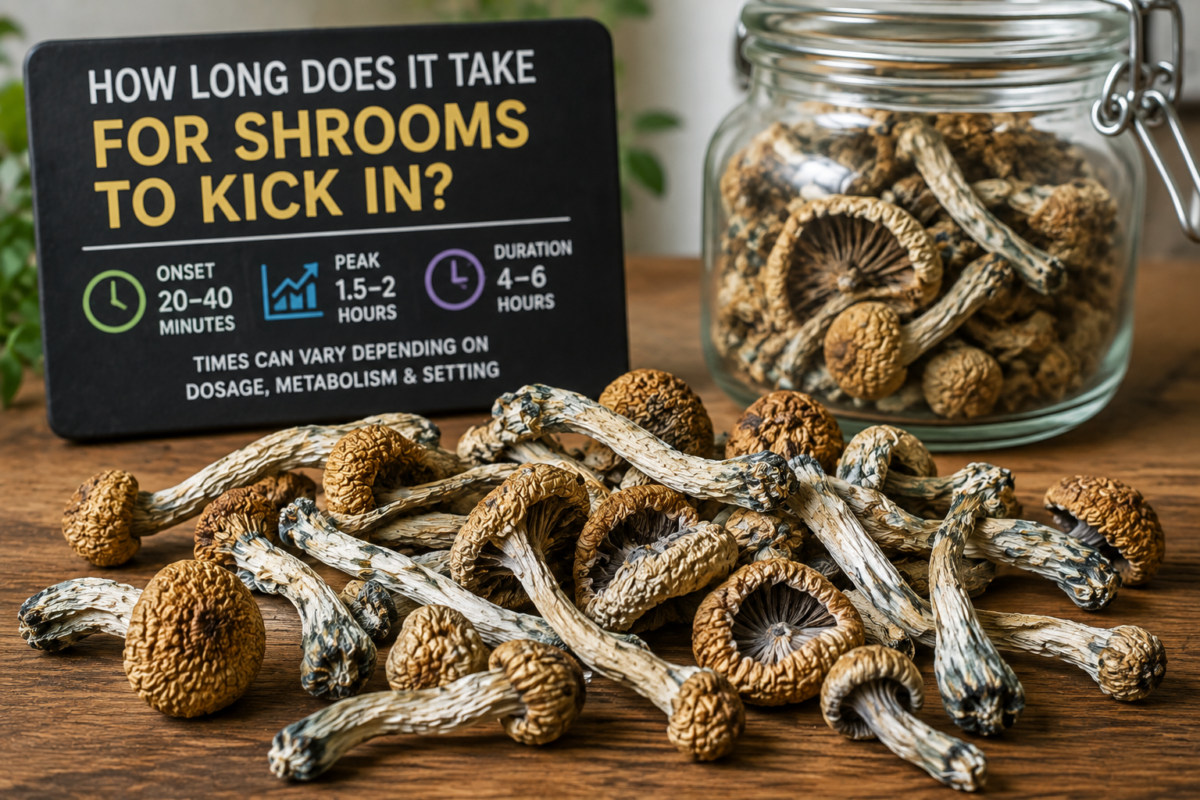
If you are asking how long does it take for shrooms to kick in, the answer is usually measured in minutes rather than seconds, but there is no single timing that applies to everyone. Research on oral psilocybin suggests that noticeable subjective effects can begin within roughly 20 to 40 minutes, while measurable psilocin concentrations and peak effects can occur later.
Several factors can influence when effects become noticeable, including the individual, the preparation, the amount administered, and circumstances surrounding absorption. That means how long does it take for shrooms to kick in should be understood as a general timing question rather than an exact countdown.
How Long Does It Take for Shrooms to Kick In?
The short answer to how long does it take for shrooms to kick in is that noticeable effects from orally administered psilocybin have commonly been reported to begin around 20 to 40 minutes after administration. Clinical literature also reports that onset can vary between people and circumstances.
A review of clinical considerations for psilocybin administration describes an onset of action of approximately 20 to 40 minutes after oral administration. The published clinical review provides additional context on the timing of psilocybin’s effects.
It is important not to interpret that range as a guarantee. The onset of subjective effects is different from the time required for psilocin to reach its maximum concentration in the blood.
In one controlled human pharmacokinetic study, peak plasma concentrations of psilocin occurred at an average of about two hours after oral psilocybin administration. The controlled pharmacokinetic study provides primary human data on psilocin concentrations and subjective effects.
This illustrates why onset, peak concentration, peak subjective effects, and total duration should be treated as separate measurements.
What Happens After Psilocybin Is Ingested?
Psilocybin is a prodrug, meaning that it is converted into the active compound psilocin after administration. A recent systematic review found that psilocybin is rapidly converted to psilocin and that psilocin is subsequently absorbed following oral administration.
A systematic review of psilocybin pharmacokinetics summarizes available research on absorption, conversion, distribution, metabolism, and elimination.
Research therefore focuses heavily on psilocin rather than treating the mushroom itself as a single measurable substance. This is important when discussing how long does it take for shrooms to kick in, because the subjective experience is associated with the pharmacological activity of psilocin.
For broader background, see the site’s verified magic mushroom resource.
What Is the Typical Onset Time?
Human research commonly places the onset of noticeable psilocybin effects in the range of approximately 20 to 40 minutes after oral administration.
Another controlled human study reported an average subjective effect onset of approximately 0.6 hours, or about 36 minutes, with variation between participants. Research therefore supports using a range rather than a guaranteed onset time.
The exact moment a person notices an effect can also be subjective. Two people exposed to similar pharmacological conditions may describe the beginning of an experience differently.
Why the timing is not exact
People do not all experience the same onset time. Differences in individual physiology, the preparation being studied, the amount administered, and other circumstances can contribute to variation.
For that reason, how long does it take for shrooms to kick in is best answered with a general range rather than a guaranteed minute-by-minute schedule.
When Do Effects Usually Reach Their Peak?
Onset and peak are different stages.
Earlier research has reported peak subjective effects approximately 60 to 90 minutes after administration, while other controlled research has found that maximum subjective effects can occur later depending on the study design and outcome being measured.
A controlled 2023 pharmacokinetic study found that maximum plasma psilocin concentrations occurred after an average of approximately two hours across the tested oral doses. The human pharmacokinetic research provides primary data on these measurements.
Peak blood concentration and peak subjective experience are related but are not necessarily identical events.
How Long Do the Effects Last?
The onset question is closely connected to duration, but they should not be confused.
Controlled human research has reported mean subjective-effect durations of roughly five to six hours in clinical study settings, although individual experiences can vary.
Clinical literature similarly describes an active duration of approximately four to six hours in research settings. The clinical review of psilocybin administration provides additional discussion of onset and duration.
| Stage | General research finding |
|---|---|
| Initial onset | Often around 20–40 minutes after oral administration. |
| Peak effects | Usually later than initial onset and dependent on the measure being used. |
| Overall subjective effects | Several hours in controlled research settings. |
These are research observations rather than guarantees for an individual experience.
What Can Affect the Timing?
Several variables can influence the apparent timing of effects. Research does not support a single formula that can accurately predict an individual’s exact onset time.
Individual differences
Human pharmacokinetic and subjective responses vary between participants. Differences in physiology and individual response can therefore affect when effects become noticeable.
Preparation and formulation
The form in which psilocybin is administered can influence how quickly it becomes available. Clinical research generally uses standardized preparations, whereas naturally occurring mushrooms can vary in composition.
Amount administered
Controlled studies have found dose-dependent differences in psilocin exposure and subjective effects. However, dose should not be used as a way to predict an exact onset time for an individual.
Food and other circumstances
Food effects have not been consistently established across the limited pharmacokinetic literature. A systematic review found that conclusions about food effects remain limited by the relatively small number of studies with known fasting status.
The systematic review of psilocin pharmacokinetics discusses the available evidence and limitations surrounding these pharmacokinetic variables.
Expectations and perception
The moment someone first notices an effect is partly subjective. Two people exposed to similar pharmacological conditions may describe the beginning of an experience differently.
Why Might Effects Take Longer to Appear?
A slower-than-expected onset does not necessarily mean that nothing is happening. Absorption and subjective perception do not occur according to an exact universal schedule.
Research has documented variability in both pharmacokinetic measurements and subjective effects. Consequently, it is not appropriate to assume that a particular individual will experience effects at exactly the same time as participants in a clinical study.
This is also why an internet article cannot reliably predict the precise onset of an individual experience.
What Is the Difference Between Onset and Peak Effects?
Onset refers to when noticeable effects begin. Peak refers to when the effects or measured concentration reach their highest point.
These can occur at substantially different times.
| Term | Meaning |
|---|---|
| Onset | When noticeable effects begin. |
| Peak concentration | When measured psilocin concentration reaches its maximum. |
| Peak subjective effect | When the person’s reported effects are strongest. |
| Duration | How long the noticeable experience continues. |
Keeping these concepts separate makes it easier to understand how long does it take for shrooms to kick in without confusing onset with the strongest part of the experience.
Important Safety Considerations
Timing information should not be used as a reason to assume that someone is safe to drive, operate machinery, or perform another hazardous activity. The end of noticeable onset or peak effects does not automatically establish that a person is unimpaired.
If someone develops severe confusion, extreme agitation, loss of consciousness, seizures, difficulty breathing, chest pain, or another medical emergency after taking a psychoactive substance, seek urgent medical assistance.
Clinical research takes place under controlled conditions with screening, supervision, and defined procedures. Those conditions may differ substantially from unsupervised use outside a research environment.
Frequently Asked Questions
How long does it take for shrooms to kick in?
Human research commonly reports noticeable psilocybin effects beginning around 20 to 40 minutes after oral administration, although individual timing can vary.
Can shrooms take longer than 40 minutes to kick in?
Yes. Research describes ranges rather than a guaranteed onset time. Individual circumstances and the preparation studied can contribute to variation.
When do shrooms usually reach their peak?
Peak effects occur later than initial onset. Studies have reported peak subjective effects at different times depending on the research design and measurement being used.
How long do shroom effects last?
Controlled human studies commonly report several hours of subjective effects, although individual experiences can vary.
Does food affect how quickly psilocybin takes effect?
The available pharmacokinetic evidence is limited. Current reviews do not establish a simple universal rule for how food changes onset timing.
Does everyone experience the same onset time?
No. Human research shows variation in pharmacokinetic and subjective responses, so the exact onset can differ between individuals.
Is onset the same as peak effect?
No. Onset is when noticeable effects begin, while peak effect refers to the strongest point of the subjective experience or another defined measurement.
Why is there no exact answer to how long does it take for shrooms to kick in?
Because onset varies between people and circumstances, and research measurements can differ depending on whether investigators measure subjective effects, plasma psilocin, or another pharmacological endpoint.
Conclusion
The best research-based answer to how long does it take for shrooms to kick in is that noticeable effects from oral psilocybin commonly begin around 20 to 40 minutes after administration, but the exact timing varies.
Onset is only one part of the timeline. Psilocybin is converted into psilocin, measurable concentrations can peak later, subjective effects can continue for several hours, and individual experiences can differ substantially.
Understanding the distinction between onset, peak effects, pharmacokinetic measurements, and overall duration provides a more accurate answer than relying on a single fixed number of minutes. If someone develops concerning or severe symptoms, medical assistance is more important than relying on a predicted timeline.
“`