
Aug
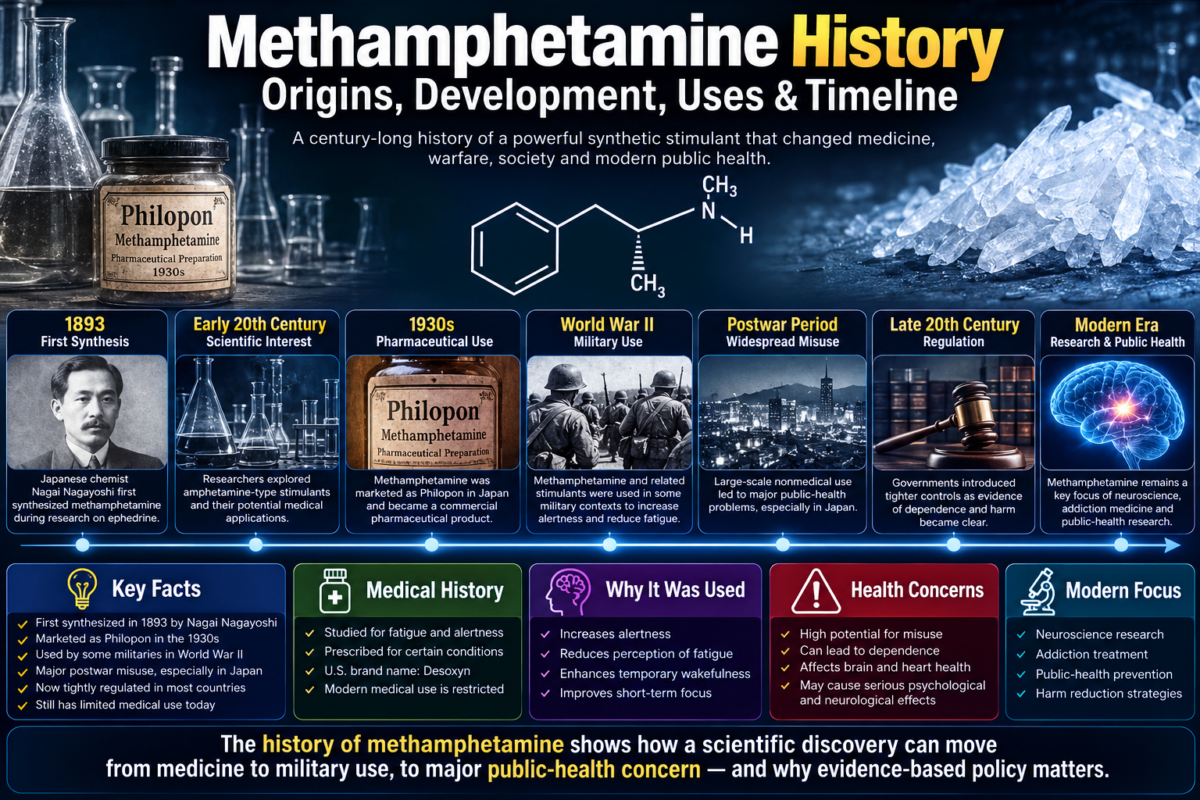
The history of methamphetamine stretches across more than a century of chemistry, medicine, military history, drug regulation, and public health. Methamphetamine is a synthetic stimulant related to amphetamine, and its historical development reflects how scientific discoveries can acquire very different roles over time.
Methamphetamine was first synthesized in the late 19th century, while its pharmacological properties and medical applications were explored more extensively during the decades that followed. The compound later became associated with wartime stimulant use, prescription medicines, illicit production, and major public-health concerns.
Understanding methamphetamine history requires separating these different periods rather than treating the substance’s entire history as one continuous story.
What Is Methamphetamine?
Methamphetamine is a synthetic psychoactive stimulant belonging to the amphetamine family. Chemically, it is closely related to amphetamine but has a different molecular structure.
The compound affects several neurotransmitter systems, particularly those involving dopamine and norepinephrine. Its pharmacological activity has contributed to both its historical medical applications and its potential for serious health consequences.
For a detailed explanation of the molecule itself, see our Methamphetamine Molecule: Chemical Structure, Formula & Chemistry article.
Methamphetamine History at a Glance
The broad history of methamphetamine can be divided into several major periods:
- Late 19th century: Early scientific work involving the compound and related stimulants.
- Early 20th century: Further investigation of amphetamine-type stimulants and pharmaceutical applications.
- 1930s: Methamphetamine became more widely known through pharmaceutical development.
- World War II: Methamphetamine and related stimulants were used in some military contexts.
- Postwar period: Medical and nonmedical use continued in different countries.
- Later 20th century: Regulation increased as concerns about misuse, dependence, and health effects became more prominent.
- Modern era: Methamphetamine remains an important subject of neuroscience, addiction medicine, toxicology, and public-health research.
Each period contributed to the way methamphetamine is understood today.
The Origins of Methamphetamine
The early methamphetamine origins are connected to the broader development of synthetic chemistry in the late 19th century. Scientists were increasingly able to modify naturally occurring compounds and investigate their pharmacological properties.
Methamphetamine was first synthesized in Japan in 1893 by chemist Nagai Nagayoshi, who was investigating compounds related to ephedrine. This early chemical work established methamphetamine as a distinct synthetic compound, although its later pharmaceutical history developed over subsequent decades.
The discovery occurred during a period when researchers were beginning to explore how chemical modifications could alter the properties of biologically active compounds.
Nagai Nagayoshi and Early Research
Japanese chemist Nagai Nagayoshi played an important role in the early history of methamphetamine. His work with ephedrine and related compounds contributed to the first synthesis of methamphetamine in the 1890s.
This was primarily a chemical discovery rather than the beginning of modern widespread methamphetamine use. The compound’s medical and commercial significance emerged later as researchers investigated its stimulant properties.
The distinction between the initial chemical synthesis and later pharmaceutical development is important when discussing who “invented” or discovered methamphetamine.
Methamphetamine and Early Chemistry
The emergence of methamphetamine occurred during a period of rapid development in organic and pharmaceutical chemistry. Scientists were studying how naturally occurring substances could be chemically modified to produce compounds with different biological properties.
Ephedrine was particularly important to this history because it provided a structural starting point for research into related stimulant compounds.
Over time, researchers learned more about the pharmacological properties of amphetamine-type stimulants and their potential medical applications.
From Amphetamine to Methamphetamine
The history of methamphetamine is closely connected to the history of amphetamine. Both compounds belong to a related chemical family and have stimulant effects, but they are chemically distinct substances.
Amphetamine itself was first synthesized in the late 19th century, while its pharmacological properties became increasingly important during the early 20th century.
Research into these compounds helped establish a broader field of stimulant pharmacology and eventually contributed to the development of pharmaceutical products containing amphetamine-type stimulants.
Early Development of Methamphetamine
Although methamphetamine had been synthesized in the 1890s, its later history was shaped by additional research into its pharmacological properties and practical pharmaceutical forms.
In the early decades of the 20th century, researchers increasingly investigated stimulant compounds for their effects on alertness, fatigue, and other aspects of the nervous system.
This period helped move methamphetamine from a chemical discovery toward a compound with recognized pharmacological properties.
Early Pharmaceutical Interest
During the 1930s, methamphetamine became associated with pharmaceutical development. In Japan, the compound was marketed as Philopon, a name that became associated with methamphetamine products during the period.
Pharmaceutical interest was influenced by the stimulant properties of the compound. Methamphetamine and related stimulants were investigated and used in circumstances where increased alertness and reduced feelings of fatigue were considered useful.
At the time, scientific understanding of dependence and long-term risks was considerably less developed than it is today.
Methamphetamine in Early Medicine
The early medical history of methamphetamine reflects a period when stimulant medicines were being explored for a variety of purposes. Physicians and researchers investigated stimulant compounds in areas such as fatigue, alertness, and certain neurological or psychiatric applications.
Methamphetamine was not the only stimulant being studied during this period. Amphetamine and other related compounds were also being developed and prescribed.
The later recognition of dependence, misuse, and serious health risks eventually changed the medical and regulatory status of these substances.
Why the Early History Matters
The early history of methamphetamine illustrates how the scientific understanding of a drug can change over time. A compound can begin as a laboratory discovery, become the subject of pharmaceutical research, and later become associated with significant public-health concerns.
This historical progression is not unique to methamphetamine. The development of many psychoactive medicines has involved changing ideas about effectiveness, safety, dependence, and appropriate medical use.
Understanding the historical context therefore provides a more complete picture than focusing only on modern illicit use.
Early Methamphetamine Timeline
| Period | Historical development |
|---|---|
| 1890s | Methamphetamine was first synthesized in Japan by Nagai Nagayoshi. |
| Early 20th century | Researchers continued investigating amphetamine-type stimulants and their pharmacological properties. |
| 1930s | Methamphetamine became associated with pharmaceutical development and commercial products. |
| World War II era | Methamphetamine and related stimulants were used in some military contexts. |
The later stages of the timeline involve changing medical practices, regulation, illicit markets, and modern public-health research, which are covered in the following sections.
Related Reading
To understand the chemistry behind this history, read our Methamphetamine Molecule: Chemical Structure, Formula & Chemistry article.
For a broader discussion of another psychoactive compound’s molecular history, see our LSD Chemical Structure: Understanding Its Molecular Framework guide.
For information about substance use disorder, symptoms, causes, and recovery, read our SUD: Understanding Substance Use Disorder, Symptoms, Causes, and Recovery article.
Methamphetamine as a Pharmaceutical Drug
The history of methamphetamine changed significantly during the early and middle decades of the 20th century as pharmaceutical companies and researchers investigated stimulant compounds for medical applications.
Methamphetamine’s stimulant properties attracted interest because they could increase alertness and reduce feelings of fatigue. During this period, scientific understanding of dependence and long-term neurological effects was still developing.
Methamphetamine therefore entered an era in which its potential medical benefits were considered alongside a much less complete understanding of its risks.
Philopon and Methamphetamine in Japan
One important chapter in methamphetamine history occurred in Japan, where methamphetamine was marketed under the name Philopon.
Philopon became associated with methamphetamine products during the 1930s and later played an important role in the history of stimulant use in Japan. The product was promoted in a period when stimulants were viewed differently from how they are understood today.
The history of Philopon illustrates how methamphetamine moved from laboratory chemistry into commercial pharmaceutical use.
Methamphetamine During World War II
World War II represents one of the most notable periods in the history of methamphetamine. Methamphetamine and related stimulant drugs were used in some military contexts because their effects could temporarily increase alertness and reduce the perception of fatigue.
Japan was particularly associated with methamphetamine use during the wartime period. Products containing methamphetamine were supplied to soldiers and workers in an effort to maintain alertness during demanding circumstances.
Other countries also used stimulant compounds during the war, although the specific substances, policies, and patterns of use varied between nations.
Why Were Stimulants Used During Wartime?
Military organizations have historically been interested in substances that can temporarily increase wakefulness and alertness. Long periods without sleep can impair attention, reaction time, decision-making, and physical performance.
During World War II, stimulants were therefore considered strategically useful in some circumstances. At the time, however, the potential for dependence and other adverse effects was not understood as thoroughly as it is today.
The wartime experience subsequently contributed to greater awareness of the risks associated with prolonged stimulant exposure.
Methamphetamine After World War II
The end of World War II did not end the history of methamphetamine. Instead, the postwar period brought new patterns of medical, commercial, and nonmedical use.
In some countries, methamphetamine remained available through medical channels. In others, concerns about misuse and dependence gradually led authorities to introduce stronger controls.
Japan experienced a particularly significant postwar methamphetamine problem, with widespread misuse contributing to what became known as the first major Japanese methamphetamine epidemic.
Japan’s Postwar Methamphetamine Epidemic
Japan’s experience after World War II became an important chapter in methamphetamine history. Large quantities of methamphetamine had been produced during the wartime period, and the postwar environment contributed to widespread nonmedical use.
The resulting public-health crisis demonstrated that methamphetamine could create significant social and medical problems when widely available outside controlled medical settings.
Japan responded with increasingly strict controls, providing an early example of how governments began changing their approach to methamphetamine.
Methamphetamine and Prescription Medicine
Despite increasing concerns about misuse, methamphetamine continued to have limited medical applications in some countries.
In the United States, methamphetamine was eventually marketed as a prescription stimulant under the brand name Desoxyn. Its medical status has been substantially more restricted than its historical availability.
This distinction is important: the existence of a prescription form does not mean that methamphetamine is broadly used as a routine medicine. Modern medical use is limited and regulated.
Changing Perceptions of Methamphetamine
One of the clearest themes in methamphetamine history is the change in how society and medicine have viewed the compound.
Early pharmaceutical interest focused heavily on stimulant effects and potential usefulness. Over time, evidence of dependence, misuse, cardiovascular complications, neurological effects, and other harms changed the balance between perceived benefits and risks.
This shift was part of a broader transformation in the way governments and medical professionals approached psychoactive drugs.
Growing Recognition of Dependence
As methamphetamine became more widely used, researchers and healthcare professionals increasingly recognized that repeated exposure could lead to problematic use and dependence.
This recognition contributed to changes in medical practice and eventually to tighter regulation.
The emerging understanding of substance use disorders also helped move discussions of methamphetamine away from simply viewing problematic use as a matter of individual behavior and toward recognizing biological, psychological, and social factors.
Postwar Medical Research
Researchers continued investigating methamphetamine and related stimulants after World War II. Scientific attention increasingly focused not only on their stimulant effects but also on their risks, mechanisms of action, dependence potential, and effects on the nervous system.
This research contributed to the modern understanding of methamphetamine as a powerful central nervous system stimulant with significant potential for harm.
The scientific picture became progressively more complex as researchers learned more about dopamine, norepinephrine, serotonin, and other neurological systems.
The Rise of Nonmedical Use
The later 20th century saw methamphetamine increasingly associated with nonmedical use in several countries. Availability through illicit markets contributed to patterns of use that differed substantially from the earlier pharmaceutical context.
This period marked an important transition in the history of methamphetamine, as public discussion increasingly focused on addiction, overdose, psychiatric effects, cardiovascular complications, and social consequences.
Governments responded through progressively stronger controls over production, distribution, possession, and medical prescribing.
From Medicine to Regulation
The changing legal status of methamphetamine reflected growing evidence about its risks. Governments began placing tighter restrictions on stimulant medicines and introducing systems designed to control access to substances with significant misuse potential.
In the United States, methamphetamine became subject to federal controlled-substance regulation, while other countries developed their own regulatory frameworks.
These policies formed an important bridge between the early pharmaceutical history of methamphetamine and the modern public-health approach.
What the Medical History of Methamphetamine Shows
The medical history of methamphetamine demonstrates that the understanding of a drug can change substantially as scientific evidence accumulates.
Early researchers recognized useful stimulant effects but had a more limited understanding of dependence, neurotoxicity, cardiovascular risks, and long-term consequences.
Modern medicine therefore approaches methamphetamine very differently from the early 20th century, with much greater emphasis on controlled use, risk assessment, dependence, and public health.
Related Reading
For the scientific structure of methamphetamine, read our Methamphetamine Molecule: Chemical Structure, Formula & Chemistry article.
For broader information about substance use disorder, symptoms, causes, and recovery, see our SUD: Understanding Substance Use Disorder, Symptoms, Causes, and Recovery guide.
For another example of how psychoactive compounds can be studied from a scientific perspective, read our LSD Chemical Structure: Understanding Its Molecular Framework article.
Methamphetamine Regulation
The history of methamphetamine entered a major new phase as governments increasingly recognized the risks associated with dependence, misuse, and harmful health effects. Regulatory approaches developed gradually, with countries introducing controls over manufacturing, distribution, prescribing, and possession.
These changes reflected a growing body of medical and public-health evidence rather than a single historical event. Methamphetamine moved from being viewed primarily through a pharmaceutical lens toward being treated as a substance requiring substantial regulatory control.
Methamphetamine as a Controlled Substance
In the United States, methamphetamine became subject to federal controlled-substance regulation. The modern regulatory framework places strict controls on methamphetamine because of its high potential for misuse and dependence.
A limited prescription form remains available under specific medical circumstances, but its use is substantially restricted compared with the broader pharmaceutical availability seen during earlier periods of methamphetamine history.
Other countries have established their own legal frameworks, so the exact classification and medical status of methamphetamine can differ by jurisdiction.
Changing Drug Laws
Drug-control policies affecting methamphetamine developed alongside broader changes in international and national approaches to psychoactive substances.
Governments increasingly focused on controlling substances with significant dependence potential while maintaining narrowly defined medical pathways where appropriate.
The result was a gradual transition from relatively accessible stimulant medicines toward much more tightly regulated systems.
The Rise of Illicit Methamphetamine
During the later 20th century, methamphetamine became increasingly associated with illicit markets in several countries. This represented a significant change from its earlier pharmaceutical history.
Illicit methamphetamine use became a major public-health concern because repeated exposure can be associated with dependence, cardiovascular complications, psychiatric symptoms, and neurological effects.
The expansion of illicit markets also created challenges for law enforcement, healthcare systems, addiction treatment services, and communities.
Methamphetamine History in the United States
The United States has played an important role in the modern history of methamphetamine. Methamphetamine was introduced into American pharmaceutical markets before increasingly strict regulation changed its availability.
During the later 20th century, illicit methamphetamine use became an increasingly visible public-health issue. Different regions experienced different patterns of use, and the characteristics of illicit markets changed over time.
Federal and state authorities responded through legislation, enforcement initiatives, prevention programs, and expanded treatment efforts.
Methamphetamine and Public Health
The transition from pharmaceutical stimulant to major public-health concern changed the way methamphetamine was discussed in medicine and society.
Healthcare professionals increasingly focused on stimulant use disorder, cardiovascular risks, psychiatric complications, neurological effects, and the challenges involved in treatment and recovery.
This broader public-health perspective became an important part of modern methamphetamine history.
The Development of Addiction Research
As scientific understanding of substance use developed, researchers increasingly investigated the biological and psychological mechanisms underlying methamphetamine dependence.
Research examined changes in dopamine signaling, brain function, behavioral reinforcement, withdrawal, and factors that can contribute to continued substance use.
This work helped establish that problematic methamphetamine use involves complex interactions between neurobiology, psychology, environment, and social circumstances.
Modern Treatment Research
Modern research into methamphetamine use disorder focuses on improving prevention, treatment, and recovery outcomes.
Researchers have investigated behavioral interventions, contingency-management approaches, medications under investigation, and other strategies designed to help people reduce or stop problematic stimulant use.
The treatment landscape continues to evolve as researchers evaluate which interventions provide meaningful and sustainable benefits.
Methamphetamine and Modern Neuroscience
Modern neuroscience has provided a much clearer understanding of how methamphetamine affects the brain than was available during the early pharmaceutical period.
Researchers have studied its effects on dopamine, norepinephrine, and serotonin systems as well as changes associated with repeated exposure.
This scientific knowledge has helped explain why methamphetamine can produce powerful stimulant effects while also carrying substantial risks with repeated or excessive exposure.
Methamphetamine in Popular Culture
Methamphetamine has also become a recurring subject in news coverage, documentaries, television, film, and other forms of popular culture.
These portrayals have influenced public perceptions of the substance, sometimes emphasizing its criminal or social dimensions while overlooking the longer pharmaceutical and scientific history.
A complete understanding of methamphetamine history requires looking beyond popular portrayals and considering documented historical, medical, and scientific evidence.
How History Shaped Modern Policy
The modern regulatory approach to methamphetamine was shaped by decades of experience with pharmaceutical use, wartime stimulant exposure, widespread nonmedical use, dependence, and public-health consequences.
This historical record influenced policies designed to reduce misuse while maintaining limited medical access where appropriate.
Modern policy therefore reflects not just the chemical properties of methamphetamine but also the lessons learned from its changing role in medicine and society.
Methamphetamine in Contemporary Medicine
Methamphetamine has not completely disappeared from medicine. In the United States, a prescription formulation remains available for specific medical indications under strict controls.
Its modern medical role is much narrower than the role stimulants played during earlier periods of pharmaceutical development.
This distinction is important when describing methamphetamine history: historical medical use and modern medical practice are not equivalent.
What Methamphetamine History Teaches Us
The history of methamphetamine demonstrates how scientific understanding can evolve as evidence accumulates.
Early researchers and physicians focused heavily on stimulant properties and potential medical applications. Later research revealed a much more complicated picture involving dependence, cardiovascular effects, neurological changes, psychiatric complications, and broader public-health consequences.
The story also demonstrates why the medical status of psychoactive compounds can change as new evidence becomes available.
Related Reading
For the chemistry behind methamphetamine, read our Methamphetamine Molecule: Chemical Structure, Formula & Chemistry article.
For information about substance use disorder, symptoms, causes, and recovery, see our SUD: Understanding Substance Use Disorder, Symptoms, Causes, and Recovery guide.
For another example of psychoactive-compound chemistry, read our LSD Chemical Structure: Understanding Its Molecular Framework article.
Methamphetamine History Timeline
| Year / Period | Historical Development |
|---|---|
| 1893 | Nagai Nagayoshi synthesized methamphetamine in Japan while conducting research involving ephedrine-related compounds. |
| Early 20th century | Researchers continued investigating amphetamine-type stimulants and their pharmacological properties. |
| 1930s | Methamphetamine entered pharmaceutical development, including commercial products in Japan. |
| World War II | Methamphetamine and other stimulants were used in some military contexts to promote alertness and reduce fatigue. |
| Postwar period | Widespread nonmedical use contributed to major public-health problems in some countries, particularly Japan. |
| Later 20th century | Governments increasingly introduced restrictions as concerns about dependence and misuse grew. |
| Modern era | Methamphetamine remains an important subject of neuroscience, toxicology, addiction medicine, and public-health research. |
Frequently Asked Questions About Methamphetamine History
When was methamphetamine invented?
Methamphetamine was first synthesized in Japan in 1893 by chemist Nagai Nagayoshi. Its pharmaceutical development and widespread use occurred decades later, so the initial synthesis should be distinguished from its later medical and commercial history.
Who discovered methamphetamine?
Japanese chemist Nagai Nagayoshi is credited with the first synthesis of methamphetamine in 1893. His work occurred during research into ephedrine and related compounds.
When did methamphetamine become a medicine?
Methamphetamine’s pharmaceutical development occurred during the early 20th century, with commercial products appearing particularly during the 1930s. Its medical role subsequently became much more restricted as evidence of dependence and other risks accumulated.
Was methamphetamine used during World War II?
Yes. Methamphetamine and related stimulant compounds were used in some military contexts during World War II. They were valued primarily for their ability to increase alertness and reduce the perception of fatigue.
Was methamphetamine used in Japan during World War II?
Yes. Japan had significant wartime production and use of methamphetamine, including products marketed under the name Philopon. The widespread availability of methamphetamine also contributed to serious postwar misuse.
What happened to methamphetamine after World War II?
After World War II, methamphetamine remained available in some medical settings while nonmedical use became a major concern in several countries. Japan experienced a particularly significant postwar methamphetamine epidemic, which contributed to increasingly strict controls.
Was methamphetamine ever prescribed by doctors?
Yes. Methamphetamine has had a history of medical and pharmaceutical use. In the United States, a prescription formulation has existed under the brand name Desoxyn, although modern medical use is much more restricted than historical stimulant prescribing.
Why did methamphetamine become more heavily regulated?
Regulation increased as scientific and public-health evidence demonstrated significant risks associated with misuse, dependence, cardiovascular effects, psychiatric complications, and other harms.
When did methamphetamine become a controlled substance?
The exact timing and legal classification differ between countries. In the United States, methamphetamine became subject to federal controlled-substance regulation, with modern law placing strict controls on its manufacture, distribution, possession, and medical use.
How did methamphetamine change from a medicine to a public-health concern?
The transition occurred gradually. Early pharmaceutical interest focused on stimulant effects and potential medical applications, while later research and experience revealed substantial risks involving dependence, neurological effects, cardiovascular complications, and problematic use.
What role did methamphetamine play in pharmaceutical history?
Methamphetamine was part of the broader development of stimulant medicines during the 20th century. Its history illustrates how pharmaceutical compounds can move through periods of scientific interest, medical use, commercial availability, regulation, and renewed public-health scrutiny.
Is methamphetamine still used medically?
A limited prescription form remains available in some jurisdictions, including the United States, for specific medical circumstances. Its modern medical role is substantially narrower and more tightly controlled than its historical use.
How has scientific understanding of methamphetamine changed?
Modern research provides a much clearer understanding of methamphetamine’s effects on dopamine, norepinephrine, serotonin, cardiovascular function, and the nervous system than was available during its early pharmaceutical history.
Why is methamphetamine history important today?
The history of methamphetamine helps explain current drug policies, public-health concerns, addiction research, and the distinction between limited medical use and illicit use. It also demonstrates how scientific understanding can change as new evidence becomes available.
Key Takeaways
- Methamphetamine history begins with its first synthesis in Japan in 1893.
- Nagai Nagayoshi is credited with the first synthesis of methamphetamine.
- Pharmaceutical development became more significant during the early 20th century.
- Methamphetamine was marketed commercially in Japan during the 1930s.
- Methamphetamine and related stimulants were used in some military contexts during World War II.
- Postwar misuse contributed to major public-health problems in several countries.
- Growing evidence of dependence and harmful effects contributed to increasingly strict regulation.
- Methamphetamine has retained a limited medical role in some countries.
- Modern research focuses heavily on neuroscience, toxicology, addiction, treatment, and public health.
- The historical record demonstrates how the medical and social understanding of a psychoactive compound can change over time.
Conclusion
The history of methamphetamine is a complex story spanning chemistry, medicine, military history, regulation, and public health. Its origins can be traced to Nagai Nagayoshi’s 1893 synthesis in Japan, but the compound’s broader significance developed during the decades that followed.
Methamphetamine became part of the early pharmaceutical stimulant era and was later used in some wartime contexts. After World War II, patterns of nonmedical use and dependence became increasingly visible, helping drive major changes in regulation and public-health policy.
Today, methamphetamine is understood as a powerful stimulant with significant risks, while a limited prescription form remains available in some medical systems under strict controls. Modern research continues to investigate its effects on the brain, mechanisms of dependence, treatment options, and broader public-health impact.
Looking at methamphetamine history in chronological context shows why its modern status cannot be understood solely from either its early pharmaceutical applications or its current illicit use. Both are important parts of a much longer scientific and social history.
Related Reading
For a detailed explanation of methamphetamine’s molecular structure, read our Methamphetamine Molecule: Chemical Structure, Formula & Chemistry article.
For information about substance use disorder, symptoms, causes, and recovery, see our SUD: Understanding Substance Use Disorder, Symptoms, Causes, and Recovery guide.
For another example of the chemistry of a psychoactive compound, read our LSD Chemical Structure: Understanding Its Molecular Framework article.
Authoritative References
- PubChem — Methamphetamine
- National Institute on Drug Abuse — Methamphetamine
- U.S. Drug Enforcement Administration — Methamphetamine
- PubMed — Biomedical and Pharmacological Research
Medical Disclaimer
This article is provided for general educational and historical purposes and is not a substitute for professional medical advice, diagnosis, or treatment. Methamphetamine can cause serious health effects and has significant potential for misuse and dependence. Anyone experiencing serious or rapidly worsening symptoms after exposure should seek urgent medical attention.
