
Aug
The methamphetamine molecule is a small organic molecule belonging to the amphetamine family of psychoactive compounds. Its chemical structure contains carbon, hydrogen, and nitrogen atoms arranged into a substituted phenethylamine framework. Understanding that structure helps explain how methamphetamine is classified chemically and how it differs from closely related compounds such as amphetamine.
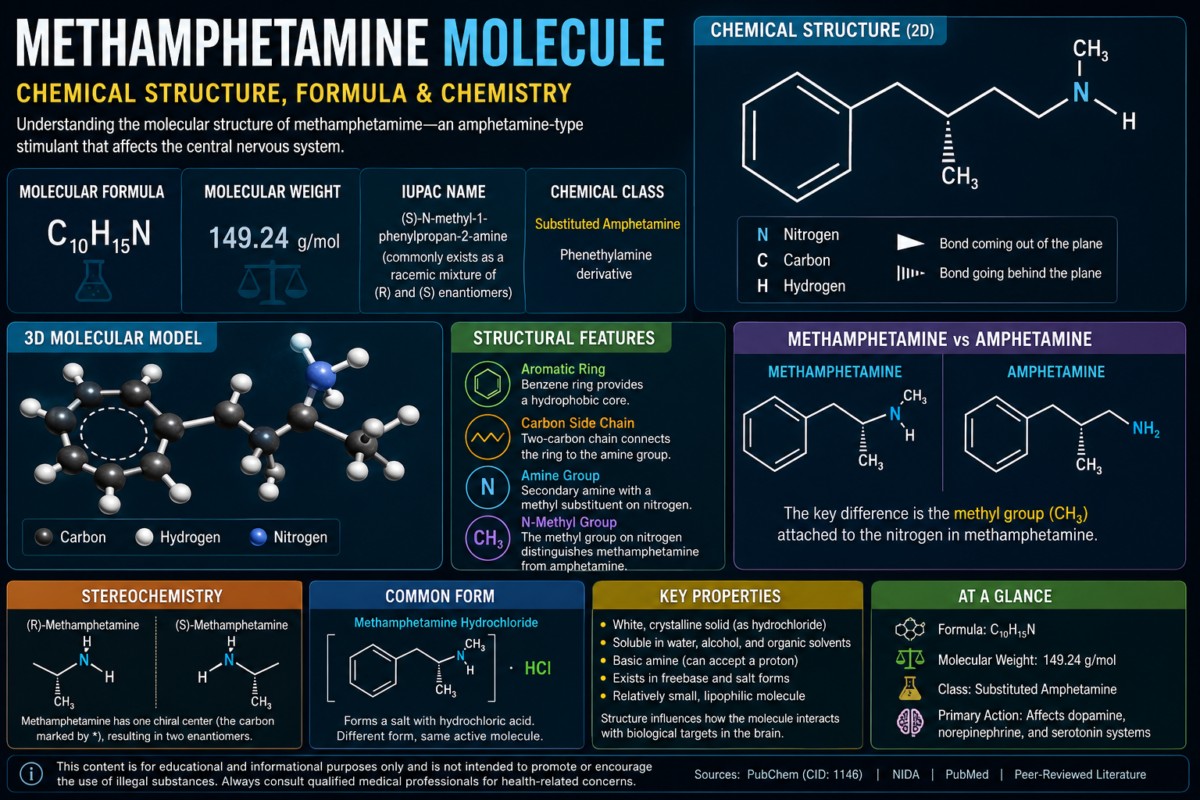
Methamphetamine has the molecular formula C10H15N. Its chemical identity can be described using several different representations, including a molecular formula, structural formula, molecular model, and systematic chemical name. Each representation highlights a different aspect of the same molecule.
The chemical identity and structural information for methamphetamine can be found in established chemical databases such as PubChem, which provides standardized information about the compound.
What Is the Methamphetamine Molecule?
The methamphetamine molecule is an organic compound composed of carbon, hydrogen, and nitrogen. Its structure contains an aromatic ring connected to a carbon chain that terminates in an amine group.
This arrangement places methamphetamine within the broader family of phenethylamine-related compounds. Small changes in the arrangement of atoms can produce chemically distinct substances, which is why comparing molecular structures is important in medicinal chemistry and pharmacology.
Methamphetamine’s structure is closely related to that of amphetamine, but the two molecules are not identical. Methamphetamine contains an additional methyl group attached to the nitrogen atom.
Methamphetamine Molecular Formula
The molecular formula of methamphetamine is C10H15N.
A molecular formula tells us which elements are present and how many atoms of each element occur in one molecule. In this case, the formula indicates that a methamphetamine molecule contains:
- 10 carbon atoms
- 15 hydrogen atoms
- 1 nitrogen atom
The molecular formula does not, by itself, show how those atoms are connected. Two compounds can sometimes contain the same numbers of atoms while having different arrangements. This is why a structural representation is also important when studying the methamphetamine molecule.
The Atoms in Methamphetamine
Carbon forms most of the framework of the methamphetamine molecule. Hydrogen atoms are attached throughout the structure, while the nitrogen atom forms part of the amine portion of the molecule.
The carbon framework includes an aromatic benzene ring and a short side chain. The nitrogen-containing portion distinguishes methamphetamine from many other simple hydrocarbons and contributes to its classification as an amine-containing organic compound.
Although the molecule is relatively small, the three-dimensional arrangement of its atoms is important. Molecular structure is not simply a matter of counting atoms; the way those atoms are connected and oriented also influences chemical behavior.
What Chemical Class Is Methamphetamine?
Methamphetamine is classified as a substituted amphetamine and belongs to the broader group of phenethylamine-related compounds.
Its structure contains an aromatic ring, an aliphatic carbon chain, and an amine group. These structural features are shared to varying degrees by several compounds in the amphetamine family.
The relationship between methamphetamine and amphetamine becomes clearer when their molecular structures are compared directly.
Methamphetamine Chemical Structure
The chemical structure of methamphetamine shows how its atoms are connected rather than simply listing their quantities. At its core is a benzene ring connected to a two-carbon side chain containing an amine group.
A methyl substituent attached to the nitrogen distinguishes methamphetamine structurally from amphetamine. This seemingly small modification changes the molecule’s physical and pharmacological properties.
Structural diagrams are therefore more informative than a molecular formula alone when explaining the methamphetamine molecule.
Functional Groups in the Molecule
Methamphetamine contains several structural features that chemists use to describe its molecular behavior.
- Aromatic ring: A six-membered carbon ring forms an important part of the molecule’s hydrophobic framework.
- Amine group: The nitrogen-containing portion gives the molecule its amine functionality.
- Alkyl substituent: The molecule contains carbon-based substituents attached to the nitrogen and carbon framework.
These structural elements help determine properties such as polarity, molecular interactions, and the way the compound interacts with biological targets.
Methamphetamine Molecular Weight
The molecular weight of methamphetamine is approximately 149.24 g/mol for the free-base molecular composition represented by C10H15N.
Molecular weight is calculated from the atomic masses of the elements present in a molecule. It is useful for identifying and characterizing compounds, but molecular weight alone does not describe a molecule’s biological activity.
Different chemical forms of a compound can have different molecular weights because additional components may be present in a salt form.
How Is the Methamphetamine Molecule Represented?
Chemists can represent the methamphetamine molecule in several ways.
- Molecular formula: Shows the number of atoms of each element.
- Structural formula: Shows how atoms are connected.
- 2D skeletal structure: Uses lines and symbols to represent the carbon framework and functional groups.
- 3D molecular model: Represents the spatial arrangement of atoms.
- Systematic chemical name: Describes the molecule using standardized chemical nomenclature.
Using more than one representation can make molecular chemistry easier to understand because each format communicates different information.
Why Does the Molecular Structure Matter?
Molecular structure is important because biological systems interact with molecules according to their shape, charge, functional groups, and other chemical characteristics.
Even a relatively small structural modification can change how a compound behaves. The difference between amphetamine and methamphetamine provides a useful example of how closely related molecules can nevertheless have different chemical and pharmacological properties.
Studying structure therefore provides a foundation for understanding pharmacology without needing to reduce a compound to its street name or its effects alone.
Methamphetamine vs Amphetamine Structure
Methamphetamine and amphetamine share a closely related molecular framework. Both contain an aromatic ring, a carbon side chain, and an amine group.
The principal structural distinction is the additional methyl group attached to the nitrogen in methamphetamine. This difference is small when viewed on a molecular diagram, but it is chemically significant.
This structural comparison helps explain why the two compounds are related while still being recognized as separate chemical substances.
Why Study Methamphetamine Chemistry?
Studying the methamphetamine molecule is relevant to analytical chemistry, toxicology, pharmacology, forensic science, and drug research. Molecular structure provides the foundation for identifying compounds and understanding their interactions with biological systems.
Scientific descriptions of methamphetamine should distinguish between its molecular identity, its physical forms, and its pharmacological effects. These are related subjects, but they are not interchangeable.
A clear understanding of the molecule also makes it easier to distinguish methamphetamine from chemically related compounds and to interpret scientific information about its properties.
Related Reading
For information about another psychoactive compound’s molecular structure, read our LSD Chemical Structure: Understanding Its Molecular Framework article.
For a broader overview of LSD types and their characteristics, see our LSDs: Essential Guide to LSD Types, Effects & Experiences guide.
For information about substance use disorder, symptoms, causes, and recovery, read our SUD: Understanding Substance Use Disorder, Symptoms, Causes, and Recovery article.
Methamphetamine Molecular Framework
The methamphetamine molecule has a recognizable molecular framework consisting of an aromatic benzene ring connected to a carbon chain containing a nitrogen atom. This framework places methamphetamine within the broader family of substituted phenethylamines.
Looking at the structure rather than only the molecular formula makes it easier to understand the relationship between methamphetamine and chemically related compounds. The positions and connections of the atoms determine the molecule’s three-dimensional shape and many of its chemical properties.
The Phenethylamine Framework
Methamphetamine contains a structural framework related to phenethylamine, a basic chemical arrangement found in numerous naturally occurring and synthetic compounds.
The aromatic ring provides one portion of the molecular framework, while the carbon chain connects that ring to the nitrogen-containing portion of the molecule. Substitutions along this framework distinguish methamphetamine from other members of the same chemical family.
This structural relationship is useful when studying the methamphetamine molecule alongside amphetamine and other related compounds.
The Nitrogen Atom and Amine Group
The nitrogen atom is an important feature of the methamphetamine structure. It forms part of an amine group and contributes to the molecule’s chemical behavior.
The nitrogen can exist in different protonation states depending on the surrounding chemical environment. This property is relevant to how methamphetamine behaves in biological systems and how different chemical forms are described.
The nitrogen-containing portion is also one of the structural features that distinguishes methamphetamine from many other organic molecules.
The Methyl Group
One structural feature that distinguishes methamphetamine from amphetamine is an additional methyl group attached to the nitrogen atom.
A methyl group consists of one carbon atom and three hydrogen atoms. Although this is a relatively small modification, changing the molecular structure in this way can influence properties such as molecular interactions and pharmacological behavior.
This illustrates an important principle of medicinal chemistry: closely related molecules can have meaningfully different properties because of relatively small structural changes.
Methamphetamine Stereochemistry
The methamphetamine molecule has a stereocenter, meaning that its atoms can be arranged in different three-dimensional configurations that are mirror images of one another.
These mirror-image forms are called enantiomers. They have the same molecular formula and the same connections between atoms, but their three-dimensional arrangements differ.
Stereochemistry is important in pharmacology because biological receptors and enzymes are themselves three-dimensional structures. Different molecular arrangements can therefore interact differently with biological targets.
Methamphetamine Enantiomers
Methamphetamine exists as two enantiomeric forms commonly distinguished by their stereochemistry. These are often described using the R and S designations.
The existence of enantiomers does not mean that the molecules have different molecular formulas. Both forms contain the same numbers of carbon, hydrogen, and nitrogen atoms. The difference lies in their spatial arrangement.
This is why a two-dimensional structural formula may not communicate every aspect of the methamphetamine molecule. Wedge-and-dash notation or three-dimensional molecular models can be used to show stereochemical information.
Why Three-Dimensional Shape Matters
A molecule is not simply a flat collection of atoms. Its atoms occupy positions in three-dimensional space, and this geometry influences how the molecule interacts with other molecules.
For biologically active compounds, molecular shape can influence interactions with receptors, transport proteins, enzymes, and other biological targets.
The stereochemistry of methamphetamine is therefore an important part of understanding its chemistry rather than a minor detail of its structural diagram.
Methamphetamine vs Amphetamine
Methamphetamine and amphetamine have closely related structures and share several important features. Both contain an aromatic ring, a carbon side chain, and an amine-containing portion.
The key structural difference is the methyl substitution on the nitrogen atom in methamphetamine. This produces a distinct molecular structure despite the strong similarity between the two compounds.
| Feature | Methamphetamine | Amphetamine |
|---|---|---|
| Molecular family | Substituted amphetamine | Amphetamine-related compound |
| Elements | Carbon, hydrogen, nitrogen | Carbon, hydrogen, nitrogen |
| Aromatic ring | Present | Present |
| Amine group | Present | Present |
| N-methyl substitution | Present | Absent |
The comparison demonstrates why molecular structure is useful: compounds can be closely related while remaining chemically distinct.
How Scientists Visualize the Molecule
Scientists use different models to represent the methamphetamine molecule. A skeletal formula is useful for showing connectivity, while a ball-and-stick model can illustrate the approximate three-dimensional arrangement of atoms.
Computer-based molecular visualization can provide additional information about bond angles, stereochemistry, and spatial relationships between atoms.
These models are especially useful when teaching organic chemistry because they show aspects of molecular structure that are difficult to communicate through a molecular formula alone.
Chemical Properties and Structure
The structure of methamphetamine contributes to several of its chemical properties, including its interaction with acids and bases and its ability to exist in different protonation states.
The amine portion of the molecule is particularly important in this respect. Depending on the surrounding chemical environment, the nitrogen can accept a proton and form a positively charged species.
This basic chemical behavior helps explain why methamphetamine can occur in different chemical forms, including salt forms used in pharmaceutical and analytical contexts.
Methamphetamine Hydrochloride
Methamphetamine hydrochloride is a salt form of methamphetamine in which the protonated amine is associated with chloride. The salt has a different molecular composition and physical properties from the neutral free-base molecule.
It is important to distinguish the chemical identity of methamphetamine from the particular form in which the compound exists. A salt form does not represent a completely different active molecule; rather, it is a different chemical form involving the same underlying methamphetamine structure.
Scientific databases and pharmaceutical references may therefore list methamphetamine and methamphetamine hydrochloride separately.
How Structure Relates to Pharmacology
The relationship between the methamphetamine molecule and its pharmacological effects begins with molecular recognition. Methamphetamine can interact with proteins involved in monoamine signaling, including systems associated with dopamine and norepinephrine.
Its molecular structure influences these interactions, while stereochemistry can further affect how a particular molecular form behaves within biological systems.
This does not mean that molecular structure alone predicts every effect. Pharmacology also depends on factors such as metabolism, distribution throughout the body, receptor and transporter interactions, and individual biological differences.
Why Small Structural Changes Matter
The comparison between amphetamine and methamphetamine demonstrates how a relatively small structural modification can create a chemically distinct compound.
In medicinal chemistry, researchers routinely examine how changes to molecular structures influence properties such as receptor binding, metabolism, solubility, and biological activity.
The methamphetamine molecule therefore provides a useful example of the broader principle that molecular structure and biological activity are closely connected.
Related Reading
For another detailed explanation of a psychoactive compound’s molecular framework, read our LSD Chemical Structure: Understanding Its Molecular Framework article.
For a broader overview of LSD and related terminology, see our LSDs: Essential Guide to LSD Types, Effects & Experiences guide.
For information about substance use disorder and recovery, read our SUD: Understanding Substance Use Disorder, Symptoms, Causes, and Recovery article.
Methamphetamine Molecule and Pharmacology
The methamphetamine molecule is important in pharmacology because its molecular structure allows it to interact with several systems involved in neurotransmitter signaling. Its effects are associated primarily with monoamine neurotransmitters, particularly dopamine and norepinephrine.
Molecular structure helps explain these interactions, but pharmacological effects are not determined by structure alone. Absorption, distribution, metabolism, elimination, dose, and individual biological differences also influence how a compound behaves in the body.
Methamphetamine and Monoamine Systems
Methamphetamine affects several monoamine signaling systems in the nervous system. These include pathways involving dopamine, norepinephrine, and serotonin.
The compound can influence the movement and release of these neurotransmitters, producing substantial changes in neural signaling. This pharmacological activity is closely related to the molecular interactions of methamphetamine with monoamine transporters and other cellular mechanisms.
Understanding these systems provides a useful bridge between the chemistry of the molecule and its biological effects.
Methamphetamine and Dopamine
Dopamine is one of the neurotransmitters most strongly associated with the pharmacology of methamphetamine. Methamphetamine can increase dopaminergic signaling by affecting dopamine transport and release.
Dopamine participates in several important functions, including motivation, reward, movement, attention, and learning. Disruption of normal dopamine signaling can therefore have broad neurological and behavioral consequences.
The relationship between the methamphetamine molecule and dopamine illustrates how a compound’s chemical properties can translate into biological activity.
Methamphetamine and Norepinephrine
Methamphetamine also affects norepinephrine signaling. Norepinephrine is involved in alertness, attention, arousal, and cardiovascular regulation.
Changes in norepinephrine activity can contribute to physiological effects such as increased heart rate and blood pressure as well as changes in alertness and arousal.
These effects arise from pharmacological interactions within the nervous system rather than from the molecule’s structure alone.
Methamphetamine and Serotonin
Methamphetamine can also influence serotonin signaling. Serotonin is involved in mood, perception, sleep, appetite, and numerous other physiological processes.
The relative influence on dopamine, norepinephrine, and serotonin systems depends on multiple pharmacological and biological factors. Consequently, the effects of methamphetamine cannot be explained through one neurotransmitter pathway alone.
Transporter Interactions
The pharmacology of methamphetamine involves interactions with monoamine transporters, proteins that normally regulate the movement of neurotransmitters such as dopamine, norepinephrine, and serotonin.
These interactions can alter the normal movement of neurotransmitters between neurons and contribute to increased extracellular concentrations of monoamines.
The ability of a molecule to interact with these proteins depends on its chemical structure, three-dimensional configuration, and other molecular characteristics.
How Molecular Structure Influences Pharmacology
The connection between molecular structure and pharmacology is one of the central concepts in medicinal chemistry. Receptors and transport proteins have specific three-dimensional structures, meaning that the shape and chemical properties of a molecule influence how it interacts with them.
The methamphetamine molecule contains structural features that allow it to interact with biological targets involved in monoamine signaling.
Its stereochemistry is also relevant because different spatial arrangements of the same atoms can produce different biological interactions.
Methamphetamine vs Amphetamine Chemistry
Methamphetamine and amphetamine share a closely related chemical framework, but their molecular structures are not identical.
Methamphetamine contains an additional methyl group attached to its nitrogen compared with amphetamine. This modification changes the molecular properties of the compound and contributes to differences in pharmacological behavior.
The comparison is a useful example of how a relatively small molecular modification can influence the behavior of a psychoactive compound.
Methamphetamine Salt Forms
Methamphetamine can exist in different chemical forms. One important example is methamphetamine hydrochloride, a salt involving methamphetamine and hydrochloride.
Salt formation can change physical and chemical properties such as stability, solubility, and handling characteristics while retaining the underlying methamphetamine molecular framework.
When reading scientific information about methamphetamine, it is therefore important to distinguish between the molecular compound itself and a particular salt form.
Methamphetamine in Analytical Chemistry
The molecular structure of methamphetamine is also important in analytical chemistry and forensic science. Scientists can use techniques such as mass spectrometry and chromatography to identify and characterize chemical compounds.
Analytical methods rely on measurable molecular properties, allowing scientists to distinguish methamphetamine from other substances with similar structures.
Reference databases containing standardized chemical information can assist researchers and laboratories in interpreting analytical results.
Methamphetamine and Toxicology
Toxicology examines how chemicals affect living organisms, including their harmful effects and biological mechanisms. Methamphetamine is relevant to toxicology because excessive exposure can produce serious effects involving the cardiovascular and nervous systems.
Potential toxicity can involve elevated body temperature, cardiovascular stress, neurological complications, agitation, confusion, and other serious symptoms.
The molecular structure is only one part of toxicology. Exposure level, individual health, interactions with other substances, and metabolism also influence toxicity.
Long-Term Biological Effects
Repeated exposure to methamphetamine can produce changes in neurological and cardiovascular function. Research has investigated its effects on dopamine systems, brain structure and function, cognition, and mental health.
These effects cannot be reduced to a single molecular mechanism. They involve interactions between pharmacology, repeated exposure, neurobiology, and individual factors.
This distinction is important when discussing the methamphetamine molecule because chemical structure explains molecular interactions but does not by itself describe the complete clinical picture.
Free Molecule vs Chemical Forms
The molecular formula C10H15N describes methamphetamine itself. When the compound forms a salt, additional ions become part of the chemical composition of that particular form.
For example, methamphetamine hydrochloride contains methamphetamine associated with chloride. Consequently, its molecular mass and formula are different from those of the uncharged methamphetamine molecule.
This distinction is commonly encountered in chemistry, pharmaceutical science, and analytical laboratory work.
Why Methamphetamine Chemistry Matters
Understanding methamphetamine chemistry provides a foundation for several scientific disciplines. Organic chemistry explains the molecular structure, pharmacology examines biological interactions, toxicology studies harmful effects, and analytical chemistry provides methods for identifying the compound.
Together, these fields show why the methamphetamine molecule is more than a simple chemical formula. Its structure, stereochemistry, physical form, and biological interactions all contribute to its scientific significance.
Current Scientific Context
Research into methamphetamine continues across neuroscience, pharmacology, toxicology, and public health. Scientists study its molecular interactions as well as the neurological and physiological consequences associated with exposure.
Scientific understanding is continually refined as researchers develop better analytical methods and improve knowledge of neurotransmitter systems and brain function.
For readers interested in molecular comparisons, our LSD Chemical Structure: Understanding Its Molecular Framework article provides a separate example of how the structure of a psychoactive compound can be examined scientifically.
Related Reading
For a broader overview of LSD and related compounds, see our LSDs: Essential Guide to LSD Types, Effects & Experiences.
For information about substance use disorder, symptoms, causes, and recovery, read our SUD: Understanding Substance Use Disorder, Symptoms, Causes, and Recovery guide.
Frequently Asked Questions About the Methamphetamine Molecule
What is the molecular formula of methamphetamine?
The molecular formula of the methamphetamine molecule is C10H15N. This indicates that one molecule contains 10 carbon atoms, 15 hydrogen atoms, and one nitrogen atom.
What does the methamphetamine molecule look like?
The methamphetamine molecule contains an aromatic benzene ring connected to a carbon side chain containing an amine group. Molecular diagrams can represent this structure in two dimensions, while molecular models can illustrate its three-dimensional arrangement.
What is the chemical structure of methamphetamine?
Methamphetamine has a substituted phenethylamine-related framework containing an aromatic ring, carbon chain, and nitrogen-containing amine group. An additional methyl group attached to the nitrogen distinguishes its structure from amphetamine.
What is the molecular weight of methamphetamine?
Methamphetamine has a molecular weight of approximately 149.24 g/mol for the molecular composition represented by C10H15N.
Is methamphetamine the same as amphetamine?
No. Methamphetamine and amphetamine are closely related compounds, but their molecular structures are different. Methamphetamine contains an additional methyl group attached to the nitrogen atom.
What chemical class does methamphetamine belong to?
Methamphetamine is a substituted amphetamine and belongs to the broader family of phenethylamine-related compounds. Its structure contains an aromatic ring, carbon side chain, and amine group.
Does methamphetamine have different enantiomers?
Yes. Methamphetamine has a stereocenter and can exist as two enantiomeric forms. These forms have the same molecular formula and atomic connectivity but differ in their three-dimensional arrangement.
Why is stereochemistry important for methamphetamine?
Stereochemistry describes how atoms are arranged in three-dimensional space. Because biological receptors, enzymes, and transport proteins also have three-dimensional structures, different molecular configurations can interact differently with biological targets.
What is methamphetamine hydrochloride?
Methamphetamine hydrochloride is a salt form of methamphetamine in which the protonated amine is associated with chloride. It has a different molecular composition and physical properties from the neutral methamphetamine molecule.
Why does the molecular structure matter?
The structure of a molecule influences its shape, charge distribution, chemical properties, and interactions with biological targets. Studying the structure of methamphetamine therefore helps explain its classification and pharmacological behavior.
How does methamphetamine affect neurotransmitters?
Methamphetamine can influence monoamine signaling systems involving dopamine, norepinephrine, and serotonin. Its interactions with monoamine transporters contribute to changes in neurotransmitter signaling.
Can molecular structure explain all of methamphetamine’s effects?
No. Molecular structure is an important foundation for understanding pharmacology, but biological effects also depend on metabolism, distribution, exposure, individual biology, interactions with other substances, and other factors.
Why is methamphetamine studied in analytical chemistry?
Methamphetamine is studied in analytical chemistry and forensic science because its molecular and physical properties allow scientists to identify and characterize it using laboratory techniques such as chromatography and mass spectrometry.
Why is methamphetamine relevant to toxicology?
Methamphetamine is relevant to toxicology because excessive exposure can produce serious effects involving the cardiovascular and nervous systems. Toxicological assessment considers the compound itself as well as exposure, individual health, metabolism, and possible interactions.
Where can I find reliable information about the methamphetamine molecule?
Reliable chemical information can be found through established scientific databases such as PubChem and scientific literature indexed through resources such as PubMed.
Key Takeaways
- The methamphetamine molecule has the molecular formula C10H15N.
- Its molecular framework contains an aromatic ring, carbon side chain, and amine group.
- Methamphetamine is closely related structurally to amphetamine.
- An additional methyl group attached to the nitrogen distinguishes methamphetamine from amphetamine.
- Methamphetamine has stereochemical forms known as enantiomers.
- Three-dimensional molecular structure can influence interactions with biological targets.
- Methamphetamine can affect dopamine, norepinephrine, and serotonin signaling.
- Methamphetamine hydrochloride is a salt form with a different molecular composition from the neutral molecule.
- Molecular structure is important in organic chemistry, pharmacology, toxicology, and analytical science.
- Molecular structure alone cannot explain every biological or clinical effect.
Conclusion
The methamphetamine molecule provides a useful example of how molecular structure, stereochemistry, and pharmacology are connected. Its formula, C10H15N, identifies the elements and their quantities, while structural diagrams show how those atoms are arranged.
Methamphetamine is closely related to amphetamine but contains an additional methyl group attached to its nitrogen atom. It also has stereochemical forms whose three-dimensional arrangements can influence interactions with biological systems.
Understanding these features helps explain why methamphetamine is studied across organic chemistry, pharmacology, neuroscience, toxicology, and analytical science. At the same time, molecular structure represents only one part of the broader scientific picture; biological effects also depend on metabolism, exposure, individual factors, and interactions with other substances.
For reliable scientific information, readers should rely on established chemical databases and peer-reviewed research rather than assuming that a molecular diagram alone explains every property or effect of a compound.
Related Reading
For another detailed explanation of a psychoactive compound’s molecular framework, read our LSD Chemical Structure: Understanding Its Molecular Framework.
For a broader overview of LSD and related compounds, see our LSDs: Essential Guide to LSD Types, Effects & Experiences guide.
For information about substance use disorder, symptoms, causes, and recovery, read our SUD: Understanding Substance Use Disorder, Symptoms, Causes, and Recovery article.
Authoritative References
- PubChem — Methamphetamine
- PubMed — Biomedical and Pharmacological Research
- National Institute on Drug Abuse — Methamphetamine Research
Medical Disclaimer
This article is provided for general educational purposes and is not a substitute for professional medical advice, diagnosis, or treatment. Methamphetamine can cause serious health effects, and information about its molecular structure should not be interpreted as guidance for producing, obtaining, or using the substance. Anyone experiencing serious or rapidly worsening symptoms after exposure should seek urgent medical attention.
