
Aug
LSD chemical structure is the molecular framework that defines lysergic acid diethylamide, a synthetic psychedelic compound that has been extensively studied in chemistry, neuroscience, and pharmacology.
Understanding the LSD chemical structure helps explain why LSD has distinctive biological properties and why researchers classify it within the broader ergoline family of compounds. Its molecular arrangement influences how the compound interacts with receptors in the nervous system.
LSD is commonly known by its abbreviation, while its full chemical name is lysergic acid diethylamide. The molecule contains several interconnected structural features that researchers can examine using analytical chemistry and molecular modeling.
This guide explains the LSD chemical structure from an educational perspective, including its molecular framework, chemical classification, relationship to lysergic acid, receptor interactions, historical development, and modern scientific research.
Table of Contents
- What Is the LSD Chemical Structure?
- Understanding the LSD Molecule
- What Does Lysergic Acid Diethylamide Mean?
- LSD and the Ergoline Family
- LSD Molecular Formula
- Important Structural Features
- How Structure Relates to Receptor Activity
- History of LSD Chemistry
- Modern Research
- Frequently Asked Questions
What Is the LSD Chemical Structure?
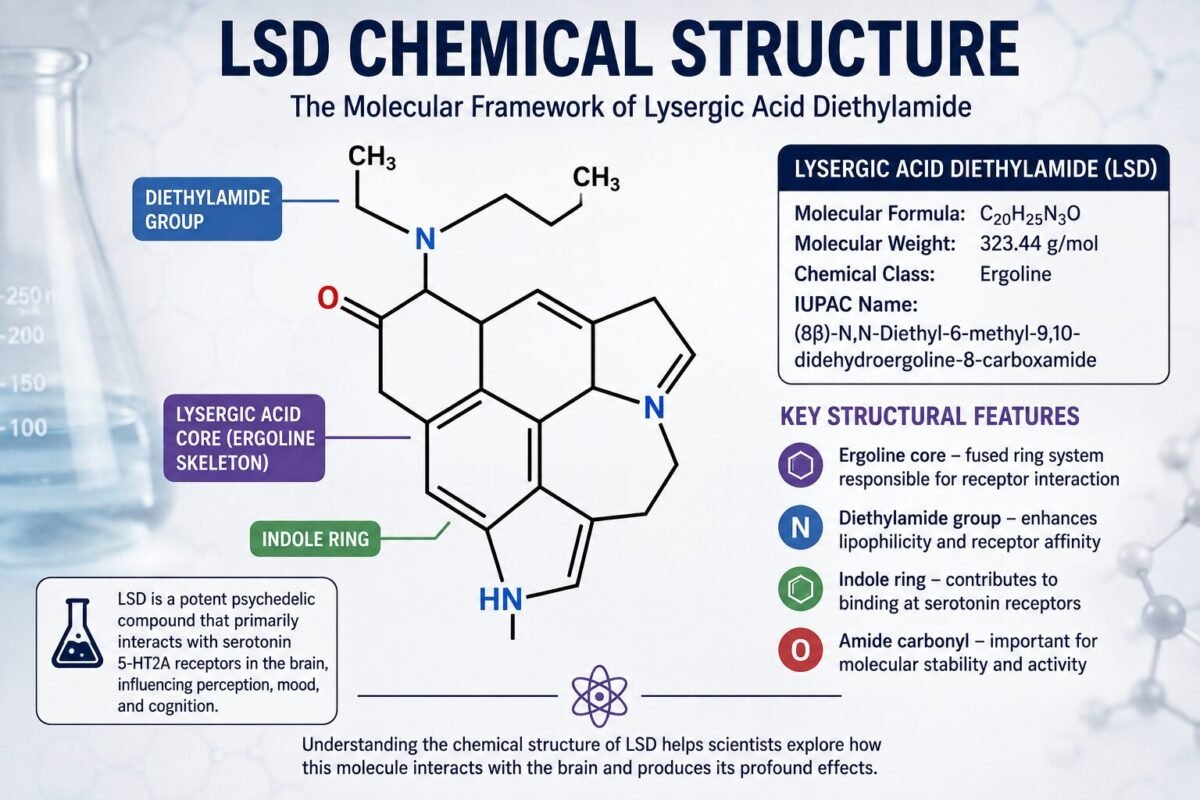
The LSD chemical structure describes the precise arrangement of atoms and chemical bonds that make up lysergic acid diethylamide.
Unlike a simple molecule containing only a few atoms, LSD has a comparatively complex molecular framework. Its structure contains interconnected ring systems and functional groups that contribute to its chemical and biological properties.
Chemists use structural diagrams to represent these relationships visually. A structural formula can show how atoms are connected without requiring the molecule to be physically observed.
Our How Is Lysergic Acid Diethylamide Made? article provides additional historical and chemical context without presenting an operational synthesis procedure.
Understanding the LSD Molecule
The LSD molecule contains carbon, hydrogen, nitrogen, and oxygen atoms arranged in a specific three-dimensional configuration.
The arrangement of these atoms is important because molecular structure influences properties such as shape, polarity, receptor binding, and chemical behavior.
When scientists study the LSD chemical structure, they can examine both the two-dimensional connectivity of the atoms and the three-dimensional shape adopted by the molecule.
This distinction is important in pharmacology because biological receptors interact with molecules according to their spatial and chemical characteristics.
What Does Lysergic Acid Diethylamide Mean?
The full name lysergic acid diethylamide provides information about the chemical identity of LSD.
“Lysergic acid” refers to the core chemical framework associated with the molecule, while “diethylamide” describes a particular functional modification incorporated into its structure.
The name therefore provides a useful starting point for understanding the LSD chemical structure without reducing the molecule to its informal name, “acid.”
For additional terminology, see our LSD vs Acid guide.
LSD and the Ergoline Family
LSD is structurally related to the ergoline family of compounds. Ergoline compounds contain a characteristic fused-ring framework that provides an important part of their molecular architecture.
The relationship between LSD and other ergoline compounds is relevant to medicinal chemistry because structural similarities can help researchers investigate how related molecules interact with biological targets.
Understanding this chemical family also provides historical context for the development of LSD research and the study of ergot-derived compounds.
For historical background, see History of LSD.
LSD Molecular Formula
The molecular formula commonly associated with LSD is C20H25N3O. A molecular formula identifies the number and types of atoms present in a molecule, while a structural formula shows how those atoms are connected.
This distinction is important when studying the LSD chemical structure. Two compounds can contain similar elements while having different arrangements of atoms and therefore different chemical and biological properties.
The molecular formula is consequently only one part of understanding LSD. Researchers also examine molecular geometry, functional groups, stereochemistry, and interactions with biological targets.
Important Structural Features
Several structural features contribute to the distinctive chemistry of LSD. The molecule contains a fused-ring framework associated with the ergoline family as well as functional groups that influence its chemical behavior.
The amide portion of the molecule is particularly relevant to its chemical identity. Researchers can examine these structural components using spectroscopy, crystallography, computational modeling, and other analytical techniques.
Studying these features helps chemists understand how the LSD chemical structure relates to molecular shape and biological activity.
Why Three-Dimensional Structure Matters
A two-dimensional structural diagram does not show everything about a molecule. Many biologically active compounds also have important three-dimensional characteristics.
The spatial arrangement of atoms can influence how a molecule fits into a receptor binding site. This is one reason stereochemistry is an important area of study in medicinal chemistry and pharmacology.
For LSD, researchers investigate how its three-dimensional molecular configuration contributes to its interaction with serotonin receptors.
How Structure Relates to Receptor Activity
The LSD chemical structure is closely connected to the molecule’s pharmacological activity. LSD interacts with several serotonin receptors in the nervous system, including the 5-HT2A receptor.
Receptor binding depends on the physical and chemical characteristics of both the molecule and the receptor. Molecular shape, charge distribution, hydrogen-bonding interactions, and other properties can influence these interactions.
This helps explain why seemingly small structural differences between related compounds can produce different biological effects.
For more information about the neurological side of LSD, see How LSD Works in the Brain.
LSD Structure and Pharmacology
Pharmacology examines how chemical compounds interact with living systems. In the case of LSD, researchers study how its molecular properties relate to changes in perception, cognition, sensory processing, and mood.
The relationship between molecular structure and pharmacological effects is complex. A molecule’s receptor interactions are only one part of the broader biological processes that contribute to a subjective psychedelic experience.
Our Acid Brain Effects guide explores the relationship between LSD and brain function in greater detail.
Why Chemical Structure Matters in Research
Understanding the LSD chemical structure allows scientists to distinguish LSD from chemically different compounds and investigate relationships between molecular structure and biological activity.
Structural information can also help researchers study metabolism, receptor binding, molecular stability, and potential interactions with other biological systems.
This type of research is fundamental to medicinal chemistry and neuroscience because it connects molecular-level observations with measurable biological effects.
LSD Compared With Other Psychedelic Molecules
LSD belongs to a different chemical family from several other well-known psychedelics. For example, DMT has a substantially different molecular framework, while psilocybin has its own distinct chemical structure.
These differences help explain why psychedelic substances cannot be treated as chemically identical simply because they can produce some overlapping subjective effects.
See DMT vs LSD and LSD vs Psilocybin for broader comparisons.
History of LSD Chemistry
The history of the LSD chemical structure is closely connected with twentieth-century research into ergot-derived compounds and lysergic acid chemistry.
LSD was first synthesized in 1938 by Swiss chemist Albert Hofmann while investigating compounds related to ergot. Its unusual psychoactive properties were recognized later, which led to extensive scientific interest in the compound.
Early research examined LSD from perspectives including pharmacology, psychiatry, psychology, and neuroscience. Over time, researchers developed increasingly sophisticated methods for studying its molecular structure and biological activity.
See our History of LSD guide for a broader historical overview.
How Scientists Study LSD Structure
Scientists can investigate the LSD chemical structure using analytical techniques designed to determine molecular composition, connectivity, geometry, and other chemical characteristics.
Techniques such as nuclear magnetic resonance spectroscopy, mass spectrometry, and computational molecular modeling can provide different types of information about a compound.
These approaches allow researchers to study molecular identity and behavior without relying on visual appearance or informal terminology.
LSD Molecular Modeling
Computer-based molecular modeling provides another way to investigate the three-dimensional characteristics of LSD. Researchers can model molecular conformations and examine how a compound may interact with biological targets.
Such models can help scientists investigate receptor binding and structure–activity relationships. However, computational models are generally interpreted alongside experimental evidence rather than treated as standalone proof.
Structure–Activity Relationships
In medicinal chemistry, researchers often examine structure–activity relationships, or SAR. This approach investigates how changes in molecular structure can influence biological activity.
For LSD research, SAR studies can help scientists understand which molecular characteristics contribute to interactions with serotonin receptors and other biological targets.
This is one reason the LSD chemical structure is important beyond simply drawing a molecular diagram.
From Molecular Structure to Brain Effects
The molecular properties of LSD ultimately connect to its effects on the nervous system. LSD interacts with serotonin receptors and can influence signaling processes involved in perception, cognition, and sensory processing.
Researchers continue to investigate how receptor-level interactions translate into changes in communication between brain networks and the subjective effects reported during psychedelic experiences.
Learn more in How LSD Works in the Brain and LSD Effects.
Modern Research Into LSD
Modern research combines chemistry, pharmacology, neuroscience, psychology, and brain imaging to develop a more complete understanding of LSD.
Scientists can now examine molecular interactions alongside changes in brain activity and subjective experience. This multidisciplinary approach provides a more detailed picture than studying the LSD chemical structure alone.
Current research also investigates how psychedelic compounds differ from one another at molecular and neurological levels.
Why Accurate Chemical Identification Matters
Understanding molecular structure is also important when distinguishing a verified chemical compound from an unidentified substance.
Color, shape, packaging, artwork, or a product name cannot establish chemical identity. Analytical testing is required to determine what a sample actually contains.
This distinction is especially important when reading information about substances described using informal terms such as “acid.”
For broader safety information, see Is LSD Safe?.
Scientific Research and Legal Controls
LSD is subject to legal controls in many jurisdictions. Scientific research involving controlled substances may therefore require appropriate regulatory authorization, institutional oversight, and laboratory procedures.
Legal requirements vary between countries and can change over time. Researchers and institutions must follow the regulations applicable to their jurisdiction.
See Is LSD Legal? for general educational context.
Frequently Asked Questions About LSD Chemical Structure
What is the LSD chemical structure?
The LSD chemical structure describes the specific arrangement of atoms and chemical bonds that make up lysergic acid diethylamide. It includes a complex molecular framework associated with the ergoline family.
What is the molecular formula of LSD?
The molecular formula commonly given for LSD is C20H25N3O. A molecular formula shows the number and types of atoms present, while a structural formula shows how those atoms are connected.
What does LSD stand for?
LSD stands for lysergic acid diethylamide. The name identifies a specific synthetic psychedelic compound rather than a broad category of unrelated substances.
What chemical family does LSD belong to?
LSD is structurally associated with the ergoline family of compounds. Its molecular framework is related to lysergic acid and other ergoline compounds.
Why is the LSD chemical structure important?
Molecular structure influences properties such as molecular shape, receptor interactions, chemical behavior, and biological activity. Studying the structure therefore helps scientists understand LSD’s pharmacology.
How does LSD interact with the brain?
LSD interacts with several serotonin receptors, including the 5-HT2A receptor. These interactions are associated with changes in perception, cognition, sensory processing, and other aspects of psychedelic experience.
See How LSD Works in the Brain.
Is LSD the same molecule as DMT?
No. LSD and DMT are chemically different compounds with different molecular structures. They can both produce psychedelic effects, but their chemistry and pharmacology are distinct.
See DMT vs LSD.
Is LSD chemically the same as psilocybin?
No. Psilocybin and LSD have different molecular structures and belong to different chemical groups. Their effects can overlap in some respects, but they are distinct compounds.
See LSD vs Psilocybin.
Who first synthesized LSD?
LSD was first synthesized in 1938 by Swiss chemist Albert Hofmann while researching compounds related to ergot. Its psychedelic properties were recognized later.
See History of LSD for more background.
Can appearance identify LSD?
No. The color, shape, artwork, packaging, or physical form of an unknown substance cannot reliably establish its chemical identity. Analytical testing is required for definitive identification.
Conclusion
The LSD chemical structure provides the molecular foundation for understanding lysergic acid diethylamide and its distinctive pharmacological properties.
Its complex ergoline-based framework, molecular geometry, and functional groups help determine how LSD interacts with biological systems. Researchers study these characteristics alongside receptor pharmacology, neuroscience, and brain imaging to better understand psychedelic effects.
Studying LSD at the molecular level also highlights why chemical identity should not be inferred from appearance or informal terminology. Reliable scientific identification requires appropriate analytical methods.
For further reading, explore How LSD Works in the Brain, Acid Brain Effects, History of LSD, and LSD Effects.
Related LSD Education
- History of LSD
- How LSD Works in the Brain
- LSD Effects
- Acid Brain Effects
- Types of LSD
- LSD vs Acid
- DMT vs LSD
- LSD vs Psilocybin
- Is LSD Safe?
- Is LSD Legal?
Authoritative References
NIDA — Psychedelic and Dissociative Drugs
PubChem — Lysergic Acid Diethylamide
PubMed — Neural Correlates of the LSD Experience
