Jun
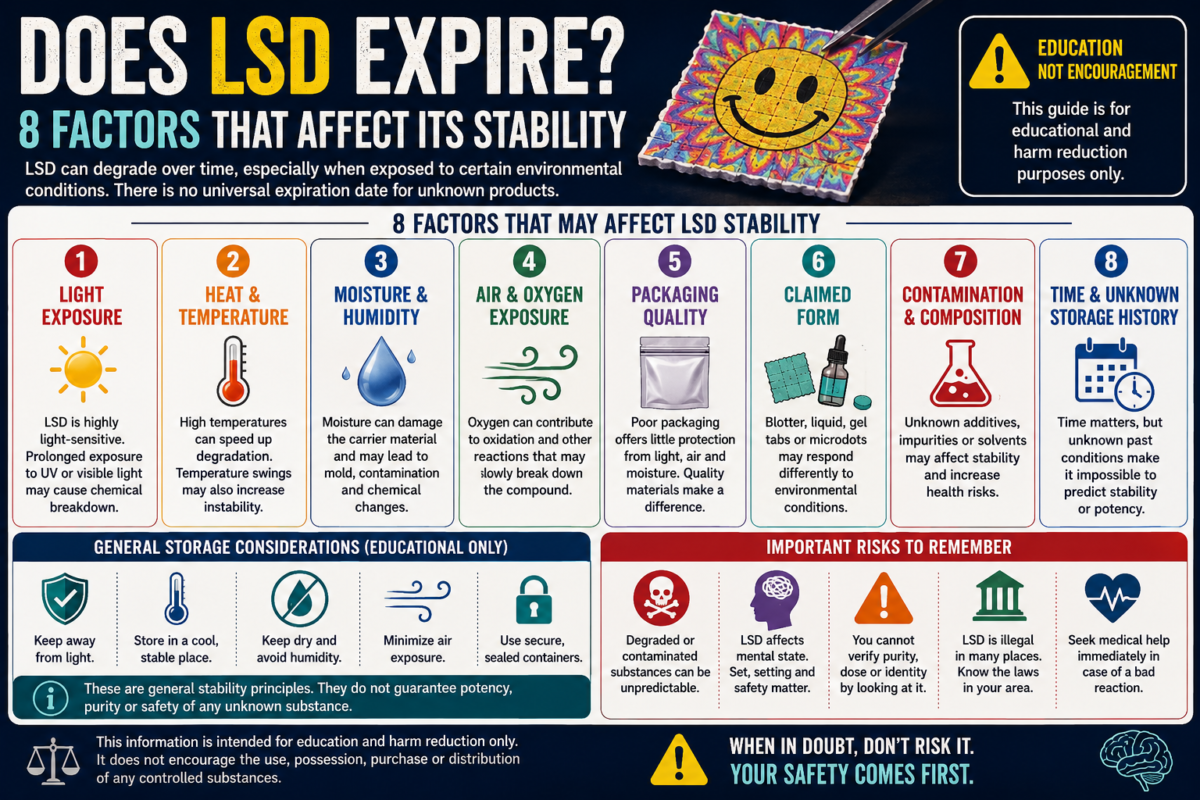
Does LSD expire is a common question because the substance is frequently described as sensitive to environmental conditions. Research involving pharmaceutical formulations and forensic samples indicates that lysergic acid diethylamide can degrade, particularly when exposed to light or unsuitable conditions. However, there is no dependable universal expiration date for an unknown substance represented as LSD.
Claims about an exact LSD shelf life should be treated cautiously. The answer can depend on the chemical form, packaging, environmental exposure, original composition and whether the substance was genuinely LSD in the first place.
This guide explains eight factors connected with LSD stability. It is intended for education and public awareness, not to help preserve, purchase or use an illegal substance.
Table of Contents
- Does LSD Expire or Lose Potency?
- Is There a Standard LSD Shelf Life?
- 8 Factors That May Affect LSD Stability
- Can Appearance Reveal Whether LSD Has Expired?
- Why Unknown Products Create Extra Risks
- Understanding Searches About How to Store LSD
- Safe Handling and Disposal Considerations
- Health and Emergency Awareness
- Frequently Asked Questions
Does LSD Expire or Lose Potency?
The practical answer to does LSD expire is that LSD can degrade, but an exact expiration date cannot normally be determined for an unidentified illicit product. Degradation refers to chemical change over time, which may reduce the amount of the original compound or create other breakdown products.
Scientific research has demonstrated that LSD is light-sensitive. A 2025 pharmaceutical-formulation study described significant challenges caused by photodegradation when researchers developed an LSD formulation for controlled clinical research.
Earlier forensic research also examined LSD stability under different laboratory conditions. However, much of this evidence concerns prepared formulations or LSD measured in biological samples. Those results should not be treated as a guaranteed shelf-life timetable for blotter paper, liquid or tablets obtained from an unregulated source.
Readers seeking general background can review the history of LSD and learn how LSD works in the brain.
Is There a Standard LSD Shelf Life?
No reliable universal LSD shelf life applies to every form or product. A regulated pharmaceutical product normally receives an expiration date after controlled stability testing. Illicit substances do not come with that same quality assurance.
Several unknowns make shelf-life claims unreliable:
- The substance may not actually be LSD.
- The original concentration may be unknown.
- The date of production may be unknown.
- Past exposure to heat or light may be impossible to establish.
- Packaging may not provide an effective environmental barrier.
- Other ingredients or contaminants may affect stability.
- A printed date or seller’s claim may be invented.
Therefore, asking does LSD expire is not the same as checking the expiry date of a licensed medicine. There may be no trustworthy manufacturing record, batch testing or verified storage history.
8 Factors That May Affect LSD Stability
1. Exposure to Light
Light is one of the most important factors discussed in scientific literature about LSD stability. Researchers developing controlled pharmaceutical formulations have described LSD as highly light-sensitive and vulnerable to photodegradation.
This means prolonged light exposure may contribute to chemical breakdown. However, a product that has been kept out of visible light is not automatically genuine, potent or safe.
2. Heat and Temperature Changes
Temperature can affect the stability of many chemical compounds. Elevated temperatures may accelerate degradation reactions, while repeated temperature changes may create additional uncertainty.
When people ask does LSD expire, they often focus only on age. Environmental exposure may be just as relevant as time. An older laboratory sample kept under controlled conditions is different from an unknown product exposed to uncontrolled temperatures.
3. Moisture and Humidity
Moisture can damage paper, alter packaging and contribute to chemical instability. High humidity may also encourage microbial growth on contaminated paper or other carrier materials.
Even when LSD itself is present, damp or visibly contaminated material may introduce risks unrelated to the original compound.
4. Air and Oxygen Exposure
Air exposure can contribute to oxidation and other chemical changes in sensitive compounds. The actual effect depends on the formulation, packaging and surrounding conditions.
It is not possible to judge the extent of degradation merely by looking at a product. An item may appear unchanged while its chemical composition remains unknown.
5. Packaging Quality
Packaging influences exposure to light, air, moisture and contamination. Unregulated products may be wrapped or stored in materials that were never designed for pharmaceutical stability.
Professional-looking packaging does not confirm that proper quality controls were followed. Labels and designs can be copied, and sellers may make unsupported storage or shelf-life claims.
6. The Claimed Form
LSD may be described as blotter, liquid, gel-like material or small tablets. These forms may respond differently to environmental conditions because the carrier material and other ingredients vary.
Our article on the different types and forms of LSD explains the terminology. A claimed form cannot verify the contents.
7. Original Composition and Contamination
Any answer to does LSD expire assumes that the original product contained LSD. In an illicit market, that assumption may be incorrect.
An unidentified item might contain:
- A different psychoactive compound
- Several substances
- Uneven concentrations
- Inactive materials
- Unexpected contaminants
- No LSD at all
Each possible substance may have different stability characteristics and risks.
8. Time and Unknown Storage History
Time can contribute to degradation, but age alone does not provide a complete answer. A product’s prior history may be unknown before it reaches the person examining it.
There is no visual method for reconstructing months or years of exposure. Seller statements about age or previous handling should not be treated as verified evidence.
Can Appearance Reveal Whether LSD Has Expired?
No. Colour, artwork, smell, shape or paper condition cannot reliably answer does LSD expire or confirm whether degradation has occurred.
Blotter artwork is decorative and does not provide chemical information. A faded image could result from ordinary ink deterioration, while a brightly coloured design does not prove that the active compound remains unchanged.
The same limitation applies to liquid and tablet-like forms. Clarity, colour and container appearance are not substitutes for laboratory analysis.
Readers can also review the guide to common street names for LSD. Slang and appearance are both unreliable methods of identification.
Why Unknown Products Create Additional Risks
The question does LSD expire may create the impression that age is the main safety concern. In reality, chemical identity is often the larger uncertainty.
An illicitly sourced substance may have been misrepresented from the beginning. Even a recently obtained product could carry risks from substitution, contamination or inaccurate potency claims.
Price provides no reassurance either. The educational article explaining how much acid costs and why reported prices vary examines how unregulated markets create misleading claims and scam risks.
No expiry claim can compensate for absent quality control. A seller cannot establish safety merely by describing a product as fresh, newly manufactured or professionally stored.
Understanding Searches About How to Store LSD
The supporting query how to store LSD overlaps closely with the question does LSD expire. People may be researching chemical stability, forensic evidence, clinical formulations, safety or an unknown item they have encountered.
Scientific publications discussing storage generally concern controlled laboratory materials, clinical-trial products or biological samples used for testing. Their procedures should not be interpreted as instructions for maintaining an illicit supply.
A responsible educational summary is that research identifies light and unsuitable environmental conditions as important stability concerns. That does not provide a reliable method for making an unregulated product safe, genuine or predictable.
Someone who discovers an unknown substance should avoid tasting, smelling or handling it unnecessarily. It should be kept away from children and animals while appropriate local authorities, poison-control professionals or hazardous-waste services are contacted for guidance.
Safe Handling and Disposal Considerations
Disposal rules vary by location. Flushing unknown substances or throwing them loose into household waste may create risks for people, animals and the environment.
Where available, contact an official medicine take-back program, poison-control service, local pharmacy, public-health department or hazardous-waste authority. Explain that the substance is unidentified so they can provide location-specific guidance.
Avoid transporting an illegal substance unnecessarily. Local laws should be considered before taking action. In an immediate exposure emergency, contact emergency services rather than focusing on disposal.
Health and Emergency Awareness
Whether or not LSD has degraded, taking an unidentified substance can cause unpredictable effects. LSD itself may produce major changes in perception, mood, thinking and judgement. Read more about the effects of LSD and how long LSD effects may last.
Possible warning signs requiring urgent assistance include:
- Loss of consciousness
- Seizures
- Chest pain
- Difficulty breathing
- Severe agitation
- Dangerous behaviour
- Extreme confusion
- Signs of overheating
The guide Is LSD Safe? provides additional health information. In an emergency, contact local medical services or a poison-control centre immediately.
What Does Scientific Research Say?
Laboratory evidence supports the conclusion that LSD stability is influenced by environmental conditions. A published study in the Journal of Analytical Toxicology examined LSD under different storage conditions in forensic samples. More recent pharmaceutical research has focused on protecting clinical LSD formulations from light-related degradation.
These studies are valuable for analytical laboratories and clinical researchers, but they do not create a universal expiration date for an illicit product. Differences in formulation, carrier material, concentration and storage history prevent a simple conversion into a consumer shelf-life estimate.
Readers can examine the LSD stability study indexed by PubMed and a 2025 study of a light-protected pharmaceutical LSD formulation. These are standard dofollow references because the links contain no rel="nofollow" attribute.
For broader drug information, consult the National Institute on Drug Abuse overview of psychedelic drugs and the DEA hallucinogens fact sheet.
Frequently Asked Questions
Does LSD expire over time?
LSD can degrade over time, but there is no universal expiration date for an unidentified product. Light, temperature, moisture, air, formulation and storage history may all influence stability.
Does LSD expire if it still looks normal?
Appearance cannot confirm chemical stability. Paper, liquid or tablet-like material may look unchanged even though its contents and potency remain unknown.
What is the average LSD shelf life?
There is no reliable average shelf life that applies to illicit LSD products. Scientific stability data generally involve controlled pharmaceutical or forensic samples rather than unverified street products.
Do heat and light affect LSD?
Scientific research identifies light sensitivity as an important concern, and unsuitable temperatures may also contribute to degradation. Exact effects depend on the formulation and conditions.
Does moisture damage LSD blotter?
Moisture may damage paper, affect packaging and introduce contamination. It cannot be assumed that dry-looking blotter is authentic or chemically stable.
Can expired LSD become dangerous?
The effects of degradation products in an unknown illicit product cannot be reliably predicted. The larger concern is that the original identity, potency and contamination status may never have been verified.
Can a seller confirm that LSD is fresh?
No seller’s statement can replace laboratory identification and regulated quality control. Terms such as fresh, pure or newly made are marketing claims unless supported by credible testing.
How can someone safely dispose of an unknown substance?
Contact a local poison-control centre, medicine take-back program, public-health department or hazardous-waste authority for location-specific guidance. Keep unidentified substances away from children and animals.
Final Thoughts
Does LSD expire has no simple date-based answer. LSD can degrade, and research indicates that light and other environmental conditions matter. However, an unknown product has no trustworthy shelf-life guarantee because its identity, original concentration and handling history may be impossible to verify.
Age, appearance and seller claims cannot establish purity, potency or safety. Anyone who encounters an unidentified substance should avoid using it and seek appropriate professional advice for safe handling or disposal.
This article is intended for education, public awareness and harm reduction. It does not encourage the possession, purchase, storage or use of controlled substances.
