Jun
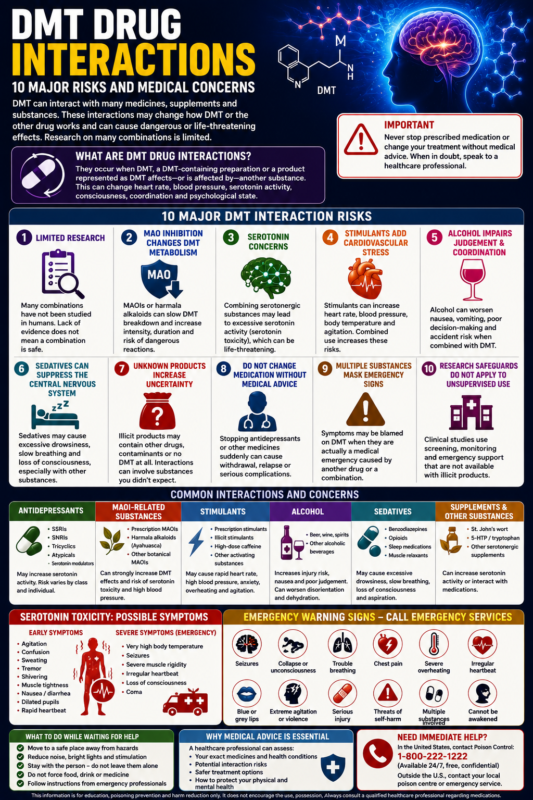
DMT Drug Interactions: 10 Major Risks and Medical Concerns
DMT drug interactions can be difficult to predict because the risks depend on the actual substance, formulation, medicines involved, individual health and whether other drugs were taken. Interactions may alter serotonin activity, blood pressure, heart rate, consciousness, coordination and psychological stability.
Research on many specific DMT drug interactions remains limited. This means the absence of a published case report should not be interpreted as evidence that a combination is safe.
This educational guide covers antidepressants, monoamine oxidase inhibitors, stimulants, alcohol, multiple-substance exposure and emergency warning signs. It does not explain combinations, timing, doses or methods intended to intensify DMT effects.
Table of Contents
- What Are DMT Drug Interactions?
- 10 Major DMT Interaction Risks
- DMT and Antidepressants
- DMT and MAOI-Related Risks
- Serotonin Toxicity
- DMT and Stimulants
- DMT and Alcohol
- DMT and Sedating Substances
- Multiple-Substance Exposure
- Why Ayahuasca Has a Different Interaction Profile
- Unknown Products and Mislabelled Drugs
- Why Individual Medical Advice Matters
- Emergency Warning Signs
- Frequently Asked Questions
What Are DMT Drug Interactions?
DMT drug interactions occur when DMT, a DMT-containing preparation or a product represented as DMT changes the effects of another medicine or substance—or when that other substance changes the effects of DMT.
An interaction may affect:
- Serotonin signalling
- Heart rate
- Blood pressure
- Body temperature
- Breathing
- Consciousness
- Coordination
- Anxiety and panic
- Risk of seizures
- Duration or intensity of effects
The interaction profile may differ between isolated DMT and preparations containing additional active compounds. Ayahuasca, for example, contains monoamine oxidase-inhibiting compounds that substantially change how DMT is metabolised.
For a broader safety overview, read is DMT safe and our complete DMT guide.
10 Major DMT Interaction Risks
1. Research on Specific Combinations Is Limited
Many possible DMT drug interactions have not been tested in controlled human studies. Existing evidence may come from small trials, case reports, pharmacology, related psychedelics or ayahuasca research.
This creates uncertainty about:
- How often severe interactions occur
- Which individuals are most vulnerable
- How different formulations compare
- Whether unregulated products contain the claimed substance
- How several medicines may interact simultaneously
Limited evidence should encourage caution rather than reassurance.
2. MAO Inhibition Can Change DMT Metabolism
Monoamine oxidase normally helps break down DMT. When monoamine oxidase is inhibited, exposure and the overall effect profile may change.
This is particularly relevant to ayahuasca and other preparations containing harmala alkaloids. It is also relevant to people prescribed monoamine oxidase inhibitor medicines.
3. Some Antidepressant Combinations Raise Serotonin Concerns
Several antidepressant classes affect serotonin or other monoamines. Combining multiple serotonergic mechanisms may create concern about excessive serotonin activity.
The evidence is not identical for every antidepressant, psychedelic or formulation. However, serotonin toxicity is potentially life-threatening and should not be dismissed.
4. Stimulants May Add Cardiovascular Stress
Stimulants may increase heart rate, blood pressure, agitation and body temperature. DMT has also produced temporary cardiovascular changes in controlled studies.
When several substances affect the cardiovascular system, symptoms may become harder to interpret and potentially more dangerous.
5. Alcohol Can Impair Judgement and Coordination
Alcohol may worsen balance, decision-making, vomiting risk and environmental awareness. DMT can also profoundly alter perception and orientation.
Together, these effects may increase the chance of falls, aspiration, burns, drowning or other accidental injuries.
6. Sedating Drugs May Complicate Consciousness and Breathing
Sedatives can reduce alertness, impair coordination and affect breathing. If someone becomes unresponsive after multiple-substance exposure, it is unsafe to assume that they are merely experiencing a psychedelic effect.
7. Unknown Products Make Interactions Less Predictable
A product sold as DMT may contain another tryptamine, stimulant, sedative, contaminant or several drugs. The interaction may therefore involve substances the person did not know they had taken.
8. Medicine Changes Should Not Be Made Without Medical Advice
Stopping antidepressants or other prescribed medicines suddenly can cause withdrawal symptoms, relapse or other complications.
No one should discontinue a prescribed medicine simply to avoid a possible interaction without first consulting a qualified clinician.
9. Multiple-Substance Exposure Can Mask Emergency Signs
Anxiety, agitation, sweating, confusion and rapid heartbeat may be blamed on DMT even when they are signs of serotonin toxicity, stimulant poisoning, overheating or another medical emergency.
10. Clinical Screening Does Not Apply to Unsupervised Use
Clinical studies may exclude people taking certain medicines or living with particular health conditions. Researchers may also monitor vital signs and have emergency protocols available.
These safeguards do not exist with illicit powders, cartridges, plant mixtures or unknown substances.
DMT and Antidepressants
Antidepressants are among the most frequently discussed areas of DMT drug interactions. However, the term “antidepressant” covers several different medicine classes with different mechanisms.
Relevant categories may include:
- Selective serotonin reuptake inhibitors
- Serotonin–norepinephrine reuptake inhibitors
- Tricyclic antidepressants
- Monoamine oxidase inhibitors
- Atypical antidepressants
- Serotonin modulators
Evidence from research involving classic psychedelics and antidepressants is mixed and incomplete. Some studies involving other psychedelics have not observed serotonin syndrome, while other reviews continue to identify theoretical and reported concerns, particularly when monoamine oxidase inhibition is involved.
These findings cannot be generalised confidently to every DMT formulation, every antidepressant or every individual.
Important questions include:
- Which antidepressant is being taken?
- Does the DMT preparation contain an MAOI?
- Are several psychiatric medicines involved?
- Does the person have cardiovascular or neurological conditions?
- Is the product chemically verified?
Individual medical review is safer than relying on social-media interaction charts.
DMT and MAOI-Related Risks
MAOI-related concerns are central to understanding DMT drug interactions. Monoamine oxidase inhibitors reduce the breakdown of certain monoamines and can significantly change the effects of other drugs.
MAO inhibition may be present because of:
- A prescription MAOI antidepressant
- Harmala alkaloids in ayahuasca
- Another botanical preparation
- An unlabelled ingredient
- A product containing several active compounds
Possible concerns include:
- Excessive serotonergic activity
- Dangerous blood-pressure changes
- Severe agitation
- Overheating
- Irregular heartbeat
- Prolonged or unpredictable effects
- Interactions with medicines and some supplements
MAOI interactions can extend beyond prescription medicines. Over-the-counter drugs, herbal products and other psychoactive substances may also be relevant.
Serotonin Toxicity and DMT Drug Interactions
Serotonin toxicity, also called serotonin syndrome, occurs when serotonin activity becomes excessive. It can range from mild symptoms to a life-threatening emergency.
Possible early symptoms include:
- Agitation
- Confusion
- Sweating
- Tremor
- Shivering
- Diarrhoea
- Nausea
- Dilated pupils
- Muscle tightness
- Rapid heartbeat
Severe warning signs may include:
- Very high body temperature
- Seizures
- Severe muscle rigidity
- Irregular heartbeat
- Loss of consciousness
- Coma
These symptoms may overlap with panic, stimulant toxicity or severe intoxication. Do not attempt to diagnose the cause at home when serious symptoms are present.
Call emergency services immediately for severe overheating, seizure, collapse, abnormal breathing or inability to awaken.
DMT and Stimulants
Stimulants may include prescription medicines, illicit stimulants, highly concentrated caffeine products or other activating substances.
Potential concerns include additive effects on:
- Heart rate
- Blood pressure
- Body temperature
- Anxiety
- Agitation
- Sleep deprivation
- Risk-taking behaviour
A rapid heartbeat may result from anxiety, a stimulant, DMT, another drug or a combination of factors. Chest pain, fainting, severe agitation or overheating require urgent evaluation.
The article should not present any stimulant combination as predictable or controllable.
DMT and Alcohol
Alcohol may reduce judgement and coordination while increasing nausea, vomiting and injury risk. DMT may temporarily reduce awareness of the physical environment.
Possible safety concerns include:
- Falls
- Head injuries
- Aspiration after vomiting
- Reduced ability to communicate symptoms
- Conflict or unsafe behaviour
- Failure to recognise an emergency
- Additional dehydration or physical stress
Alcohol may also make it harder for observers or clinicians to determine which substance caused a particular symptom.
DMT and Sedating Substances
Sedating substances can include prescription sleep medicines, anti-anxiety medicines, opioids and other central nervous system depressants.
Depending on the substance, concerns may include:
- Reduced alertness
- Poor coordination
- Abnormal breathing
- Vomiting while impaired
- Loss of consciousness
- Difficulty assessing neurological symptoms
Breathing difficulty, blue or grey lips, very slow breathing or inability to awaken requires emergency assistance.
Multiple-Substance Exposure
Multiple-substance exposure is one of the most unpredictable forms of DMT drug interactions. Risk may increase when several medicines, recreational substances, herbs or unknown products are involved.
Multiple substances may:
- Produce opposing effects
- Intensify the same cardiovascular effects
- Increase confusion
- Mask sedation or overheating
- Alter metabolism
- Increase seizure risk
- Make diagnosis more difficult
A person seeking emergency care should provide the names of all known medicines, supplements and substances. Packaging or photographs may be helpful for clinicians, but no one should delay calling for help while gathering evidence.
Why Ayahuasca Has a Different Interaction Profile
Ayahuasca is not pharmacologically equivalent to isolated DMT because it normally contains beta-carboline compounds that inhibit monoamine oxidase.
This changes the interaction profile and increases concern involving:
- Serotonergic medicines
- Prescription MAOIs
- Some stimulants
- Other monoamine-affecting substances
- Certain herbal supplements
- Blood-pressure effects
Safety information about isolated DMT cannot simply be applied to ayahuasca, and safety information about ayahuasca cannot automatically be applied to every other DMT product.
Unknown Products and Mislabelled Drugs
Illicit-market products increase the uncertainty surrounding DMT drug interactions. A powder, cartridge or liquid may be mislabeled or contaminated.
Unknown products may contain:
- Another tryptamine
- Several psychoactive compounds
- A stimulant
- A sedative
- Residual chemicals
- Unknown vape additives
- Metals or particles
- No DMT at all
Colour, crystal appearance, packaging and seller-provided documents cannot reliably establish identity.
Read what does DMT look like for more information about visual-identification limitations.
Why Individual Medical Advice Matters
Online articles cannot determine whether a particular interaction is safe for an individual. A clinician or pharmacist can assess factors that generic interaction charts cannot fully consider.
Relevant personal factors include:
- Exact prescription medicines
- Over-the-counter products
- Herbal supplements
- Heart or blood-pressure conditions
- Neurological conditions
- Psychiatric history
- Pregnancy
- Liver or kidney function
- Recent medication changes
- Previous adverse reactions
Do not stop antidepressants, blood-pressure medicines, seizure medicines or other prescriptions abruptly. Withdrawal and relapse may create their own serious risks.
When asking a healthcare professional about DMT drug interactions, honesty about all medicines and substances is important. Medical advice is more reliable when the clinician has complete information.
Emergency Warning Signs
Call emergency services immediately if someone who may be experiencing DMT drug interactions:
- Has a seizure
- Collapses or loses consciousness
- Cannot be awakened
- Has trouble breathing
- Develops blue or grey lips
- Has chest pain
- Shows severe overheating
- Has extreme muscle rigidity
- Develops an irregular heartbeat
- Becomes dangerously agitated or violent
- Threatens self-harm or harm to others
- May have taken several substances
While waiting for professional help:
- Move the person away from traffic, fire, water and heights when safe.
- Reduce noise, bright lights and unnecessary stimulation.
- Do not force food, drink or medicine.
- Do not induce vomiting.
- Do not place anything in the mouth during a seizure.
- Do not leave an unconscious person alone.
- Follow instructions from emergency professionals.
In the United States, contact Poison Control for immediate assistance. People in other countries should contact their local poison centre or emergency service.
Frequently Asked Questions
What are the main DMT drug interactions?
Major concerns involve antidepressants, MAOIs, stimulants, sedatives, alcohol, serotonergic medicines and multiple-substance exposure.
Can DMT interact with antidepressants?
Potential interactions vary by antidepressant class and DMT formulation. MAOI-containing preparations create particular concern, while evidence for many other combinations remains incomplete.
Why are MAOIs important in DMT interactions?
MAOIs change the breakdown of DMT and other monoamines. They can also interact dangerously with certain medicines and substances.
Can DMT cause serotonin syndrome?
The risk is not fully defined for every formulation, but excessive serotonergic activity is a serious concern when multiple serotonin-affecting agents or MAOIs are involved.
Does DMT interact with stimulants?
Stimulants may add cardiovascular stress, agitation and overheating. The severity is difficult to predict, particularly when products are unregulated.
Does alcohol make DMT safer?
No. Alcohol can worsen judgement, coordination, vomiting and injury risk.
Can someone stop antidepressants before using DMT?
Prescribed medicines should not be stopped or changed without guidance from a qualified clinician. Abrupt discontinuation can be dangerous.
Are online interaction charts reliable?
They may oversimplify incomplete evidence and cannot account for individual health, exact medicines or unknown product contents.
Do clinical DMT studies include people taking medications?
Many studies use strict inclusion criteria and may exclude participants taking medicines that could increase risk or complicate interpretation.
When should emergency help be requested?
Call immediately for seizure, collapse, abnormal breathing, chest pain, severe overheating, extreme agitation, irregular heartbeat or inability to awaken.
Final Thoughts
DMT drug interactions can involve antidepressants, MAOIs, stimulants, alcohol, sedatives and unknown substances. The risks may include serotonin toxicity, cardiovascular stress, impaired consciousness, dangerous behaviour and delayed emergency treatment.
Evidence remains limited for many specific combinations, and individual health factors can significantly change the risk. Prescribed medicines should never be stopped or altered without professional medical advice.
This article is provided for education, poisoning prevention and harm reduction. It does not encourage combining substances or using controlled drugs.
