
Jun
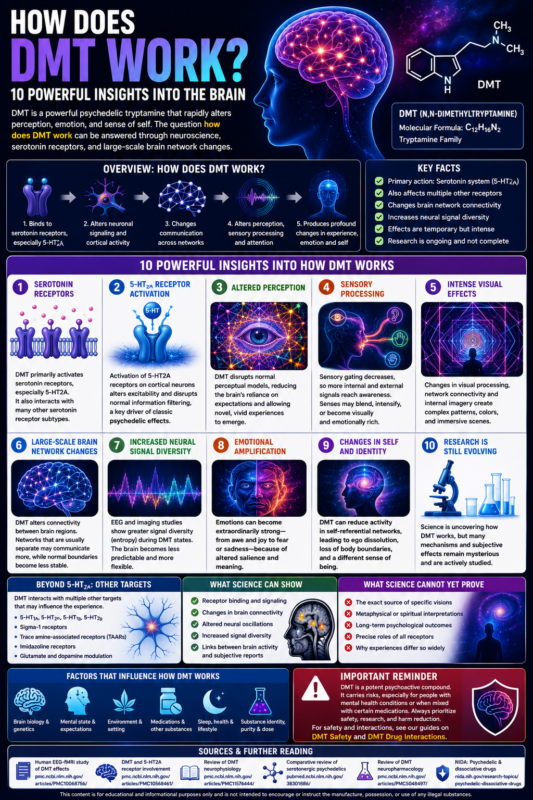
How Does DMT Work? 10 Powerful Insights Into the Brain
How does DMT work is a complex neuroscience question involving serotonin receptors, brain-network activity, sensory processing, emotion and consciousness. DMT can produce rapid and profound changes in visual perception, time, identity and awareness, but scientists do not yet have a complete explanation for every effect.
The strongest evidence links classic psychedelic effects to activation of serotonin 5-HT2A receptors. DMT also interacts with several other serotonin-receptor subtypes and additional molecular targets, meaning its effects cannot be reduced to one receptor or one brain region.
This educational article explains how DMT may affect the brain at a high level. It does not provide instructions for obtaining, preparing, dosing or consuming DMT.
Table of Contents
- How Does DMT Work?
- 10 Powerful Insights Into DMT and the Brain
- DMT and Serotonin Receptors
- The Role of the 5-HT2A Receptor
- How DMT Alters Perception
- DMT and Sensory Processing
- Why Visual Effects Can Be So Intense
- DMT and Large-Scale Brain Networks
- Neural Signal Diversity
- DMT and Emotional Effects
- Changes in Identity and Sense of Self
- Other Receptors and Molecular Targets
- Current Research Limitations
- Common Myths About How DMT Works
- From Receptors to Conscious Experience
- DMT and Cortical Signalling
- Predictive Processing
- Sensory Gating
- Information Flow Through the Brain
- DMT, Memory and Meaning
- Emotional Salience
- Brain-Network Boundaries
- Brain Entropy and Signal Diversity
- Why Effects Differ Between People
- What Research Can Reveal
- What Scientists Cannot Yet Explain
- Frequently Asked Questions
How Does DMT Work?
The clearest answer to how does DMT work is that it changes signalling in serotonin-related brain systems and alters communication across networks involved in perception, emotion, attention and self-awareness.
DMT is considered a classic serotonergic psychedelic. Its characteristic effects are strongly associated with activation of 5-HT2A receptors, especially in cortical brain regions involved in integrating information.
Researchers believe the experience may arise from several overlapping processes:
- Altered serotonin-receptor signalling
- Changes in cortical excitability
- Changes in communication between brain networks
- Reduced stability of ordinary perceptual models
- Greater influence of internally generated imagery
- Changes in emotional and autobiographical processing
- Increased variability or diversity in neural activity
For a broader introduction to forms, duration, effects and safety, visit our complete DMT guide.
10 Powerful Insights Into DMT and the Brain
1. DMT Acts Primarily Through Serotonin-Related Systems
DMT resembles other tryptamine molecules structurally and interacts with multiple serotonin receptors. These receptors help regulate mood, perception, cognition and many other biological processes.
The involvement of serotonin systems helps explain why DMT can influence both sensory experience and emotional state.
2. The 5-HT2A Receptor Is Especially Important
The 5-HT2A receptor is widely considered central to the effects of classic psychedelics. Activation of this receptor can alter signalling in cortical neurons and affect the way the brain integrates information.
However, 5-HT2A activation alone may not explain every aspect of the DMT experience.
3. DMT Changes How the Brain Organises Information
Ordinary perception depends on the brain combining sensory input with expectations, memory and context. DMT may disrupt the normal balance between incoming information and internally generated predictions.
This may contribute to unusual visual scenes, geometric imagery and altered interpretations of space and time.
4. Internal Imagery May Become More Influential
During a DMT experience, internally generated images and associations may become unusually vivid. The brain may give greater weight to spontaneous activity that would normally remain outside conscious awareness.
This could help explain why experiences can feel immersive even when they do not match the physical environment.
5. Sensory Boundaries May Become Less Stable
DMT may affect the way sensory information is filtered and organised. Visual, emotional and bodily experiences may blend together in unusual ways.
Some people report that sounds appear visual, emotions seem physical or ordinary objects take on unfamiliar meaning.
6. Large-Scale Brain Networks Become Less Conventional
Human neuroimaging research suggests that DMT changes communication across major brain networks. Regions that do not usually communicate strongly may show altered connectivity.
At the same time, familiar network organisation may become less stable.
7. Neural Signal Diversity May Increase
EEG and imaging studies have reported greater complexity or diversity in brain activity during DMT effects.
This does not mean the brain becomes simply “more active.” Instead, its patterns may become less repetitive and more variable.
8. Emotional Responses Can Become Intensified
DMT may strongly amplify fear, wonder, awe, sadness or joy. Emotional effects may be influenced by the person’s expectations, environment, memories and mental-health history.
The same perceptual change may feel meaningful to one person and terrifying to another.
9. The Sense of Self May Temporarily Change
Some people report losing their ordinary sense of identity, body boundaries or personal history. This is sometimes described as ego dissolution or loss of self.
These effects may relate to altered communication among networks involved in self-referential thinking and autobiographical memory.
10. Scientists Still Do Not Fully Understand DMT
Research has identified important receptors and brain-network changes, but many questions remain unresolved.
Current studies cannot yet explain why particular visual themes occur, why experiences differ so dramatically or how molecular events become complex subjective experiences.
DMT and Serotonin Receptors
Understanding how does DMT work requires a basic understanding of serotonin receptors. Serotonin is a signalling molecule involved in mood, sleep, perception, appetite, cognition and many other functions.
There are multiple serotonin-receptor families and subtypes. DMT has shown activity at several of them, including:
- 5-HT1A
- 5-HT1B
- 5-HT1D
- 5-HT2A
- 5-HT2B
- 5-HT2C
- 5-HT5A
- 5-HT6
- 5-HT7
These receptor interactions differ in strength and biological importance. The 5-HT2A receptor remains the best-established target for explaining classic psychedelic effects.
The existence of multiple receptor interactions means that DMT’s pharmacology is broader than a one-receptor model.
The Role of the 5-HT2A Receptor
5-HT2A receptors are widely distributed in the cerebral cortex, including regions involved in perception, cognition and integration of information.
When DMT activates these receptors, it may change the excitability and signalling behaviour of cortical neurons.
At a simplified level, this may influence:
- How strongly neurons respond to input
- How cortical regions communicate
- How sensory information is interpreted
- How expectations shape perception
- How attention is distributed
- How internal imagery reaches awareness
The 5-HT2A receptor is not a simple “hallucination switch.” Its effects depend on cell type, brain region, signalling pathway and wider network context.
How DMT Alters Perception
Perception is not a direct recording of the outside world. The brain continuously interprets sensory signals using prior experience, expectation and context.
DMT may alter this interpretive process. Under its effects, ordinary assumptions about shape, colour, movement, distance and meaning may become less stable.
Possible perceptual changes include:
- Geometric patterns
- Intensified colour
- Apparent movement in stationary objects
- Changes in depth and scale
- Complex scenes or figures
- Altered bodily awareness
- Distorted passage of time
These experiences may feel real because they arise from the same brain systems that normally construct conscious perception.
DMT and Sensory Processing
Sensory processing involves detecting, filtering and interpreting information from vision, hearing, touch and the body.
DMT may change sensory processing by altering:
- Filtering of incoming signals
- Attention to internal versus external information
- Communication between sensory regions
- Top-down expectations
- Response to unexpected stimuli
- Integration of different sensory channels
Research on psychedelics suggests that ordinary filtering mechanisms may become less restrictive. This may allow more internally generated or weak sensory information to enter awareness.
This remains an active research area, and conclusions drawn from other psychedelics may not apply perfectly to DMT.
Why DMT Visual Effects Can Be So Intense
DMT is known for particularly vivid visual experiences. These may include repeating patterns, complex environments and highly detailed imagery.
Several processes may contribute:
- Altered activity in visual-processing regions
- Greater influence of internal imagery
- Changes in sensory gating
- Reduced stability of ordinary visual predictions
- Increased communication between visual and associative regions
- Heightened neural variability
No single mechanism currently explains why specific images or themes appear.
Computational models have explored how altered information flow and generative brain processes might contribute to psychedelic imagery, but these models remain theoretical rather than complete explanations.
DMT and Large-Scale Brain Networks
The brain is organised into networks that support vision, attention, emotion, memory and self-related thought. These networks normally maintain relatively stable patterns of communication.
Human DMT studies using EEG and functional MRI have reported changes in:
- Network connectivity
- Global integration
- Communication between normally separated systems
- Organisation of resting-state activity
- Relationships between brain activity and subjective intensity
Research suggests that DMT may reduce some ordinary network boundaries while increasing unusual patterns of communication.
This may help explain why perception, memory, emotion and imagination can become deeply blended.
Neural Signal Diversity
Neural signal diversity describes how varied or unpredictable brain-activity patterns are over time.
Studies have reported increases in measures of signal diversity during psychedelic states, including DMT.
Greater diversity may reflect a wider range of possible brain states. It may contribute to:
- Unusual associations
- Rapidly changing imagery
- Altered emotional meaning
- Reduced predictability of thought
- A less stable sense of reality
Greater signal diversity should not automatically be described as healthier, superior or more conscious. It is a descriptive finding whose full significance remains uncertain.
DMT and Emotional Effects
DMT can produce intense emotional reactions. Possible effects include:
- Awe
- Wonder
- Fear
- Panic
- Joy
- Grief
- Paranoia
- A sense of significance
- Emotional detachment
Emotional responses may result from interactions among serotonin signalling, memory, expectation and changes in perceived meaning.
When sensory and self-related processing change rapidly, ordinary experiences may acquire powerful emotional importance.
For a safety-focused overview of psychological reactions, read our guide to DMT side effects.
Changes in Identity and Sense of Self
The brain maintains a continuing model of the body, identity and personal history. DMT may temporarily disturb this model.
Reported experiences include:
- Loss of body boundaries
- Feeling detached from the body
- Loss of personal identity
- Feeling merged with the environment
- Altered autobiographical awareness
- A sense of entering another reality
Researchers have linked psychedelic changes in self-awareness to altered activity in networks associated with self-referential thinking. However, the exact relationship between network changes and subjective ego dissolution remains under investigation.
Other Receptors and Molecular Targets
Although serotonin receptors are central, DMT has also been studied in relation to other molecular targets, including sigma-1 receptors and trace-amine-associated receptors.
The importance of these targets to the acute human psychedelic experience remains uncertain.
Laboratory findings may suggest possible roles in:
- Cellular stress responses
- Ion-channel regulation
- Neural plasticity
- Immune signalling
- Intracellular communication
These hypotheses should not be overstated. Evidence from cells or animals does not automatically establish the same role in human conscious experience.
For an explanation of the molecule’s indole and tryptamine features, see our DMT structure guide.
Current DMT Research Limitations
A complete answer to how does DMT work must acknowledge significant scientific limitations.
Current research is limited by:
- Small participant numbers
- Differences in study design
- Different formulations and administration methods
- Difficulty measuring rapidly changing experiences
- Reliance on subjective reports
- Participant expectations
- Limited long-term data
- Difficulty separating receptor effects
- Limited diversity among research participants
Human brain-imaging studies can show associations between neural activity and subjective effects, but association does not always prove direct causation.
Animal and cell studies offer mechanistic clues, but their findings may not translate directly to complex human experiences.
Common Myths About How DMT Works
Myth: DMT Activates Every Part of the Brain
DMT changes patterns of brain activity and connectivity, but it does not simply switch on every brain region at maximum capacity.
Myth: DMT Works Only Through One Receptor
The 5-HT2A receptor is central, but DMT interacts with multiple receptor systems.
Myth: DMT Proves the Brain Receives Information From Another Dimension
Current neuroscience can document altered perception and brain activity, but it cannot scientifically confirm metaphysical interpretations of subjective experiences.
Myth: DMT Is Released in Large Amounts During Dreams or Near Death
DMT has been investigated as an endogenous compound, but strong claims that the human pineal gland releases psychedelic amounts during dreaming, birth or near-death experiences are not supported by established evidence.
Myth: Greater Brain Complexity Automatically Means Better Brain Function
Increased neural diversity is a measurable feature of some psychedelic states, but it does not automatically mean improved cognition, safety or mental health.
How Does DMT Work From Receptor to Conscious Experience?
To understand how does DMT work, it helps to separate the process into several levels. DMT first interacts with molecular targets, including serotonin receptors. Those receptor interactions influence individual neurons, which then affect local circuits and large-scale brain networks. Changes across those networks may contribute to altered perception, emotion, memory and self-awareness.
This process is not a simple chain in which one receptor creates one visual effect. The brain is a dynamic system containing billions of interacting neurons. A change in one signalling pathway may influence many regions and networks at the same time.
A simplified explanation of how DMT works involves:
- DMT reaching receptor-binding sites
- Activation of serotonin-related signalling
- Changes in cortical-neuron activity
- Altered communication among brain regions
- Changes in sensory filtering and prediction
- Greater influence of internally generated information
- Temporary changes in conscious perception
Therefore, the question how does DMT work cannot be answered only by naming the 5-HT2A receptor. Receptors begin a biological process, but the conscious experience emerges from activity across a much larger system.
How Does DMT Work in the Cerebral Cortex?
The cerebral cortex supports perception, language, attention, planning and interpretation of sensory information. It contains many 5-HT2A receptors, particularly on neurons involved in integrating information across cortical layers.
When researchers investigate how does DMT work in the cortex, they examine how receptor activation changes neuronal excitability and communication. Psychedelic receptor signalling may make some cortical systems more responsive, less predictable or more influenced by information that would ordinarily remain weak or unconscious.
Possible cortical changes include:
- Altered firing patterns
- Changes in communication between cortical layers
- Greater responsiveness to internal signals
- Reduced stability of ordinary perceptual interpretations
- Changes in how sensory and emotional information are combined
The human study of DMT and 5-HT2A receptor involvement provides useful evidence that serotonin-receptor activity is central to the acute experience. However, the study does not imply that every feature of DMT can be mapped to one receptor mechanism.
How Does DMT Work Through Predictive Processing?
One influential neuroscience framework proposes that the brain does not passively record reality. Instead, it continuously predicts what sensory signals mean and updates those predictions when new information arrives.
This framework may help explain how does DMT work on perception. Under ordinary conditions, stable expectations help the brain interpret incomplete or noisy sensory input. During a psychedelic state, some of those expectations may become less dominant or less stable.
This may allow:
- Weak sensory details to gain unusual importance
- Internally generated imagery to influence awareness
- Unexpected associations to form rapidly
- Ordinary objects to appear unfamiliar
- Visual patterns to emerge from ambiguous input
- Time and space to feel distorted
Predictive-processing models do not prove why a specific person sees a particular image. They provide a high-level explanation for why perception may become less constrained by ordinary expectations.
When answering how does DMT work, predictive processing should therefore be presented as a scientific model rather than a final or complete explanation.
How Does DMT Work on Sensory Gating?
Sensory gating refers to the brain’s ability to filter repetitive, irrelevant or weak information. Without this filtering, conscious awareness could become overwhelmed by competing sights, sounds, bodily sensations and memories.
Research into psychedelics suggests that altered serotonin signalling may affect this filtering process. This may be another part of the answer to how does DMT work.
If normal filtering becomes less selective:
- Background details may become highly noticeable.
- Internal imagery may feel externally present.
- Sounds may appear unusually meaningful.
- Body sensations may become magnified.
- Separate sensory experiences may feel connected.
- Attention may shift rapidly between stimuli.
This does not mean every sensory system simply becomes stronger. Some signals may become amplified, while others become disorganised, distorted or difficult to interpret.
How Does DMT Work on Information Flow Through the Brain?
The thalamus helps organise and relay information between sensory systems and the cerebral cortex. It also participates in attention, arousal and coordination across brain networks.
Some theories of psychedelic action propose that changes in thalamic and cortical communication may allow a broader or less filtered flow of information into conscious awareness.
This may contribute to:
- Intensified sensory experience
- Changes in attention
- Reduced distinction between internal and external information
- Unusual combinations of memories and perceptions
- A feeling that many experiences are occurring simultaneously
However, the thalamus is not a simple sensory gate that opens or closes completely. Its role is complex, and DMT studies have not established one universal thalamic explanation.
A responsible answer to how does DMT work should acknowledge that information flow involves many interacting cortical and subcortical systems.
How Does DMT Work on Memory and Meaning?
DMT experiences may contain vivid scenes, emotionally charged memories or a powerful sense that events carry exceptional meaning. Scientists are investigating how these experiences relate to memory and associative brain systems.
DMT may alter communication between systems involved in:
- Autobiographical memory
- Emotional learning
- Visual imagery
- Attention
- Self-related thought
- Meaning and significance
When a person asks how does DMT work on memory, the answer is not that DMT simply plays stored memories like a recording. Instead, it may change how memories, emotions and current sensory information are reconstructed and combined.
Human memory is reconstructive. The brain actively rebuilds an experience from fragments, expectations and emotional associations. Altered network organisation may make this reconstruction unusually vivid, symbolic or unfamiliar.
How Does DMT Work on Emotional Salience?
Emotional salience refers to the importance or urgency the brain assigns to an experience. DMT may cause ordinary images, thoughts or sensations to feel deeply significant.
This may help explain why DMT experiences are sometimes described as profound, frightening, sacred or life-changing. The strength of the emotional reaction does not scientifically prove that an interpretation is objectively true.
Possible influences on emotional salience include:
- Serotonin-receptor activation
- Changes in attention
- Altered self-processing
- Activation of emotionally relevant memories
- Reduced stability of ordinary interpretations
- Heightened physiological arousal
Understanding how does DMT work on emotion requires considering both brain mechanisms and personal context. Expectations, prior experiences, anxiety and environment may shape whether the altered state feels positive, frightening or confusing.
How Does DMT Work on Brain-Network Boundaries?
Healthy brain function depends partly on a balance between network integration and segregation. Integration allows distant systems to communicate, while segregation allows specialised networks to maintain distinct functions.
DMT research suggests that this balance may temporarily shift. Some normal network boundaries may become less stable, while communication between ordinarily separated regions may increase.
The EEG-fMRI study of the human brain under DMT reported widespread changes in organisation and connectivity. These findings help researchers examine how does DMT work at the network level rather than focusing only on individual receptors.
Altered network boundaries may contribute to:
- Blending of sensory and emotional information
- Unusual associations
- Changes in self-awareness
- Complex visual imagery
- A reduced distinction between thought and perception
- An altered sense of time and place
These findings describe statistical changes in brain activity. They do not prove metaphysical claims about the meaning of the experience.
How Does DMT Work and What Is Brain Entropy?
Brain entropy is a term used to describe variability, unpredictability or diversity in neural activity. Psychedelic studies often report increased measures of signal diversity or entropy.
This concept can contribute to the answer to how does DMT work. A more variable neural state may allow the brain to move through patterns of activity that are less common during ordinary waking consciousness.
This may relate to:
- Rapidly changing visual content
- Novel associations
- Flexible or unstable interpretations
- Altered emotional meaning
- Reduced predictability of thought
- Temporary disruption of ordinary self-models
The review of DMT neurophysiology discusses findings involving oscillations, signal diversity and changes in organised brain activity.
Higher entropy does not automatically mean better mental performance. It may support unusual experiences while also contributing to confusion, anxiety or reduced ability to respond safely to the environment.
Why Does DMT Work Differently Between People?
Another important part of how does DMT work is individual variation. People may experience different imagery, emotional intensity and levels of confusion even under apparently similar circumstances.
Possible reasons include:
- Differences in receptor biology
- Brain-network organisation
- Mental-health history
- Current emotional state
- Expectations
- Previous psychedelic experiences
- Medicines and other substances
- Sleep and physical health
- The actual identity of the product
Clinical research attempts to control some of these variables, but it cannot eliminate normal biological and psychological diversity.
Unregulated products create additional uncertainty because their identity, purity and concentration may be unknown. Read our guide to what DMT looks like for an explanation of why appearance cannot confirm chemical contents.
What Research Can Reveal About How DMT Works
Modern research can measure several aspects of brain function during DMT effects, including:
- Electrical brain activity through EEG
- Blood-flow-related signals through fMRI
- Subjective intensity reports
- Heart rate and blood pressure
- Receptor involvement
- Changes in network connectivity
- Measures of signal diversity
The comparative review of serotonergic psychedelics places DMT findings within the broader study of classic psychedelics and serotonin-receptor mechanisms.
These methods help answer how does DMT work, but each method has limitations. EEG has strong timing information but limited spatial precision. fMRI offers better spatial information but measures brain activity indirectly. Subjective reports provide essential personal information but are influenced by language, memory and expectations.
What Scientists Still Cannot Explain
Despite advances in imaging and pharmacology, scientists cannot yet fully explain:
- Why particular visual themes appear
- Why some experiences feel more real than ordinary perception
- Why emotional reactions differ so widely
- How receptor activity becomes a complex conscious scene
- Why some people report lasting psychological changes
- Which mechanisms are unique to DMT
- How findings vary across different formulations
The review of DMT neuropharmacology explains the broad range of proposed receptors and biological mechanisms, while also showing that many questions remain unresolved.
The most scientifically accurate answer to how does DMT work is therefore incomplete. Researchers understand several important mechanisms, but they do not yet possess a complete map connecting every molecular event to every subjective effect.
How Does DMT Work? Expanded Summary
How does DMT work can be explained through interacting molecular, cellular and network-level changes. DMT activates serotonin-related systems, particularly 5-HT2A receptors, and alters communication across brain regions involved in perception, emotion, attention and self-awareness.
At the perceptual level, DMT may change sensory filtering, predictive processing and the influence of internally generated imagery. At the network level, DMT may reduce ordinary boundaries between specialised systems and increase unusual communication patterns.
At the experiential level, these changes may contribute to vivid imagery, altered time, emotional intensity, unusual meaning and temporary disruption of the ordinary sense of self.
However, how does DMT work remains an active research question. Receptor activation, brain connectivity and neural diversity provide important pieces of the explanation, but none alone explains the entire experience.
Frequently Asked Questions
How does DMT work in the brain?
DMT primarily alters serotonin-related signalling, particularly through 5-HT2A receptors, while also changing communication across brain networks involved in perception, emotion and self-awareness.
Which receptor does DMT affect most?
The 5-HT2A receptor is considered especially important for classic psychedelic effects, although DMT interacts with several other receptors.
Does DMT increase serotonin?
DMT acts at serotonin receptors, but this is not the same as simply increasing serotonin throughout the brain. Its effects involve receptor activation and broader network changes.
Why does DMT cause visual experiences?
Visual effects may result from altered visual processing, sensory filtering, network communication and greater influence of internally generated imagery.
Does DMT affect emotions?
Yes. DMT can intensify fear, awe, joy, sadness, panic and other emotional experiences.
What is neural signal diversity?
It is a measure of how varied or unpredictable patterns of brain activity are over time. Some studies report increased signal diversity during DMT effects.
Does DMT shut down the default mode network?
The evidence is more complex than a simple shutdown. DMT alters connectivity and organisation across several brain systems, including networks associated with self-related processing.
Does DMT work through the pineal gland?
There is no established evidence that the pineal gland releases psychedelic quantities of DMT to produce dreams or near-death experiences.
Is every DMT experience caused by the same brain activity?
No. Individual brain biology, expectations, mental state, environment and product identity may all influence the experience.
Do scientists fully understand how DMT works?
No. Researchers understand several receptor and network mechanisms, but many aspects of perception, imagery and consciousness remain unresolved.
Final Thoughts
How does DMT work can be answered partly through serotonin receptors, cortical signalling and changes in large-scale brain networks. The 5-HT2A receptor appears central, while other receptors and molecular targets may also contribute.
DMT may alter sensory filtering, increase neural signal diversity and disrupt ordinary models of perception, identity and emotional meaning. However, current research does not fully explain every effect or subjective experience.
This article is provided for neuroscience education and harm reduction. It does not encourage the purchase, preparation or use of controlled substances.
