
Aug
LSD visuals are changes in visual perception that can occur during an LSD experience. People have reported changes such as intensified colors, geometric patterns, altered shapes, visual distortions, afterimages, and apparent movement in stationary objects. Scientific literature describes substantial variation between individuals, meaning there is no single visual experience that everyone who takes LSD will have. :contentReference[oaicite:0]{index=0}
When people search for LSD visuals, they may be looking for information about psychedelic visual effects, acid visuals, patterns, color changes, distortions, or the difference between visual illusions and hallucinations.
It is useful to understand that the word “visuals” describes subjective changes in perception rather than a single predictable phenomenon. Research has documented both relatively simple effects, such as intensified colors and recurring geometric patterns, and more complex visual experiences involving recognizable people, animals, landscapes, or objects that are not physically present. :contentReference[oaicite:1]{index=1}
LSD can also affect the way the brain processes information from the visual environment. Neuroimaging research has found changes involving the visual cortex during the LSD state, with alterations in visual-cortex activity and connectivity associated with reported visual hallucinations. :contentReference[oaicite:2]{index=2}
This guide explores LSD visuals from a scientific and educational perspective. It explains commonly described visual changes, why patterns and distortions may occur, how visual illusions differ from hallucinations, and why experiences can vary considerably between people.
Table of Contents
- What Are LSD Visuals?
- Common Types of LSD Visuals
- Changes in Color and Brightness
- Geometric Patterns and Shapes
- Visual Distortions
- Movement, Trails, and Afterimages
- Visual Illusions vs. Hallucinations
- How LSD Can Affect Visual Processing
- Why LSD Visuals Vary Between People
- Persistent Visual Disturbances
- Frequently Asked Questions
What Are LSD Visuals?
LSD visuals refers to altered visual perception associated with LSD. Rather than simply “seeing things,” the experience can involve changes in how ordinary visual information is interpreted.
Research on serotonergic hallucinogens describes several recurring categories of visual changes, including increased color saturation and brightness, visual illusions, geometric imagery, recurring patterns, and more complex hallucinations. :contentReference[oaicite:3]{index=3}
For example, an ordinary surface may appear unusually textured or visually dynamic, while colors may seem more intense than usual. Some people report geometric forms or repeating patterns, whereas others describe distortions involving the apparent size or shape of objects.
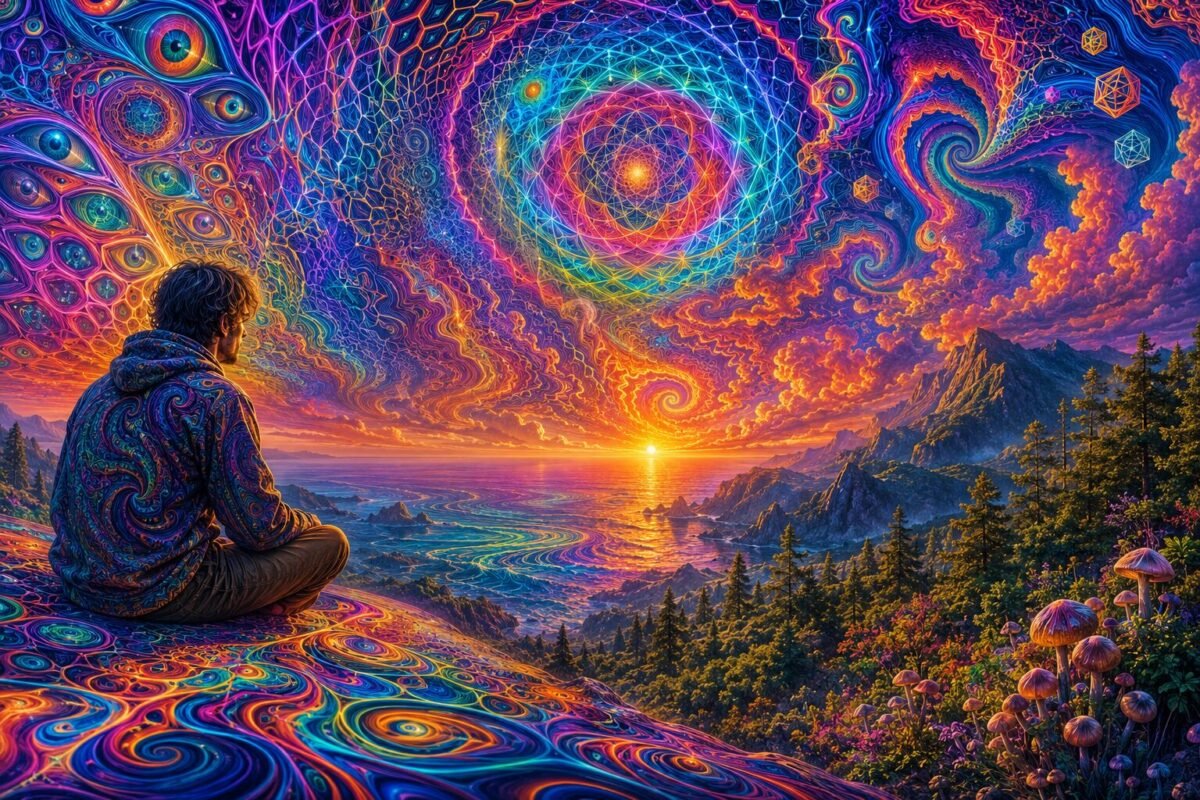
These experiences can be difficult to reproduce accurately in a photograph or illustration because they involve subjective perception rather than simply an external visual scene.
Common Types of LSD Visuals
There is considerable variation in reported LSD visuals, but scientific literature has identified several recurring categories.
- Color intensification: Colors may appear brighter or more saturated.
- Geometric imagery: Repeating lines, grids, shapes, or patterns may appear.
- Visual distortions: Objects can appear altered in size, shape, texture, or position.
- Movement effects: Stationary objects may appear to ripple, breathe, wave, or move.
- Trails and afterimages: Moving objects may appear to leave visual traces.
- Complex imagery: Some people report recognizable figures, environments, or scenes without corresponding physical stimuli.
Not everyone experiences all of these effects, and the intensity and character of visual changes can differ substantially between individuals. :contentReference[oaicite:4]{index=4}
Changes in Color and Brightness
One of the more commonly described aspects of LSD visuals is a change in the perceived intensity of colors. Research reviews have documented reports of increased color saturation, brightness, and contrast. :contentReference[oaicite:5]{index=5}
An ordinary environment may therefore appear visually more pronounced, with colors seeming unusually vivid or boundaries between colors appearing more noticeable.
These changes do not necessarily mean that the physical colors of objects have changed. Rather, the altered experience reflects changes in visual perception and processing.
Geometric Patterns and Shapes
Geometric patterns are another frequently described category of LSD visuals. People have reported recurring shapes, lines, grids, spirals, and other organized visual structures.
Scientific reviews of hallucinogen-induced visual changes describe elementary imagery that can include flashes of light and recurring geometric figures or patterns. :contentReference[oaicite:6]{index=6}
These patterns can sometimes appear over the existing visual environment rather than replacing it completely. This distinction helps explain why a person may simultaneously recognize an ordinary room while perceiving additional geometric structures within their field of vision.
Visual Distortions
LSD visuals can also involve distortions of ordinary objects and environments. Research has described changes in perceived size and other visual illusions among the effects associated with serotonergic hallucinogens. :contentReference[oaicite:7]{index=7}
A stationary object may appear to change shape, a surface may seem to undulate, or the apparent boundaries of an object may become less stable.
These effects illustrate why psychedelic visual experiences are more accurately described as changes in perception rather than simply as the appearance of colorful images.
Movement, Trails, and Afterimages
Another category of LSD visuals involves apparent movement, trails, and afterimages. A stationary surface may seem to ripple or shift, while moving objects can sometimes appear to leave a temporary visual trace behind them.
These effects are related to changes in visual processing rather than physical movement in the environment. Research into hallucinogen-related perception has documented alterations involving motion perception, visual persistence, and other aspects of how sensory information is processed. ([pubmed.ncbi.nlm.nih.gov](https://pubmed.ncbi.nlm.nih.gov/27900674/?utm_source=chatgpt.com))
Afterimages can also occur in ordinary vision under many circumstances, so their presence alone does not establish that someone is experiencing a psychedelic state. Context and the overall pattern of perceptual changes are important.
Changes in Depth and Spatial Perception
LSD visuals may also involve changes in how depth, distance, or spatial relationships are perceived.
An object can appear unusually close or distant, while the apparent relationship between foreground and background may seem different from normal. Some people may describe rooms as appearing unusually large, small, deep, or visually distorted.
Because perception depends on the brain integrating information from multiple sensory systems, changes in visual processing can influence the way a three-dimensional environment is experienced.
Visual Illusions vs. Hallucinations
It is useful to distinguish visual illusions from hallucinations when discussing LSD visuals.
A visual illusion involves misinterpreting or transforming something that is actually present. For example, a textured surface might appear to move or change shape.
A visual hallucination, in contrast, involves experiencing a visual perception without an equivalent external visual stimulus. Research on LSD and related hallucinogens has documented both simpler visual phenomena and more complex hallucination-like experiences. ([pubmed.ncbi.nlm.nih.gov](https://pubmed.ncbi.nlm.nih.gov/27900674/?utm_source=chatgpt.com))
The distinction is useful because not every unusual visual experience during an LSD state should be described as a hallucination.
Closed-Eye Visuals
Some descriptions of LSD visuals involve imagery experienced with the eyes closed. This can include geometric structures, colors, patterns, flashes, or more elaborate imagery.
Closed-eye imagery is different from seeing an ordinary physical object because the visual experience occurs without the same external visual input. Research into hallucinogens has described both elementary and complex forms of internally experienced visual phenomena. ([pubmed.ncbi.nlm.nih.gov](https://pubmed.ncbi.nlm.nih.gov/27900674/?utm_source=chatgpt.com))
Experiences can vary substantially, however, and there is no single pattern that should be expected by every person.
The Visual Cortex and LSD
Researchers have investigated how LSD changes activity in brain systems involved in vision. Neuroimaging studies have found changes in visual-cortex activity and communication between brain regions during the LSD state.
One study using functional magnetic resonance imaging reported increased connectivity between the visual cortex and other brain regions under LSD. The researchers also found relationships between changes in visual-cortex activity and reported visual hallucinations. ([pubmed.ncbi.nlm.nih.gov](https://pubmed.ncbi.nlm.nih.gov/27071089/?utm_source=chatgpt.com))
These findings provide one possible neurological explanation for why ordinary visual information can be experienced differently during an LSD state.
Color Processing and Visual Contrast
Changes in color perception are frequently discussed in descriptions of LSD visuals. Colors may seem brighter, more saturated, or more visually prominent.
Visual contrast can also appear altered. Edges, textures, and boundaries may become more noticeable, potentially making ordinary environments seem unusually detailed.
These effects demonstrate that psychedelic visual experiences involve more than simply “seeing colors.” They can involve changes in how the brain organizes and interprets incoming sensory information.
Why Ordinary Objects Can Look Different
An important feature of LSD visuals is that unusual perception can occur while looking at completely ordinary surroundings.
Walls, floors, trees, fabrics, photographs, and other objects can appear to shift, breathe, ripple, or develop repeating patterns. The physical object itself has not necessarily changed; rather, its visual representation is being processed differently.
This is one reason psychedelic visual experiences are difficult to reproduce accurately with conventional photography. A photograph records the physical scene, while the subjective experience involves the brain’s interpretation of that scene.
Why LSD Visuals Vary Between People
There is considerable variation in reported LSD visuals. Two people can encounter the same environment and describe very different visual experiences.
Individual differences in perception, expectations, psychological state, surroundings, previous experiences, and other factors can influence how an altered perceptual state is experienced.
Research therefore does not support the idea that there is one universal set of “LSD visuals.” Instead, psychedelic visual phenomena exist along a broad spectrum, from relatively subtle changes in color and texture to complex perceptual experiences.
LSD Visuals Compared With Other Psychedelic Visuals
Different psychedelic substances can be associated with different patterns of reported perceptual changes, but experiences overlap and cannot be reduced to a simple visual checklist.
For comparison, our Shrooms Visuals guide examines visual experiences associated with psilocybin mushrooms, while Patterns Psychedelic focuses specifically on psychedelic-inspired artwork and visual design.
Keeping these topics separate is important because psychedelic artwork is a deliberate creative product, whereas LSD visuals describe subjective changes in perception.
How LSD Can Affect Visual Processing
The brain does not simply record the outside world like a camera. Visual perception is produced through continuous processing of information from the eyes together with signals generated within the brain. Research suggests that LSD can alter this balance, allowing internally generated activity to have a greater influence on visual perception.
Neuroimaging research has found increased activity and altered functional connectivity involving the visual cortex during LSD administration. In one study, changes in visual-cortex connectivity were strongly associated with participants’ ratings of visual hallucinations. :contentReference[oaicite:0]{index=0}
This may help explain why LSD visuals can involve both the existing environment and additional patterns, distortions, or imagery. The physical surroundings remain present, but the brain’s interpretation of those surroundings can change.
The Role of the Visual Cortex
The visual cortex is a group of brain regions involved in processing information related to sight. Research into hallucinogenic visual phenomena has proposed that some recurring geometric experiences may arise from the organization of activity within the visual cortex.
Researchers studying geometric visual hallucinations have identified recurring forms such as tunnels, spirals, lattices, and cobweb-like structures across different conditions that can produce visual hallucinations. Their work proposes that the organization of the visual cortex can help explain why certain geometric forms repeatedly appear. :contentReference[oaicite:1]{index=1}
This provides useful context for understanding why geometric patterns are frequently reported among LSD visuals. However, it does not mean that every person’s visual experience will contain the same shapes.
Why LSD Visuals Differ Between People
There is substantial variation in LSD visuals between individuals and even between different experiences in the same person. A major review of serotonergic hallucinogen-induced visual phenomena found consistent categories of visual changes while also emphasizing considerable variation between and within individuals. :contentReference[oaicite:2]{index=2}
Some people may primarily notice intensified colors and patterns, while others may experience substantial distortions or more complex imagery. Expectations, surroundings, psychological state, individual differences in perception, and other factors may contribute to this variability.
Consequently, descriptions of psychedelic visuals should be treated as reports of subjective perception rather than as a universal checklist of effects.
Complex Visual Imagery
Not all LSD visuals are simple geometric patterns. Scientific reviews have described more complex imagery involving recognizable people, animals, landscapes, or other scenes that do not correspond to an external physical stimulus. :contentReference[oaicite:3]{index=3}
These experiences are different from simply noticing that a wall appears to ripple or that colors seem unusually bright. They involve more elaborate perceptual content and demonstrate the wide range of phenomena that can occur during altered states of consciousness.
Complex imagery should also not be assumed to have a particular psychological meaning. The content of a subjective visual experience can differ substantially from person to person.
Eyes-Closed LSD Visuals
LSD visuals can also occur with the eyes closed. Neuroimaging research has found changes in functional connectivity within the early visual cortex during eyes-closed LSD states, suggesting that the visual system can exhibit altered internally generated activity even without ordinary visual input. :contentReference[oaicite:4]{index=4}
This helps explain why some psychedelic visual experiences are described as internally generated imagery rather than simple distortions of the surrounding environment.
Eyes-closed experiences can range from relatively simple colors and geometric forms to much more elaborate imagery. Again, there is considerable individual variation.
Persistent Visual Disturbances
Most discussion of LSD visuals concerns temporary changes during an acute psychedelic experience. However, persistent or recurring visual disturbances have also been reported after hallucinogen exposure.
Research has documented cases of recurring visual phenomena after hallucinogen use, although these experiences are distinct from the temporary visual effects occurring during intoxication. :contentReference[oaicite:5]{index=5}
Persistent visual disturbances can be concerning, particularly when they interfere with daily activities or cause significant distress. Anyone experiencing ongoing or unexplained changes in vision should discuss them with an appropriately qualified healthcare professional rather than assuming they are simply normal psychedelic aftereffects.
What Research Tells Us About LSD Visuals
Modern research suggests that LSD visuals involve complex changes in visual processing rather than a single mechanism.
Reviews have documented visual intensification, geometric imagery, visual illusions, altered perception of objects, and complex hallucination-like experiences. :contentReference[oaicite:6]{index=6}
Neuroimaging studies add another layer of evidence by showing measurable changes in the visual cortex and its communication with other brain regions during LSD states. :contentReference[oaicite:7]{index=7}
Together, these findings support the idea that psychedelic visual experiences emerge from altered interactions between sensory processing and internally generated brain activity. Researchers are still investigating exactly how these processes produce the wide variety of experiences people report.
Frequently Asked Questions About LSD Visuals
What are LSD visuals?
LSD visuals are subjective changes in visual perception that can occur during an LSD experience. They can include intensified colors, geometric patterns, distortions, apparent movement, afterimages, and more complex visual phenomena. Research shows that the type and intensity of these effects can vary considerably between individuals. :contentReference[oaicite:0]{index=0}
What do LSD visuals look like?
There is no single appearance. Some people report geometric patterns, changes in color or brightness, rippling or shifting surfaces, altered shapes, trails, or complex imagery. Scientific research has identified recurring geometric forms as well as more elaborate visual phenomena. :contentReference[oaicite:1]{index=1}
Are LSD visuals the same for everyone?
No. LSD visuals can differ substantially from one person to another and can also vary between different experiences in the same individual. Research on psychedelic visual phenomena demonstrates considerable individual variation.
Why do people see geometric patterns on LSD?
Researchers have proposed that some recurring geometric hallucinations may relate to the organization of the visual cortex. Studies of geometric visual hallucinations describe recurring forms including tunnels, spirals, lattices, and cobweb-like structures. :contentReference[oaicite:2]{index=2}
Can LSD cause visual hallucinations?
Yes. Visual hallucinations have been documented in controlled research involving LSD. Neuroimaging research has found changes in visual-cortex activity and connectivity that correlated with participants’ reports of visual hallucinations. :contentReference[oaicite:3]{index=3}
Can LSD visuals happen with your eyes closed?
Yes. Research has specifically investigated eyes-closed psychedelic imagery under LSD, including geometric patterns and more complex phenomena. Changes in functional connectivity within early visual areas have been observed during eyes-closed LSD states. :contentReference[oaicite:4]{index=4}
Are LSD visuals the same as psychedelic art?
No. Psychedelic art is deliberately created by an artist, while LSD visuals describe subjective changes in perception. Our Patterns Psychedelic guide focuses on psychedelic-inspired visual design rather than drug-induced perception.
Can LSD cause visual effects after the experience?
Persistent or recurring visual disturbances have been reported after hallucinogen exposure. These experiences are distinct from the temporary visual effects occurring during an acute LSD state. Persistent unexplained changes in vision should be discussed with a qualified healthcare professional.
How does LSD affect the visual system?
Neuroimaging studies have found changes in visual-cortex blood flow, activity, and functional connectivity during LSD administration. One study found that changes in the primary visual cortex were associated with reported visual hallucinations. :contentReference[oaicite:5]{index=5}
Conclusion
LSD visuals represent a broad range of altered visual experiences rather than one predictable phenomenon. Reported effects can include intensified colors, geometric patterns, distortions, apparent movement, afterimages, changes in spatial perception, and complex imagery.
Research suggests that these experiences involve changes in the brain’s visual-processing systems. Studies using neuroimaging have identified altered activity and connectivity involving the visual cortex, while theoretical work on geometric hallucinations provides possible explanations for recurring visual forms. :contentReference[oaicite:6]{index=6}
It is also important to separate subjective LSD visuals from psychedelic artwork. A digitally created pattern may resemble descriptions of psychedelic perception without actually reproducing what a person experiences.
For related information, explore LSD Effects, How LSD Works in the Brain, LSD Trip, and Shrooms Visuals.
If unusual visual disturbances continue after an LSD experience or interfere with everyday activities, seeking professional medical advice is appropriate rather than assuming the symptoms are harmless.
Related Psychedelic Education Guides
- LSD Effects
- How LSD Works in the Brain
- LSD Trip
- Is LSD Safe?
- Acid Brain Effects
- Shrooms Visuals
- Patterns Psychedelic
Authoritative References
PubMed — Modern Clinical Research on LSD
PubMed — Neural Correlates of the LSD Experience
PubMed — LSD and Eyes-Closed Visual Cortex Connectivity
PubMed — Geometric Visual Hallucinations and the Visual Cortex
