Aug
Molly vs E is a common comparison because the two terms are often used to describe MDMA. In everyday drug terminology, “Molly” and “Ecstasy” are frequently treated as different names for the same substance, but the distinction becomes more complicated when discussing illicit products sold under those names.
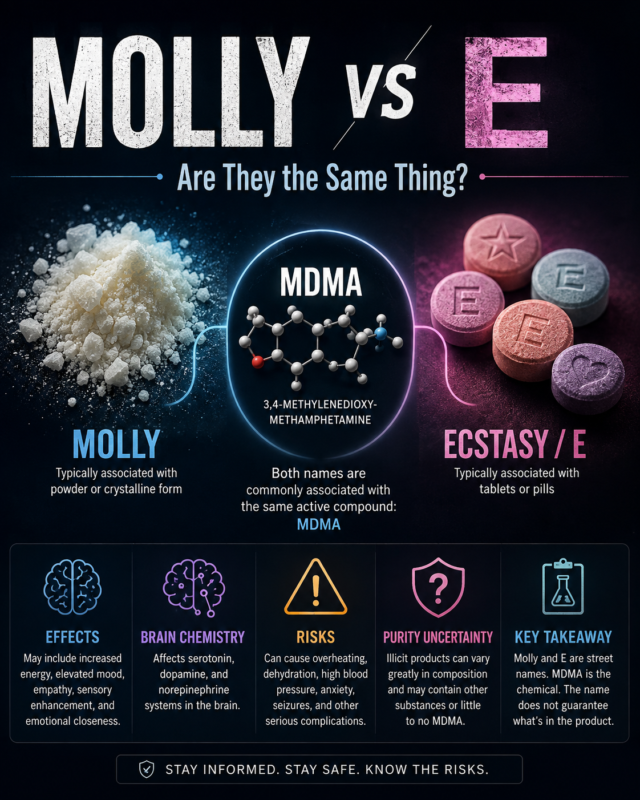
MDMA is the chemical compound associated with both terms. The main difference traditionally used is the form in which the product is sold: Ecstasy is commonly associated with tablets or pills, while Molly is commonly associated with powder or crystalline material. However, the name or appearance of an illicit product does not guarantee that it actually contains MDMA or that it contains only MDMA. The National Institute on Drug Abuse notes that products sold as Molly may contain other substances or may not contain MDMA at all. (NIDA)
What Is Molly?
Molly is a common name associated with MDMA, a psychoactive substance with both stimulant and hallucinogenic properties. The term is often used when referring to MDMA in powder or crystalline form.
The word “Molly” is therefore best understood as a street term rather than a guarantee of chemical purity. A product marketed as Molly may contain MDMA, other substances, or a mixture of compounds.
This is one of the most important points in the Molly vs E comparison: the names used in illicit markets do not necessarily provide reliable information about what a product actually contains.
What Is E or Ecstasy?
“E” is a commonly used abbreviation for Ecstasy. Ecstasy is another name frequently associated with MDMA and is often used when referring to MDMA-containing tablets or pills.
Historically, Ecstasy tablets have been sold in many different colors, shapes, and designs. However, the appearance of a tablet does not establish its chemical contents.
A tablet sold as Ecstasy may contain MDMA, another psychoactive substance, several substances together, or little or no MDMA. Consequently, the term Ecstasy describes how the product is marketed or referred to rather than providing a laboratory-confirmed description of its contents.
What Is MDMA?
MDMA is short for 3,4-methylenedioxymethamphetamine. It is a psychoactive substance that affects several neurotransmitter systems in the brain, particularly serotonin, dopamine, and norepinephrine.
MDMA can produce changes in mood, perception, energy, and feelings of closeness or empathy. Its effects are related to increased activity of several neurotransmitters, with serotonin playing a particularly important role.
Understanding MDMA provides the chemical foundation for the Molly vs E discussion because both names are commonly associated with products intended to contain MDMA.
Are Molly and E the Same Thing?
In terms of terminology, Molly and Ecstasy are often used as names for MDMA. The U.S. Drug Enforcement Administration identifies both “Ecstasy” and “Molly” among names associated with MDMA. (DEA)
However, saying that the terms refer to the same drug does not mean that every product sold as Molly or Ecstasy contains the same substance.
That distinction is essential. Molly vs E is partly a question of terminology and partly a question of how illicit products are marketed and represented.
Molly vs E: What Is the Main Difference?
The traditional distinction is based primarily on physical form and terminology. Molly is commonly associated with powder or crystalline material, whereas Ecstasy or E is commonly associated with tablets.
| Feature | Molly | Ecstasy / E |
|---|---|---|
| Common terminology | Often used for MDMA | Often used for MDMA |
| Common form | Powder or crystalline material | Tablets or pills |
| Chemical identity | Intended to refer to MDMA | Often intended to refer to MDMA |
| Purity guarantee | No | No |
| Potential additional substances | Yes | Yes |
These differences should not be interpreted as proof that one form is purer or safer than the other. An illicit product’s name, color, texture, or physical form cannot establish its actual composition.
Powder vs Pill: Does the Form Matter?
The physical form can explain why different names are commonly used, but it does not establish what is chemically present.
A powder sold as Molly may contain substances other than MDMA. Likewise, a tablet sold as Ecstasy may contain MDMA together with other compounds or may contain a completely different psychoactive substance.
For this reason, the Molly vs E comparison should focus on terminology and product variability rather than assuming that powder automatically means pure MDMA or that a tablet automatically contains a particular amount of MDMA.
Why Are There Different Names for MDMA?
Drug terminology develops through popular culture, regional slang, marketing, and changes in the illicit drug market. MDMA has therefore been associated with several names, including Molly, Ecstasy, and E.
Different names can sometimes refer to the same intended substance while also being used for products with different compositions.
This is why scientific discussions generally refer to the chemical compound as MDMA rather than relying solely on street terminology.
Is Molly Pure MDMA?
Not necessarily. The name Molly does not provide a laboratory-confirmed guarantee of purity.
NIDA has reported that products sold as Molly may contain other drugs or substances and that some products sold under the name may contain little or no MDMA. (National Institute on Drug Abuse)
Therefore, the word Molly should not automatically be interpreted as meaning “pure MDMA.” The same principle applies to products sold as Ecstasy.
Is Ecstasy Always MDMA?
No. Although Ecstasy is commonly associated with MDMA, the name itself does not prove the chemical composition of an illicit tablet.
Tablets sold as Ecstasy can contain MDMA along with other substances, or they may contain substances other than MDMA. The contents can vary between products and even between visually similar tablets.
This uncertainty is an important part of understanding the difference between a drug’s scientific name and the names used to market illicit products.
Related Molly Information
For a broader explanation of the term Molly, its effects, history, and associated risks, read our Molly: Understanding Its Meaning, Effects, Risks, and History guide.
For a broader discussion of substance use disorder and recovery, see our SUD: Understanding Substance Use Disorder, Symptoms, Causes, and Recovery article.
Molly vs E: Are the Effects Different?
When comparing Molly vs E, the expected effects are generally discussed in relation to MDMA rather than the street name used for the product. MDMA can affect mood, perception, energy, and social feelings by changing activity involving serotonin, dopamine, and norepinephrine in the brain.
Commonly reported effects associated with MDMA include increased energy, elevated mood, heightened sensory experiences, and feelings of emotional closeness. The experience can also include unwanted effects such as anxiety, agitation, nausea, increased heart rate, and changes in body temperature.
Because products sold as Molly or Ecstasy can contain different substances, however, the effects of a particular illicit product cannot be predicted solely from its name.
How Does MDMA Affect Serotonin?
Serotonin is one of the main neurotransmitters affected by MDMA. The substance increases serotonin activity in the brain, contributing to changes in mood, perception, and emotional experiences.
MDMA also affects dopamine and norepinephrine. The combined effects of these neurotransmitter systems help explain why MDMA can produce both stimulant-like and empathogenic effects.
This chemistry is more useful for understanding Molly vs E than assuming that powder and tablets necessarily produce different pharmacological effects.
MDMA, Dopamine and Norepinephrine
In addition to serotonin, MDMA affects dopamine and norepinephrine. Dopamine is involved in reward and motivation, while norepinephrine plays an important role in alertness and the body’s stress response.
Changes in these systems can contribute to increased energy, alertness, and stimulation. They can also contribute to unwanted effects such as increased heart rate and blood pressure.
The balance of these effects can differ from one person to another and may also depend on what substances are actually present in an illicit product.
Short-Term Effects of Molly and Ecstasy
When a product actually contains MDMA, commonly reported short-term effects can include:
- Elevated or intensified mood
- Increased energy and alertness
- Greater feelings of emotional closeness
- Heightened sensory experiences
- Increased sociability
- Changes in perception of time
- Increased heart rate
- Increased body temperature
- Nausea or stomach discomfort
- Anxiety or agitation
The presence of these effects does not establish that a product contains MDMA. Other substances can produce overlapping effects.
Why Is MDMA Associated With Empathy and Emotional Closeness?
MDMA is sometimes described as an empathogen or entactogen because of its reported effects on emotional closeness, empathy, and social interaction.
These effects are associated in part with changes in serotonin signaling and other neurotransmitter systems. They help distinguish MDMA’s typical subjective profile from that of many traditional stimulants.
However, individual responses vary considerably. A person’s experience can also be influenced by health, surroundings, other substances, and the actual contents of an illicit product.
How Long Do Molly and E Effects Last?
There is no single duration that applies to every experience involving Molly or Ecstasy. If a product contains MDMA, the timing and intensity of its effects can vary according to individual and product-related factors.
The physical form of a product does not by itself establish how long its effects will last. A tablet and a powder can contain different amounts of MDMA or entirely different substances.
For that reason, the Molly vs E comparison should not be reduced to a claim that one form always lasts longer than the other.
Why Can Experiences With Molly or E Differ?
Experiences can vary because products sold under the same name may have different chemical compositions. Individual differences also matter, including body chemistry, health, previous exposure to substances, and whether other drugs are involved.
Environmental factors can influence the subjective experience as well. Stress, surroundings, expectations, and psychological state may all affect how someone experiences a psychoactive substance.
Consequently, there is no reliable way to predict an individual’s response simply from the label “Molly” or “E.”
Physical Effects
MDMA can produce physical changes including increased heart rate, increased blood pressure, muscle tension, sweating, nausea, and changes in body temperature.
Some physical effects can become serious, particularly when body temperature rises significantly. Severe overheating can damage organs and become life-threatening.
Anyone experiencing severe confusion, collapse, seizures, extreme overheating, or other serious symptoms after taking an unknown substance should receive urgent medical attention.
What Is the MDMA Comedown?
Some people report unwanted emotional or physical effects after the main effects of MDMA have subsided. These may include tiredness, low mood, difficulty concentrating, irritability, or sleep disturbances.
These experiences can vary substantially between individuals. They may also be influenced by sleep, hydration, other substances, and the contents of the product involved.
A difficult period following drug use does not necessarily establish that a product was Molly or Ecstasy because other substances can produce similar after-effects.
Molly vs E: Are the Risks Different?
The names Molly and E do not automatically determine the level of risk. If both products contain MDMA, many of the underlying risks are related to the same active substance.
However, illicit products can contain other compounds, which means the risk profile can differ considerably from one product to another.
Potential concerns associated with MDMA include overheating, cardiovascular stress, dehydration or excessive water intake, confusion, seizures, and other serious complications.
Why Can MDMA Cause Overheating?
MDMA can increase body temperature and affect the body’s ability to regulate heat. Physical exertion and hot environments can make overheating more dangerous.
Severe hyperthermia can become a medical emergency because very high body temperatures can damage organs and interfere with normal physiological functions.
Severe overheating, confusion, collapse, or seizures after suspected MDMA exposure require urgent medical attention.
Dehydration and Excessive Water Intake
MDMA-related changes in body temperature and physical activity can contribute to fluid loss. At the same time, drinking excessive amounts of water can also be dangerous because it can disrupt the body’s sodium balance.
This means that both inadequate fluid intake and excessive water consumption can present health concerns in certain circumstances.
Anyone experiencing severe confusion, vomiting, seizures, or altered consciousness after using a suspected MDMA product should receive urgent medical care.
Related Reading
For a broader explanation of Molly, including its meaning, effects, history, and risks, read our Molly: Understanding Its Meaning, Effects, Risks, and History guide.
For information about substance use disorder and recovery, see our SUD: Understanding Substance Use Disorder, Symptoms, Causes, and Recovery article.
Is Molly Pure MDMA?
One of the biggest misconceptions in the Molly vs E comparison is that the word “Molly” automatically means pure MDMA. It does not. The name is commonly used for MDMA, but illicit products sold under that name may contain other substances.
NIDA has warned that products sold as Molly can contain other drugs or substances and that some products sold as Molly may contain little or no MDMA. This makes the name alone an unreliable indicator of chemical composition. (National Institute on Drug Abuse)
The same principle applies to Ecstasy. A tablet sold under that name cannot be assumed to contain only MDMA.
What Can Be in Ecstasy Tablets?
Ecstasy tablets can vary in composition. Some may contain MDMA, while others may contain additional psychoactive substances or substances unrelated to MDMA.
Tablet color, shape, logo, or name does not establish what is inside. Two tablets that look identical can have different chemical contents.
This variability is an important consideration when discussing Molly vs E because the difference between powder and tablets does not necessarily correspond to a difference in chemical purity.
Why Can Illicit MDMA Products Contain Other Substances?
Illicit drug products are not manufactured and quality-controlled in the same way as regulated medicines. As a result, products sold as Molly or Ecstasy can vary in their composition.
Additional substances may alter the effects of a product or introduce risks that are not caused by MDMA itself. Some compounds can also produce effects that overlap with those commonly associated with MDMA.
For this reason, the label attached to an illicit product should not be treated as a laboratory analysis.
Can Molly or Ecstasy Cause an Overdose?
Yes. Products containing MDMA can produce serious or potentially life-threatening toxicity. The risk can be especially difficult to predict when the actual contents or strength of an illicit product are unknown.
Severe overheating, seizures, significant confusion, loss of consciousness, abnormal heart rhythms, and other serious symptoms can require emergency medical treatment.
An overdose involving an unknown substance should be treated as a medical emergency rather than assuming that the symptoms are simply a normal part of an MDMA experience.
MDMA and Serotonin-Related Risks
MDMA substantially affects serotonin signaling. In some circumstances, excessive serotonin activity can contribute to a potentially serious condition known as serotonin syndrome, particularly when MDMA is combined with other substances that also affect serotonin.
Symptoms can include agitation, confusion, sweating, rapid heart rate, changes in body temperature, muscle rigidity, and abnormal reflexes. Severe cases require urgent medical attention.
Because illicit products may contain substances that are not disclosed, the potential for drug interactions can be difficult to predict.
Molly, E and the Cardiovascular System
MDMA can increase heart rate and blood pressure. These effects can place additional stress on the cardiovascular system, particularly in people with underlying health conditions.
Severe cardiovascular symptoms, including chest pain, fainting, significant shortness of breath, or an abnormal heartbeat, warrant urgent medical evaluation.
The cardiovascular risks are related to the pharmacological effects of MDMA, but additional substances in an illicit product can introduce further risks.
Mental and Psychological Effects
MDMA can produce changes in mood, perception, and emotional experience. Some people report increased feelings of closeness or empathy, while others may experience anxiety, agitation, confusion, or emotional distress.
Psychological responses can vary substantially between individuals. Setting, expectations, existing mental health concerns, sleep, and other substances can all influence the experience.
A product sold as Molly or E may also contain substances capable of producing different psychological effects.
What Happens After the Effects Wear Off?
Some people experience tiredness, low mood, irritability, difficulty concentrating, or sleep disruption after the effects associated with MDMA have subsided.
These after-effects can vary from person to person. They may also be influenced by sleep deprivation, physical exertion, other substances, and the actual composition of the product.
Persistent or severe psychological symptoms should be discussed with a qualified healthcare professional.
Why Unknown Drug Contents Matter
The central issue in the Molly vs E comparison is that street names do not provide a reliable chemical analysis.
A powder called Molly may not contain only MDMA, and a tablet called Ecstasy may contain substances other than MDMA. This means that comparing the names alone cannot establish which product contains more MDMA, which is purer, or which carries less risk.
Scientific terminology is more precise: MDMA refers to the chemical compound, while Molly and Ecstasy are commonly used names associated with products intended to contain it.
When Should Someone Seek Medical Help?
Urgent medical attention is appropriate when someone develops severe symptoms after taking a product sold as Molly, Ecstasy, or another unknown substance.
Warning signs can include:
- Severe overheating
- Seizures
- Loss of consciousness
- Severe confusion or agitation
- Difficulty breathing
- Chest pain
- Very rapid or irregular heartbeat
- Severe muscle rigidity
These symptoms can indicate serious toxicity and should not be dismissed as an ordinary drug effect.
Treatment for Problematic MDMA Use
Some people develop problematic patterns of MDMA use or use multiple substances in ways that create significant health or social problems.
There is no single treatment approach that applies to everyone. Healthcare professionals can assess substance use, identify associated health concerns, and recommend appropriate behavioral or psychological support.
For broader information about substance use disorders, read our SUD: Understanding Substance Use Disorder, Symptoms, Causes, and Recovery.
Related Molly Information
For a detailed explanation of Molly, including its terminology, effects, history, and risks, read our Molly: Understanding Its Meaning, Effects, Risks, and History guide.
You can also explore our LSDs: Essential Guide to LSD Types, Effects & Experiences article for information about another category of psychedelic substances.
P3 Summary
The most important point in the Molly vs E comparison is that the names do not guarantee chemical composition. Molly and Ecstasy are commonly used terms associated with MDMA, but illicit products sold under either name can contain additional or entirely different substances.
MDMA can affect serotonin, dopamine, and norepinephrine and may produce both desired and unwanted effects. Serious risks can include overheating, cardiovascular complications, seizures, severe psychological symptoms, and other forms of toxicity.
Understanding the distinction between the chemical name MDMA and street terms such as Molly and E provides a more accurate way to understand the differences, similarities, and uncertainties surrounding these products.
Frequently Asked Questions About Molly vs E
Is Molly the same as E?
Molly vs E is primarily a terminology comparison. Molly and E are both commonly used names associated with MDMA, although Molly is often associated with powder or crystalline material while E or Ecstasy is commonly associated with tablets. The names themselves do not guarantee that an illicit product contains MDMA.
Is Molly the same as Ecstasy?
Molly and Ecstasy are commonly used as names for MDMA. The traditional distinction is that Molly is associated with powder or crystal and Ecstasy with tablets or pills. However, illicit products sold under either name can contain other substances.
Is Molly pure MDMA?
No. The name Molly does not guarantee purity. Products sold as Molly can contain substances other than MDMA, and some may contain little or no MDMA.
Is Ecstasy always MDMA?
No. Although Ecstasy is commonly associated with MDMA, a tablet sold under that name does not provide a guarantee of its chemical contents. Illicit tablets can contain MDMA, additional substances, or other psychoactive compounds.
What is the main difference between Molly and E?
The most commonly described difference is the form associated with each name. Molly is generally associated with powder or crystalline material, while E or Ecstasy is generally associated with tablets. This does not establish a difference in purity or safety.
Is Molly stronger than Ecstasy?
There is no reliable answer based solely on the names. The actual composition and strength of illicit products can vary, so neither “Molly” nor “Ecstasy” automatically indicates a particular concentration or potency.
Is E the same as MDMA?
“E” is a common street term associated with Ecstasy, which in turn is commonly associated with MDMA. However, the contents of an illicit product cannot be confirmed simply from its name.
What does MDMA stand for?
MDMA stands for 3,4-methylenedioxymethamphetamine. It is the chemical name for the psychoactive compound commonly associated with the terms Molly and Ecstasy.
Why are Molly and Ecstasy different names?
The terms developed as different forms of street terminology surrounding MDMA. Molly became particularly associated with powder or crystalline products, while Ecstasy became strongly associated with tablets. Their meanings can vary between regions and over time.
Can Molly contain other drugs?
Yes. Products sold as Molly can contain other substances or may not contain MDMA at all. This is one reason the name of an illicit product should not be treated as a laboratory-confirmed description of its contents.
Can Ecstasy pills contain other substances?
Yes. Ecstasy tablets can contain MDMA along with other compounds, or they can contain substances other than MDMA. The appearance of a tablet cannot reliably establish its chemical composition.
Do Molly and Ecstasy have the same effects?
If both products actually contain MDMA, their expected pharmacological effects are related to the same active compound. However, products sold under these names can contain different substances, so the effects of an individual illicit product may vary.
Can Molly or Ecstasy be dangerous?
Yes. MDMA can produce serious adverse effects, including significant increases in body temperature, cardiovascular stress, confusion, seizures, and other forms of toxicity. Additional substances in illicit products can create further risks.
Can Molly or Ecstasy cause an overdose?
Yes. Severe MDMA toxicity can become life-threatening. Serious overheating, seizures, loss of consciousness, severe confusion, chest pain, or significant breathing or heart problems require urgent medical attention.
How does MDMA affect the brain?
MDMA affects several neurotransmitter systems, particularly serotonin, dopamine, and norepinephrine. These changes contribute to its effects on mood, energy, perception, and emotional experience.
Is Molly a different drug from MDMA?
Not necessarily. Molly is a street term commonly used for MDMA, particularly when referring to powder or crystalline material. However, a product marketed as Molly cannot automatically be assumed to contain MDMA.
Key Takeaways
- Molly vs E is primarily a comparison of terminology and commonly associated product forms.
- Molly and Ecstasy are both commonly associated with MDMA.
- Molly is often associated with powder or crystalline material.
- Ecstasy or E is often associated with tablets or pills.
- The name of an illicit product does not guarantee its chemical composition.
- Products sold as Molly or Ecstasy can contain substances other than MDMA.
- MDMA affects serotonin, dopamine, and norepinephrine systems in the brain.
- MDMA can produce serious adverse effects, including dangerous overheating and cardiovascular complications.
- Severe toxicity can require emergency medical attention.
- The most scientifically precise term is MDMA because it identifies the specific chemical compound rather than relying on street terminology.
Conclusion
The Molly vs E comparison can be confusing because both terms are commonly associated with MDMA. Traditionally, Molly is associated with powder or crystalline material, while E or Ecstasy is associated more often with tablets or pills.
The distinction becomes more important when considering illicit products. A product sold as Molly is not necessarily pure MDMA, and an Ecstasy tablet is not necessarily composed only of MDMA. The names, appearance, and marketing of these products cannot reliably establish their chemical contents.
MDMA itself affects several neurotransmitter systems, particularly serotonin, dopamine, and norepinephrine. These effects can produce changes in mood, energy, perception, and emotional experience, but they can also contribute to serious health complications.
Ultimately, Molly and E are commonly used names associated with MDMA, not reliable guarantees of what an illicit product contains. Understanding that distinction provides a more accurate picture of the similarities, differences, and risks involved.
Related Reading
For a more detailed explanation of Molly, its meaning, effects, history, and associated risks, read our Molly: Understanding Its Meaning, Effects, Risks, and History guide.
For broader information about substance use disorder, symptoms, causes, and recovery, see our SUD: Understanding Substance Use Disorder, Symptoms, Causes, and Recovery article.
You can also explore our LSDs: Essential Guide to LSD Types, Effects & Experiences guide for information about another category of psychoactive substances.
Authoritative References
- National Institute on Drug Abuse — MDMA (Ecstasy/Molly)
- U.S. Drug Enforcement Administration — MDMA, Ecstasy, or Molly
Medical Disclaimer
This article is provided for general educational purposes and is not a substitute for professional medical advice, diagnosis, or treatment. MDMA and products sold as Molly or Ecstasy can carry serious health risks, particularly when their actual contents are unknown. Anyone experiencing severe symptoms after taking an unknown or suspected MDMA-containing substance should seek urgent medical attention.
