
Aug
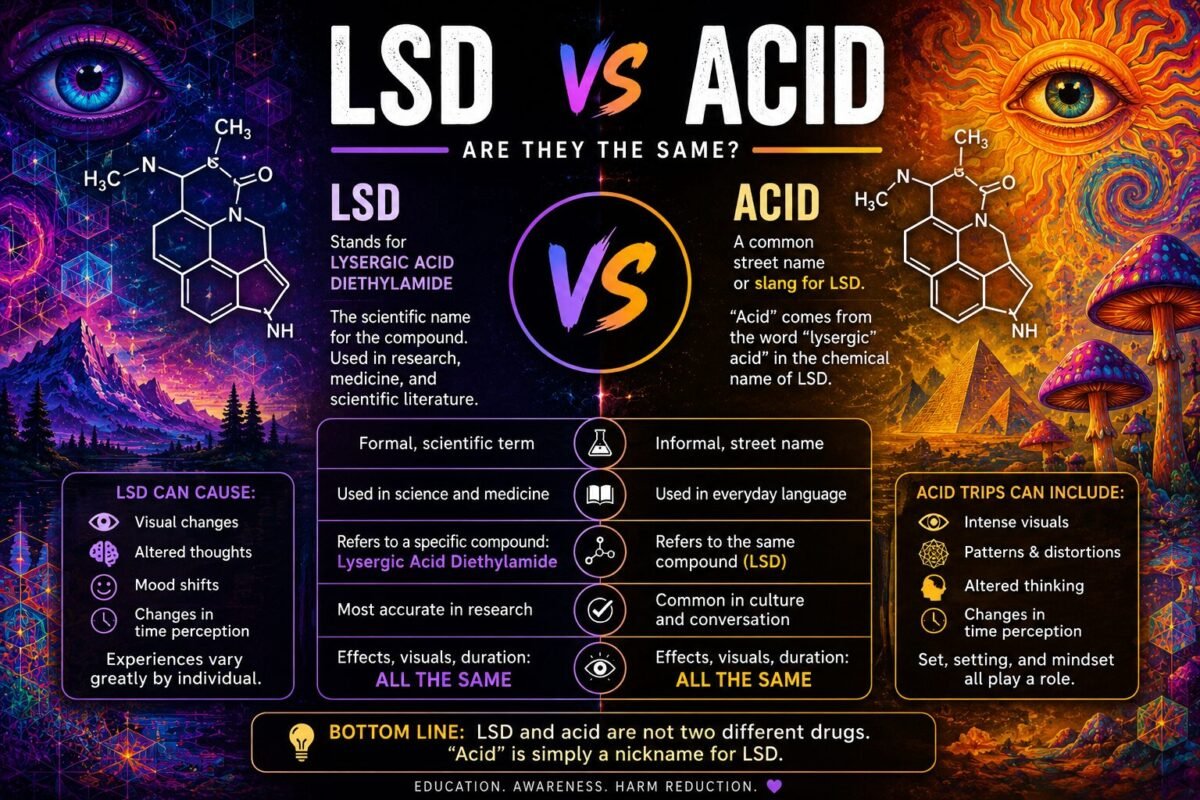
LSD vs acid is a common comparison, but the two terms generally refer to the same psychedelic substance. “LSD” is the standard abbreviation for lysergic acid diethylamide, while “acid” is a widely used informal name for LSD.
Because the terms are often used interchangeably, searching for LSD vs acid can create the impression that they are two different drugs. In most contexts, however, “acid” is simply a slang term for LSD rather than a separate substance.
The terminology can still be confusing because “acid” is a broad word in chemistry, whereas the informal drug term specifically refers to LSD. Understanding this distinction makes it easier to interpret discussions about LSD, acid trips, acid visuals, and related psychedelic terminology.
This guide explains LSD vs acid by looking at the names, chemical identity, history, effects, visual changes, duration, and common misconceptions surrounding the two terms.
Table of Contents
- Are LSD and Acid the Same Thing?
- What Does LSD Mean?
- Why Is LSD Called Acid?
- LSD and Chemical Terminology
- Is There Any Difference Between LSD and Acid?
- LSD and Acid Effects
- LSD and Acid Visuals
- How Long Do LSD and Acid Effects Last?
- Common Misconceptions
- Safety Considerations
- Frequently Asked Questions
Are LSD and Acid the Same Thing?
In common drug terminology, yes. LSD vs acid is usually not a comparison between two different substances. “Acid” is one of the informal names used for LSD.
LSD stands for lysergic acid diethylamide. The abbreviation comes from the scientific name, while “acid” became a popular shortened name in informal language.
This means that references to an “acid trip” generally refer to an LSD experience. Similarly, expressions such as “acid visuals” generally describe the visual effects associated with LSD.
Our existing Street Names for LSD guide provides additional information about terminology used for LSD.
What Does LSD Mean?
LSD is the abbreviation for lysergic acid diethylamide, a potent psychedelic compound that can produce substantial changes in perception, cognition, mood, and sensory processing.
The term LSD is generally preferred in scientific and medical literature because it identifies the specific compound being discussed.
In everyday conversation, however, people may use several informal terms when referring to LSD. This is one reason searches for LSD vs acid can arise even though the terms generally refer to the same substance.
For more background, see our History of LSD guide.
Why Is LSD Called Acid?
The nickname “acid” comes from the chemical name lysergic acid diethylamide. Over time, “acid” became established as an informal term for LSD, particularly within psychedelic culture.
The shortened name is convenient in everyday conversation, but it can also create confusion because acid is a general chemical term rather than the formal name of LSD.
When someone refers to an “acid trip,” they are ordinarily referring to an LSD trip. Likewise, an “acid visual” generally means a visual effect associated with an LSD experience.
LSD and Chemical Terminology
From a scientific perspective, LSD vs acid is primarily a terminology question rather than a comparison of two separate compounds.
LSD is a specific chemical compound. The word “acid,” when used as slang for LSD, does not mean that the substance is simply a generic acid or that every chemical containing the word “acid” is related to LSD.
This distinction is important when reading scientific information. Scientific sources generally use the abbreviation LSD or the compound’s full chemical name rather than relying on slang terminology.
Is There Any Difference Between LSD and Acid?
In ordinary drug terminology, there is generally no separate substance to distinguish when comparing LSD vs acid. LSD is the formal name or abbreviation, while “acid” is commonly used as a nickname for the same psychedelic compound.
The main difference is therefore the context in which the terms are used. LSD is the term most commonly found in scientific, medical, and research literature, whereas acid is more informal.
This distinction matters because informal terminology can sometimes be inconsistent. When discussing scientific information, using the specific term LSD makes the subject clearer and reduces ambiguity.
LSD and Acid Effects
Because LSD and “acid” generally refer to the same substance, there is not a separate set of effects for each. The effects associated with an acid trip are the effects associated with an LSD experience.
Reported effects can include changes in visual perception, thought patterns, emotions, sensory processing, and the perception of time. Some people experience intensified colors or geometric patterns, while others describe changes in their interpretation of familiar surroundings.
Individual experiences can vary substantially. Expectations, psychological state, surroundings, and other circumstances can influence how an LSD experience is perceived.
For a broader overview, see our LSD Effects guide.
LSD and Acid Visuals
Another common source of confusion when researching LSD vs acid involves visual effects. Terms such as “acid visuals” and “LSD visuals” generally describe the same category of psychedelic visual phenomena.
Reported effects can include intensified colors, geometric patterns, apparent movement, distortions, afterimages, and changes in perceived depth or shape.
These effects are subjective changes in perception rather than necessarily changes to the physical environment. Our LSD Visuals guide examines these phenomena in greater detail.
How Long Do LSD and Acid Effects Last?
Because LSD and acid generally refer to the same substance, their effects do not have separate timelines. The duration associated with an “acid trip” refers to the duration of an LSD experience.
The acute psychedelic experience can continue for many hours, although the exact timeline varies between individuals and circumstances. Some subjective effects may continue after the strongest effects have subsided.
For additional educational information about duration, see How Long Does LSD Last?.
LSD, Acid, and Other Names
Understanding terminology can make psychedelic information easier to interpret. LSD is the standard abbreviation used in scientific sources, while acid is an informal name commonly associated with the same substance.
Other informal terminology may also appear in discussions about LSD. However, slang can vary between communities and regions, so scientific terminology is generally more precise.
Our Types of LSD guide provides additional background on LSD terminology and related concepts.
How the Terms Became Associated
The connection between LSD and the word “acid” developed alongside the wider cultural history of LSD. As the substance became known outside scientific and research settings, informal terminology became increasingly common.
The term “acid” subsequently became strongly associated with psychedelic culture and expressions such as “acid trip.”
For a deeper historical overview, visit our History of LSD guide.
Common Misconceptions About LSD vs Acid
One of the most common misconceptions surrounding LSD vs acid is that they are two different psychedelic drugs. In ordinary drug terminology, “acid” is generally a slang term for LSD, so the comparison is usually between a formal name and an informal name rather than two separate substances.
Another misconception is that the word “acid” means the substance is simply a generic chemical acid. That is not what the slang term means. In this context, “acid” is a shortened informal name associated specifically with LSD.
It is also important not to assume that every substance or product described using informal psychedelic terminology necessarily contains LSD. Informal labels are not reliable substitutes for verified chemical identification.
Why People Use Both Terms
People may use “LSD” and “acid” differently depending on the setting. Scientific publications generally use LSD, while conversations about psychedelic culture may use acid.
For example, researchers may discuss the effects of LSD, while someone describing a personal experience might say they had an acid trip. In these contexts, both expressions can refer to the same substance.
This difference in terminology explains why search queries such as LSD vs acid, “acid trip,” and “LSD trip” can appear to represent separate topics even when their underlying subject overlaps.
Safety Considerations
Although LSD vs acid is primarily a terminology question, the substance being discussed can produce substantial changes in perception and judgment.
LSD experiences can involve altered visual perception, changes in thinking, anxiety, confusion, and other psychological effects. Individual responses can vary considerably.
People with particular medical or psychological circumstances may face additional concerns, which is one reason controlled clinical research uses screening and monitoring procedures.
For broader educational information, see Is LSD Safe?.
What Happens in the Brain?
The effects associated with both “acid” and LSD are connected to LSD’s activity within serotonin systems and its influence on communication between brain networks.
Neuroimaging research has identified changes in functional connectivity during LSD experiences, including changes involving brain regions associated with perception and cognition.
Research has also examined changes in the visual cortex that correlate with reported visual effects. For more information, see How LSD Works in the Brain and Acid Brain Effects.
LSD vs Acid Compared With Other Psychedelics
The fact that “acid” generally refers to LSD should not be confused with comparisons between LSD and other psychedelic substances.
For example, DMT vs LSD compares two different psychedelic compounds, while LSD vs Psilocybin examines another genuine substance comparison.
By contrast, LSD vs acid is primarily a terminology comparison because the two names generally refer to the same substance.
Does the Name Affect LSD’s Legal Status?
Changing the name from LSD to “acid” does not change the underlying substance. Legal classifications generally concern the substance itself rather than which informal name someone uses to describe it.
Because drug laws vary by jurisdiction and can change over time, legal questions should be evaluated according to the specific country or region involved. See our Is LSD Legal? guide for additional educational context.
Why Accurate Terminology Matters
Understanding the distinction between formal terminology and slang can make psychedelic information easier to interpret.
When discussing scientific evidence, LSD is the clearer term because it identifies a specific compound. “Acid” can be useful when explaining common language, but its informal nature makes it less precise.
Understanding this distinction also helps prevent unnecessary confusion when reading about acid trips, acid visuals, LSD effects, and psychedelic research.
Frequently Asked Questions About LSD vs Acid
Are LSD and acid the same thing?
In common drug terminology, yes. LSD vs acid is generally a comparison between the formal name of the substance and an informal name. LSD stands for lysergic acid diethylamide, while “acid” is commonly used as slang for LSD.
Why is LSD called acid?
The nickname “acid” is derived from the substance’s chemical name, lysergic acid diethylamide. It became a widely recognized informal term for LSD.
Is acid a different drug from LSD?
Usually, no. When “acid” is being used as a drug slang term, it generally refers to LSD. The two terms should not normally be interpreted as two separate psychedelic substances.
Does acid have different effects from LSD?
No separate effect profile exists simply because a different name is being used. If “acid” refers to LSD, the effects being discussed are LSD effects, including possible changes in perception, cognition, emotions, and sensory processing.
Are acid visuals and LSD visuals the same?
Generally, yes. When “acid visuals” refers to visual effects produced by LSD, the term describes the same general category of phenomena as LSD Visuals, including patterns, color changes, distortions, and altered perception.
Is an acid trip the same as an LSD trip?
Yes. An “acid trip” generally means an LSD trip. Both expressions describe the altered state associated with LSD.
Is LSD the same as other psychedelic drugs?
No. Although LSD is a psychedelic, it is chemically distinct from other psychedelics. For example, DMT vs LSD and LSD vs Psilocybin are comparisons between genuinely different substances.
Does calling LSD “acid” change its legal status?
No. Using a slang name does not change the identity or legal classification of a substance. Laws vary by jurisdiction, so the applicable law depends on the specific country or region.
Why do scientific sources usually say LSD instead of acid?
Scientific and medical sources generally use LSD because it is the recognized abbreviation for a specific chemical compound. “Acid” is informal slang and is therefore less precise in scientific writing.
Where can I learn more about LSD?
Our LSD Effects, LSD Trip, How LSD Works in the Brain, Is LSD Safe?, and History of LSD guides provide additional educational information.
Conclusion
LSD vs acid is generally not a comparison between two different drugs. In common terminology, LSD is the formal abbreviation for lysergic acid diethylamide, while “acid” is a widely used informal name for LSD.
The distinction is therefore mainly one of terminology. Scientific and medical sources generally use LSD because it is more precise, while “acid” commonly appears in informal conversations and descriptions such as “acid trip.”
Understanding this terminology can also make it easier to interpret information about LSD Effects, LSD Visuals, and the broader history and science surrounding psychedelic experiences.
For genuine comparisons between different substances, explore DMT vs LSD or LSD vs Psilocybin.
Related LSD Education
- LSD Effects
- LSD Visuals
- LSD Trip
- How LSD Works in the Brain
- Is LSD Safe?
- Is LSD Legal?
- History of LSD
- Street Names for LSD
- DMT vs LSD
- LSD vs Psilocybin
Authoritative References
PubMed — Neural Correlates of the LSD Experience
NIDA — Psychedelic and Dissociative Drugs
